George Mandrovny
Best beaches in Puglia: where the sand is, and where the photos are
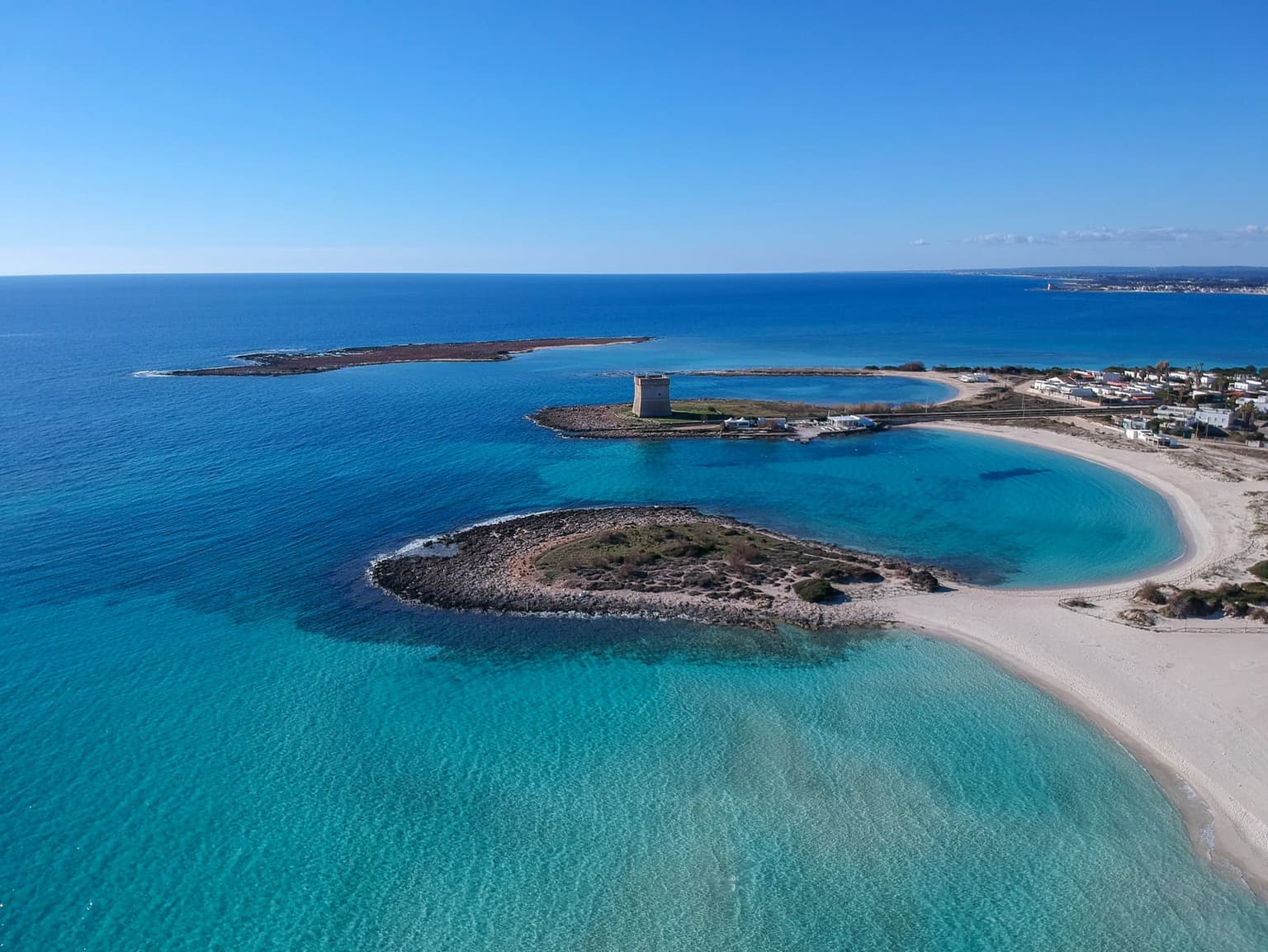
Puglia's long sand beaches are mostly on the Salento's Ionian side (Punta Prosciutto, Gallipoli, Pescoluse), with Adriatic exceptions at Torre dell'Orso, Alimini, Torre Guaceto and Vieste. The famous photo spots are rock: Polignano's cove is a pebble beach under cliffs, and the Grotta della Poesia is a sinkhole you may not swim in, with a €5 ticket since July 2026. In the Salento, the trap is picking a beach before you check the wind.
- Which sea today: in the Salento, go Ionian when the wind blows from the north (the tramontana), and Adriatic, north of Otranto, when it blows from the southeast (the scirocco). The two coasts are under an hour apart by car.
- What it costs: by law, at least 60% of every coastal municipality's shore is free beach. A lido (beach club) day with an umbrella and two loungers ran €25 - €35 at San Foca and Torre dell'Orso in June 2026 and €50 - €60 in August, when Torre Lapillo went as high as €95.
- The car: the central coast works by train (Polignano, Monopoli). Most of the Salento's wild beaches and the Gargano coves need a car in practice.
The beaches in the photos and the beaches you spend a day on are different places. So this guide sorts them by what is underfoot.
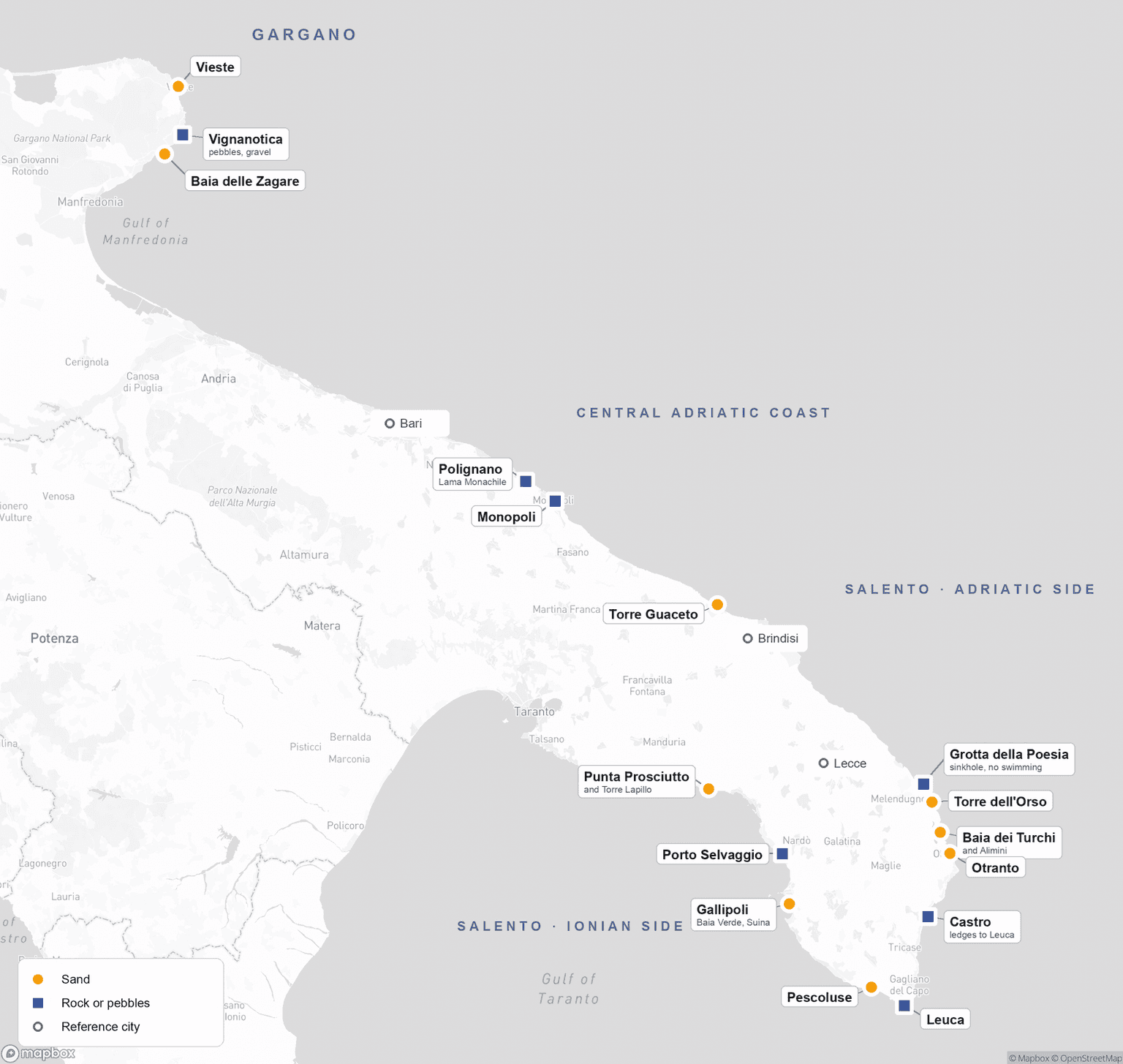
Read the map for the rock: mostly around Polignano and Monopoli, and the coast from Otranto south to Leuca.
| Beach | Coast | Underfoot | Best for |
|---|---|---|---|
| Punta Prosciutto, Torre Lapillo | Ionian | White sand, shallow (Punta Prosciutto) | Long sand days, early |
| Porto Selvaggio | Ionian | Rock and small pebbles | A wild swim under pines |
| Gallipoli (Baia Verde, Punta della Suina) | Ionian | Fine white sand, small sandy bays | Beach clubs, a pine-backed cove |
| Marina di Pescoluse | Ionian | Fine pale sand, shallow at first | Small kids |
| Torre dell'Orso | Adriatic | Pale sand crescent | Sand on a scirocco day |
| Baia dei Turchi, Alimini | Adriatic | Pale sand, pines behind | A walk-in beach |
| Otranto town beach | Adriatic | Sand below the walls | Toddlers, a swim in town |
| Castro to Leuca | Adriatic | Rock ledges, deep water | Confident swimmers |
| Grotta della Poesia | Adriatic | Sinkhole, no swimming | A look from the rim |
| Polignano (Lama Monachile) | Central | Pebbles under cliffs | The photo, an early swim |
| Monopoli | Central | Sandy-bottomed town cove, rock coves south | A car-free base |
| Torre Guaceto | Central | Golden sand, dunes | A reserve beach |
| Vieste, Gargano coves | Gargano | Sand (Vieste), coarse sand and pebbles (Vignanotica) | A separate trip |
Polignano a Mare and the Grotta della Poesia: a photo, not a beach day
Lama Monachile, Polignano's famous cove, is a small white-pebble beach over a rocky seabed, between limestone cliffs right outside the old-town walls: a swim, not a beach day. You reach it across a Roman bridge, a 10-minute walk (about 750 m) from Polignano a Mare station.
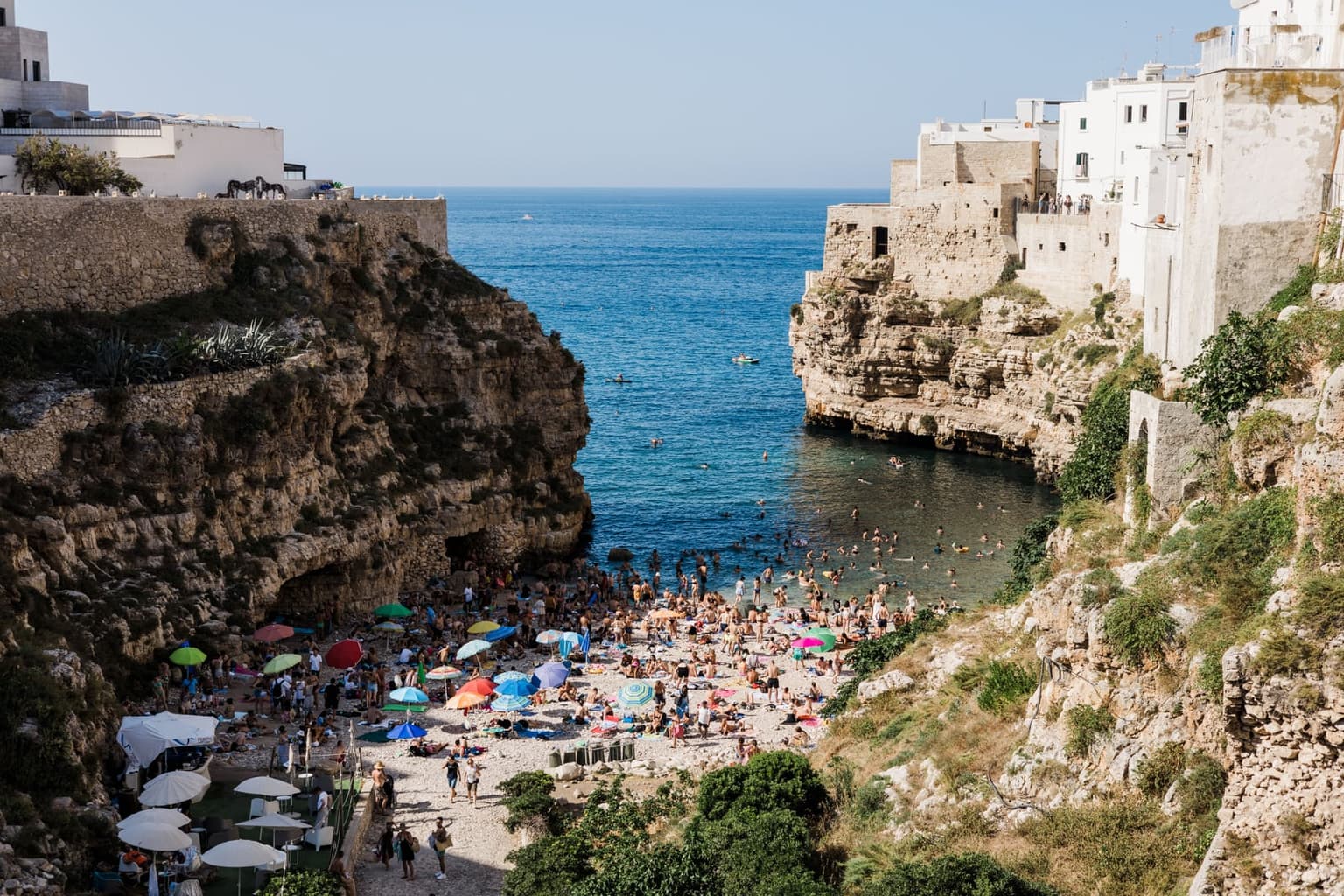
Everyone has seen this frame, and in August everyone seems to be standing in it by mid-morning. Treat it as an early swim: in the water by 08:00, out by 10:00. It is no place for small toddlers. And a town sign closes the cove when it rains, with no access, no standing and no swimming.
If the cove is full, Cala Paura is about 1.5 km from the old town: rocky inlets you enter from the rocks or from wooden platforms, with water that gets deep fast. I'd treat Polignano as a town you visit with a swimsuit in the bag, not the base for a beach vacation.
The Grotta della Poesia is in the Salento, at Roca Vecchia near Melendugno, a long drive south of Polignano, so the two are not neighbors. It sits about 1.25 km north of Torre dell'Orso: a round karst sinkhole open to the sea inside an archaeological area, and the most photographed spot on that coast.
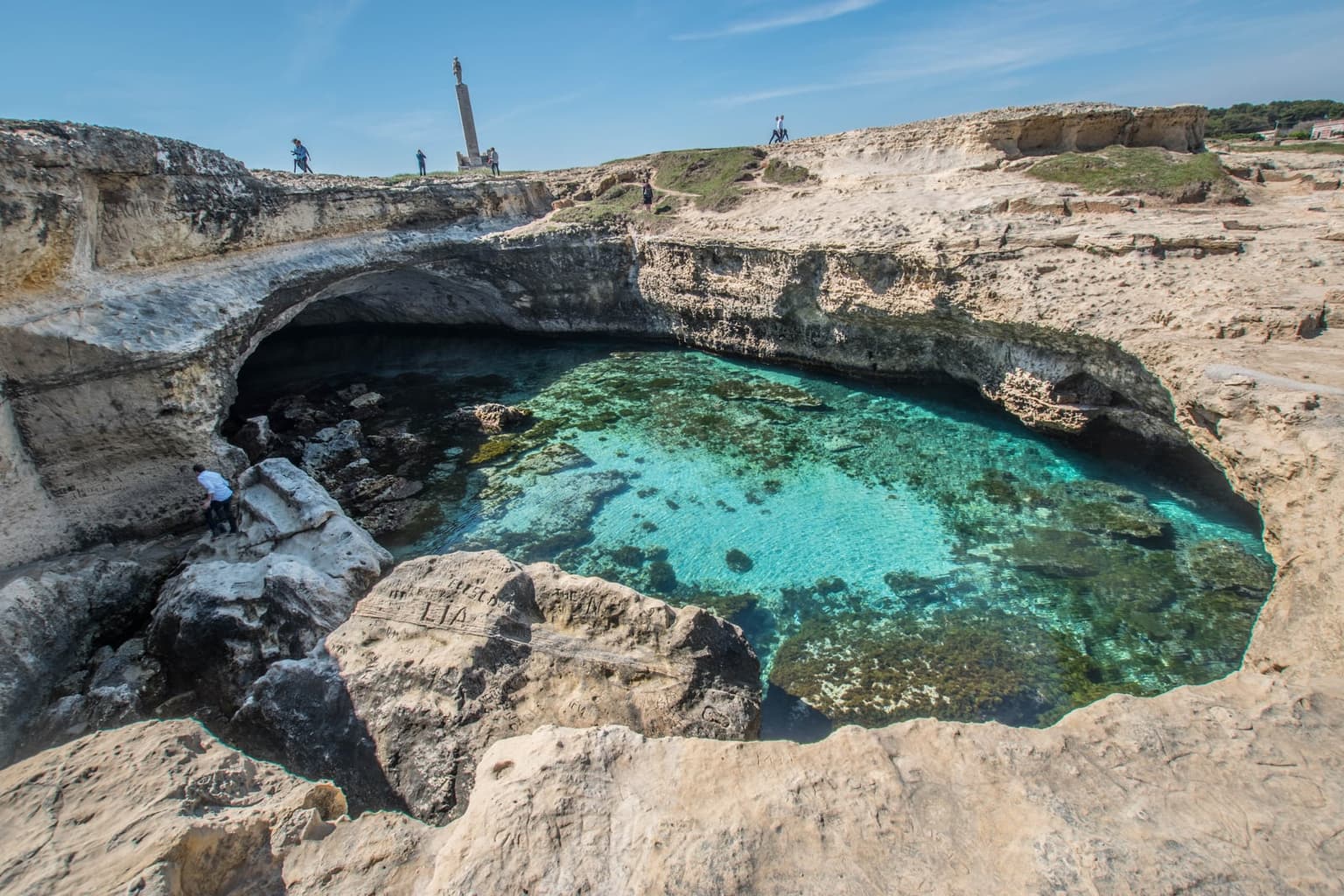
Since July 2026 it has been ticketed: €5 standard, or €10 for the Experience (a guided visit plus virtual reality). Buy online from the operator or at the ticket booths on site. The 2026 hours were 09:00 - 20:00 in June and July and 09:00 - 19:00 in August and September. Plan it as a stop, not an afternoon.
The operator's online ticket office has an English version: ArcheoRoca's ticket page.
⚠️ Warning
The ticket does not buy a swim. Swimming and diving are banned under a standing Coast Guard landslide ordinance, and that ban is older than the ticket.
The swim ban's own text, in Italian: the Coast Guard's landslide ordinance for the Melendugno coast.
For the swim itself, the sand at Torre dell'Orso is a short hop south.
Monopoli to Torre Guaceto: rock coves in town, sand in the reserve
Monopoli's town beach, Cala Porta Vecchia, sits beside the 16th-century sea walls, with a mostly sandy bottom and shallow water: a swim without leaving town. You can also swim off the old town's fortress walls.
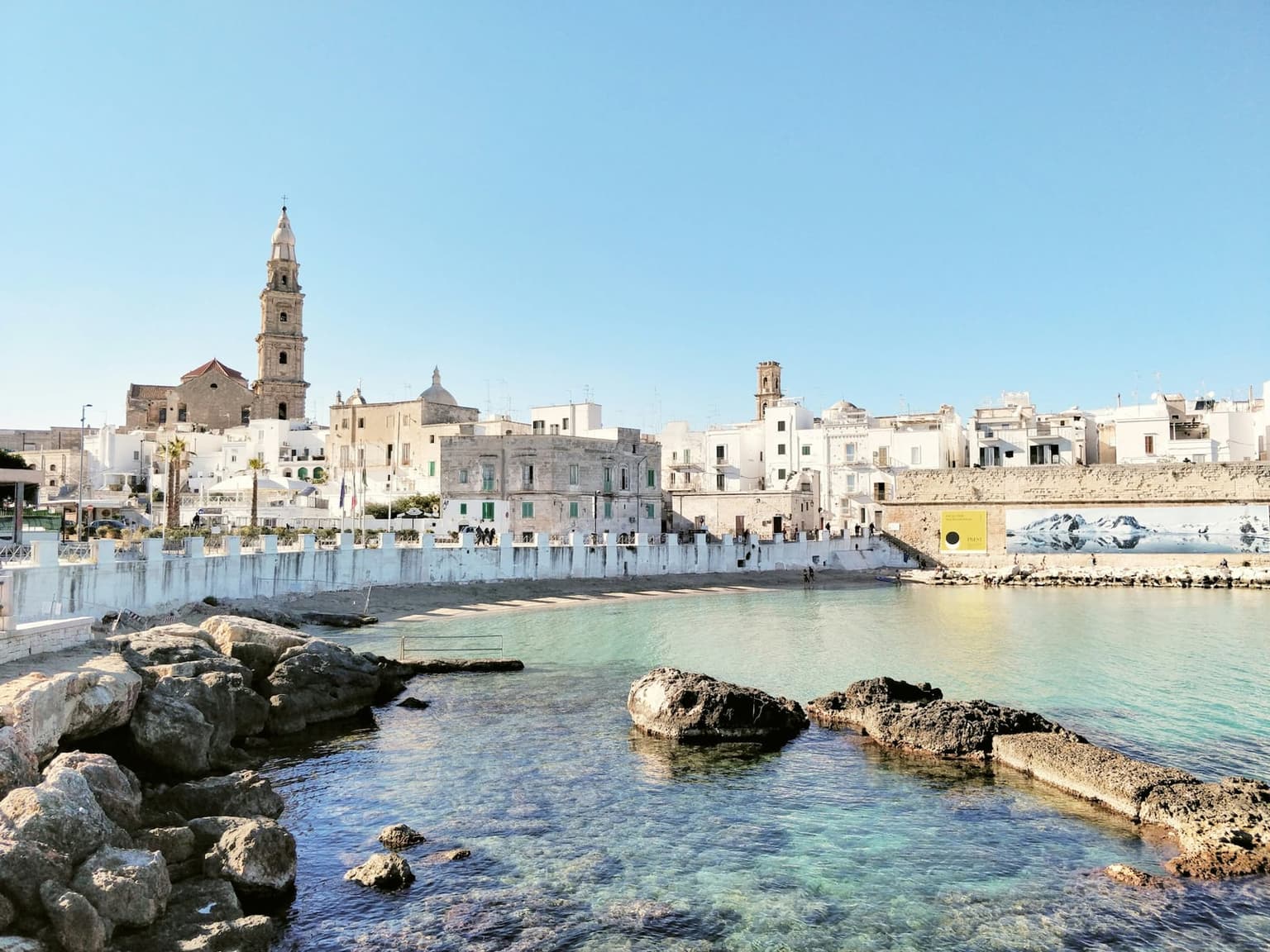
South of town the coast turns to rock coves. Porto Verde, a short walk along the coast southeast of the center, is a cove closed in by two walls of rock. Beyond it come the Capitolo coves, often very crowded, with stretches of fine sand toward Capitolo itself.
The local bus down this coast toward Porto Ghiacciolo is a gamble: it can leave you at the stop for well over an hour past its posted time, so I'd walk whatever is walkable.
For the longest sand on this coast, go to Torre Guaceto near Carovigno, 26 minutes by car from Brindisi airport: golden beaches backed by dunes, inside a state nature reserve and marine protected area.
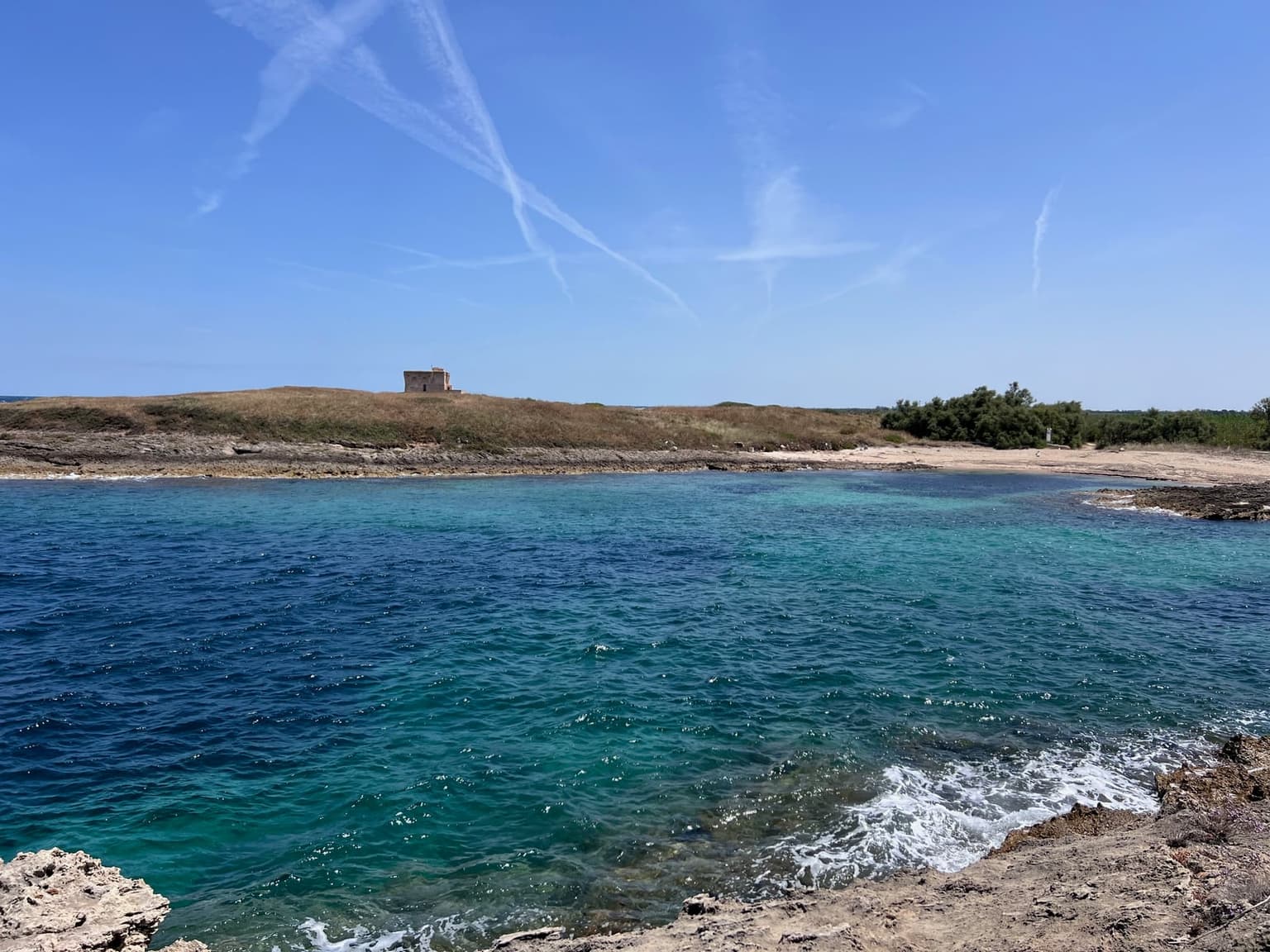
Park at the 500-space Porta della riserva lot outside the protected area: open 08:00 - 19:30 daily in the 2026 season, €8 a car or €4 a motorcycle for the day. From there a shuttle runs to the first beach, Punta Penna Grossa, or you walk or cycle the signed 1.2 km path. The reserve's own lido, open 09:00 - 19:00, books through the reserve's website, not an app; its prices are in the cost table below. Plenty of free beach sits beside the concessions.
Swimming is off-limits in Zone A, the lagoon by the Aragonese tower and the last two coves before it; in Zone B you can swim from dawn to sunset. Dogs, drones, speakers and motor vehicles are banned, and wardens fined 32 people in the first days of the 2026 season, mostly for parking on the beach area. Use the lot.
The reserve posted the 2026 lot and lido rates in its own season-opening notice, in Italian.
The Ostuni coast has sand too. Rosa Marina has long stretches of it inside a resort village, Pilone is fine sand, Lido Morelli is fine white sand with no rocks, and Costa Merlata alternates sand with rock.
Salento beaches on the Adriatic: Torre dell'Orso to the cliffs of Leuca
On the Salento's Adriatic side, the sand runs from Torre dell'Orso to the Alimini beaches north of Otranto. South of Otranto the coast turns to cliffs, and you swim off the rock.
Torre dell'Orso and Torre Sant'Andrea
Torre dell'Orso is a long crescent of fine, silver-pale sand backed by dunes, pine wood and a white cliff, with two rock stacks, the Due Sorelle ("Two Sisters"), standing in the water. Lidos and free stretches share the sand, 35 minutes by car from Lecce.
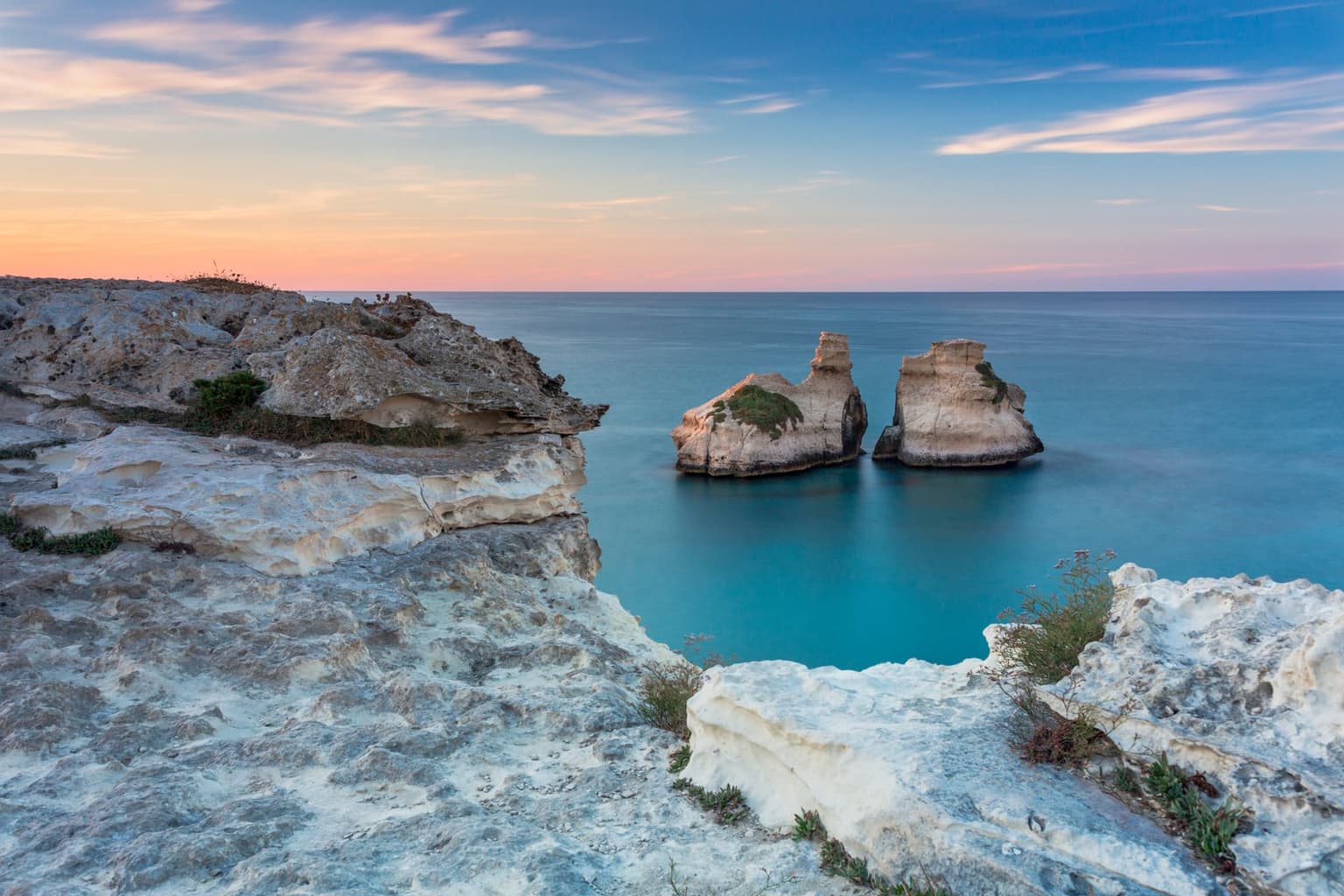
Torre Sant'Andrea, about 2.5 km down the coast toward Otranto, is a pocket of sand in a rock cove ringed by stacks and arches. Swim from the sand: the Coast Guard's landslide ban keeps swimmers 7 m off the ledges and 50 m off the stacks.
I'd rate Torre dell'Orso as good sand rather than a reason to cross the region: pleasant, crowded in high summer, and hot enough by late August that any sightseeing plan loses the argument.
Baia dei Turchi and the Alimini beaches
Baia dei Turchi is a set of pale-sand coves between low rocks at the end of a pine-wood path, inside the Alimini protected area. The wider Alimini beach runs about 6 km of very fine sand, with dunes up to 12 m.
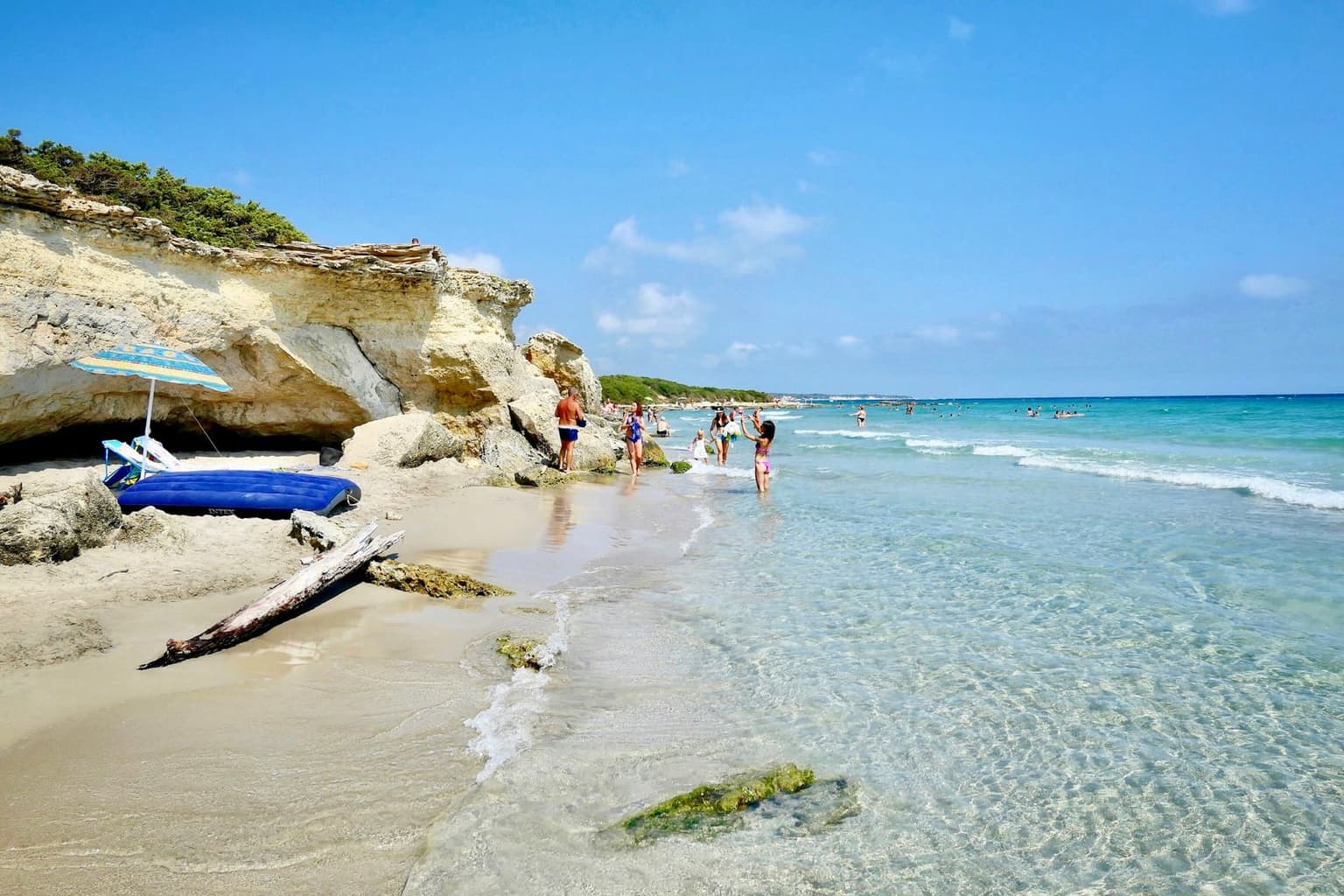
You cannot drive to the sand. Park in a lot on the coast road (about €4 - €8 a day in 2026, shuttle included at the main lots), then ride or walk in; the drop-off leaves about 200 - 300 m of pine path. It is an excellent swim at the end of all that.
Otranto's town beach
Otranto's town beach is sand, right below the old town's walls. At its edge, a patch of shallow water lets toddlers play among small fish. It is small, and full in August. Lecce is 37 minutes away by car, and the municipal lots are paid from April through October.
The cliff coast from Otranto to Leuca
At Castro you get in off the reef, and a concrete deck behind the marina is the obvious jumping-in spot. Santa Cesarea has deep water right off the rock, with steps cut into it, and Porto Badisco is a tiny inlet. Pack water shoes: the rock carries on under the water.
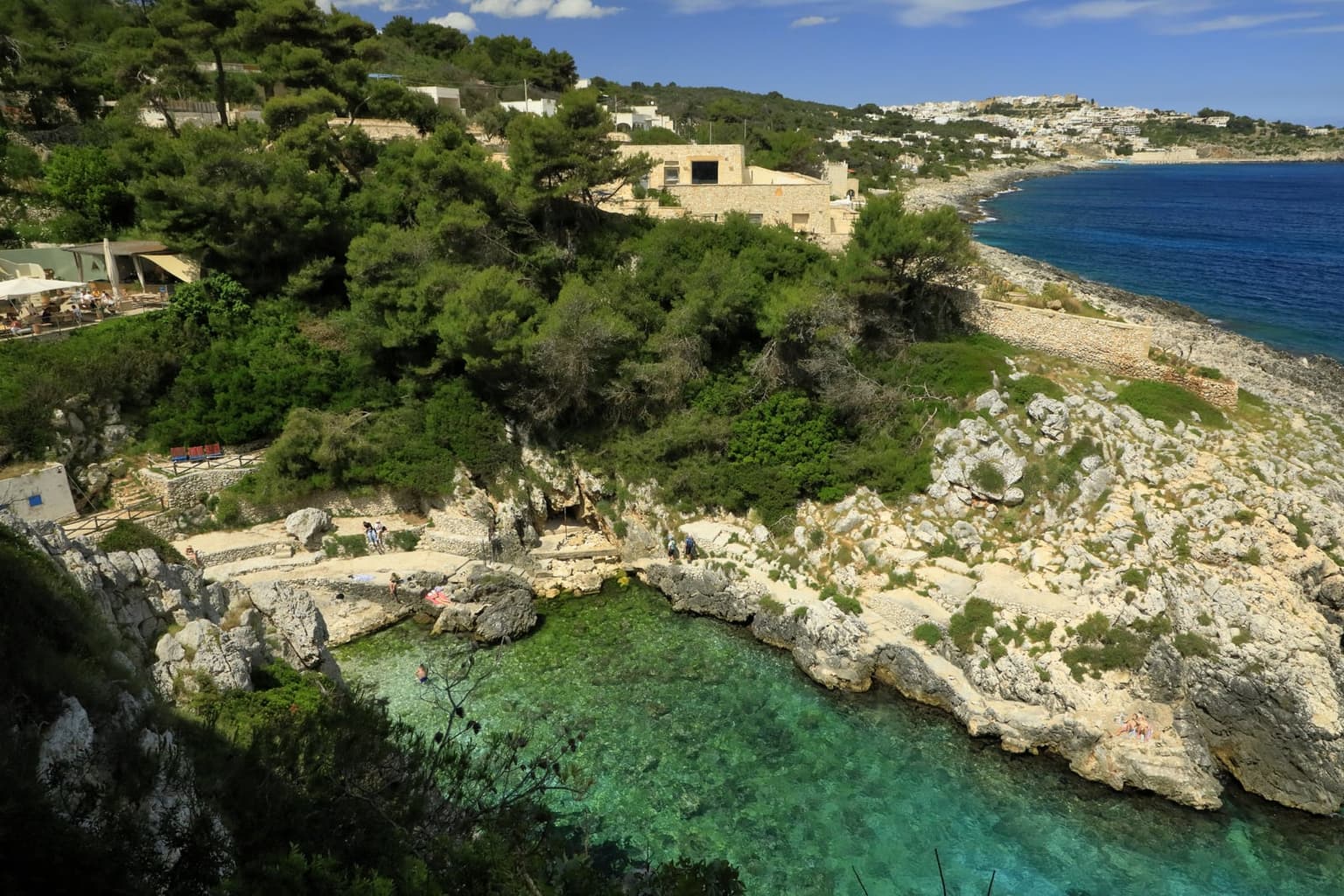
At the Ciolo, jumping from the bridge over the gorge is banned, and people still do it: in July 2026 an 18-year-old was badly hurt after a jump of about 20 m. With deep water straight off the rock, this coast is no place for small children.
At Santa Maria di Leuca you mostly get in off rock too, and boat trips to the sea caves ran from about €20 a person in 2026.
Use this coast as a drive, not a beach. Start at Leuca or Tricase, head north on the coast road toward Otranto, and swim at the jetties and small marinas along the way. Lunch in Castro, then end the day on sand at Torre dell'Orso. Otranto to Leuca alone is just over an hour by car, so give it the whole day.
Salento beaches on the Ionian: where Puglia keeps its long sand
The Ionian side of the Salento, from Porto Cesareo down to Pescoluse, is where Puglia keeps its long sand: pale, fine and shallow at the edge, with one rocky exception worth the walk.
Punta Prosciutto and Torre Lapillo
Punta Prosciutto is the beach at the top of this page: soft white sand and shallow water inside a regional park, mostly free, with a few beach clubs. It and Torre Lapillo both sit inside the Porto Cesareo marine reserve, where swimming is allowed in Zones B and C. Porto Cesareo is 37 minutes by car from Lecce.
The catch is everyone else. Both stay crowded into early September, so arrive first thing, before the morning's calm turns into a parking lot with towels. The water and the width of the sand vary too: the same stretch can be narrow and cloudy one day and the best beach of the trip the next.
Porto Selvaggio
Porto Selvaggio is the Ionian's exception: a wild bay of rock and small pebbles at the foot of a pine-covered slope, in a regional park on Nardò's stretch of coast. Freshwater springs rise from the seabed and cool the water.
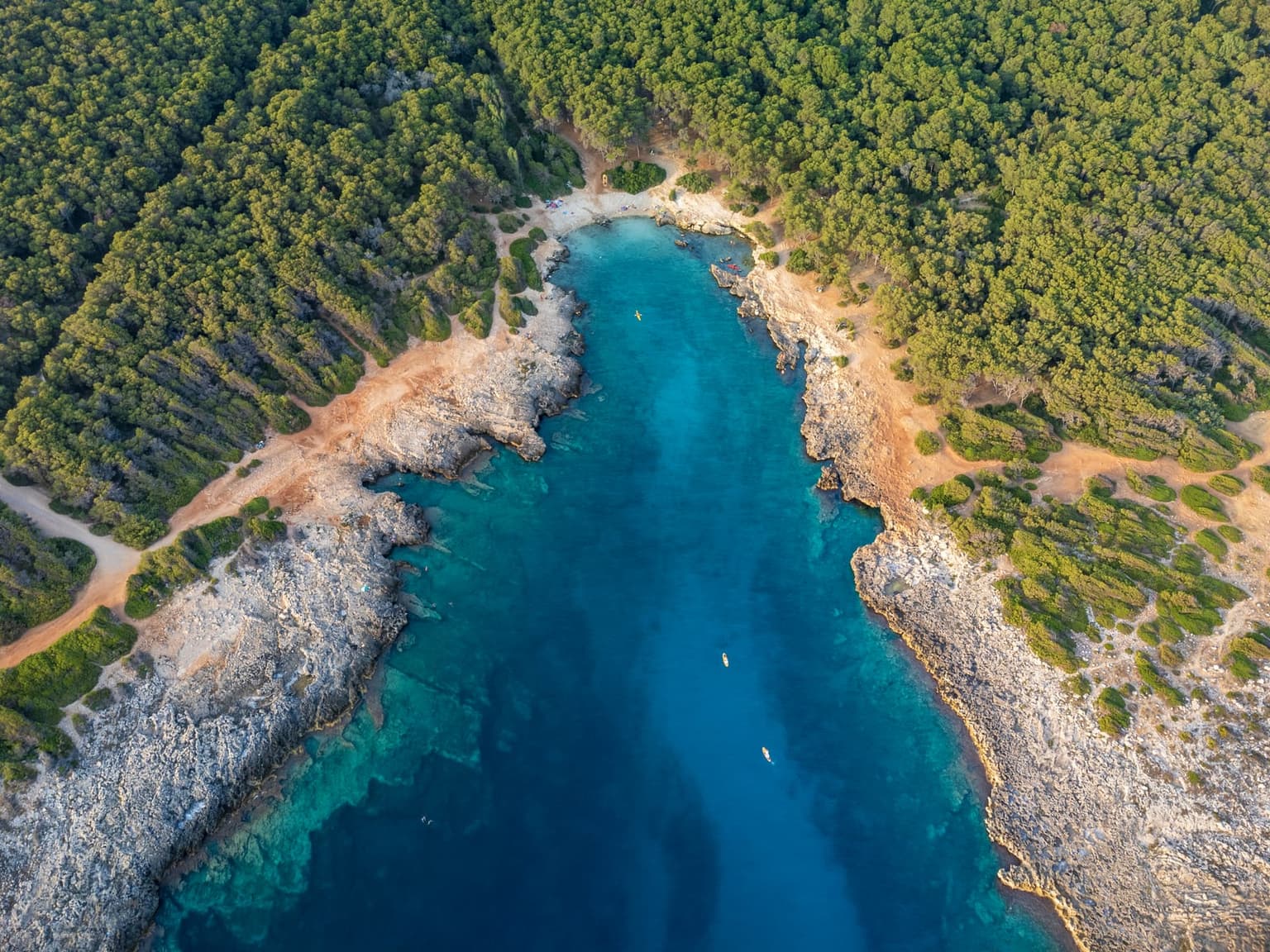
In 2026 the town of Nardò ran electric shuttles daily, 08:00 - 20:00 from June 19, between the park's Torre Uluzzo entrance and the last clearing on the trail; otherwise you walk down through the pines. There is no sand, and the real price is the walk back up in the afternoon heat, so carry everything you need. I think it is worth every step down, and most of the steps back up.
Gallipoli: Baia Verde and Punta della Suina
Baia Verde is about 3 km of fine white sand and shallow water south of Gallipoli, lined with beach clubs that turn into open-air nightclubs after dark, and in high summer the crowd skews young and loud. The beaches farther south have deep, soft sand that is a slog to walk through; closer in and north of town is easier going. Gallipoli is 34 minutes from Lecce by car.
Punta della Suina is two small sandy bays in the Punta Pizzo regional park, about ten minutes on foot through the pines from private parking. Beach clubs hold most of the sand, and the free spots are mostly on rock.
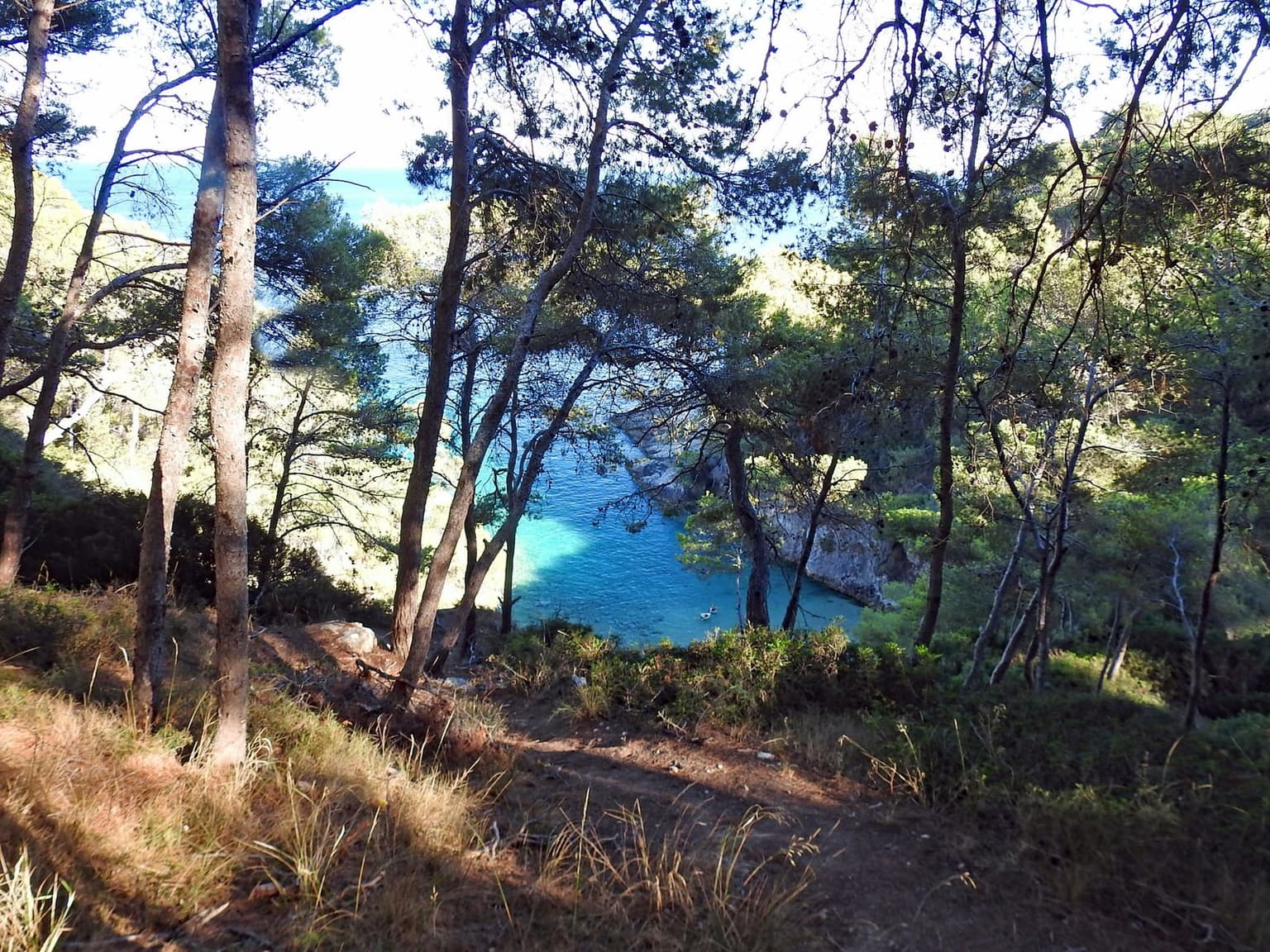
South of Gallipoli, the Spiaggia degli Innamorati ("Lovers' Beach") has no services at all: park at the roadside, walk in, and carry your own food and drinks. The water is clear, warm and gentle, the kind of sea you float in long after you meant to get out. It helps to be very fond of whoever is carrying the cooler.
Marina di Pescoluse
Marina di Pescoluse is fine pale sand with a shallow, sandy bottom for the first meters out, then deeper water. Beach clubs alternate with free stretches.
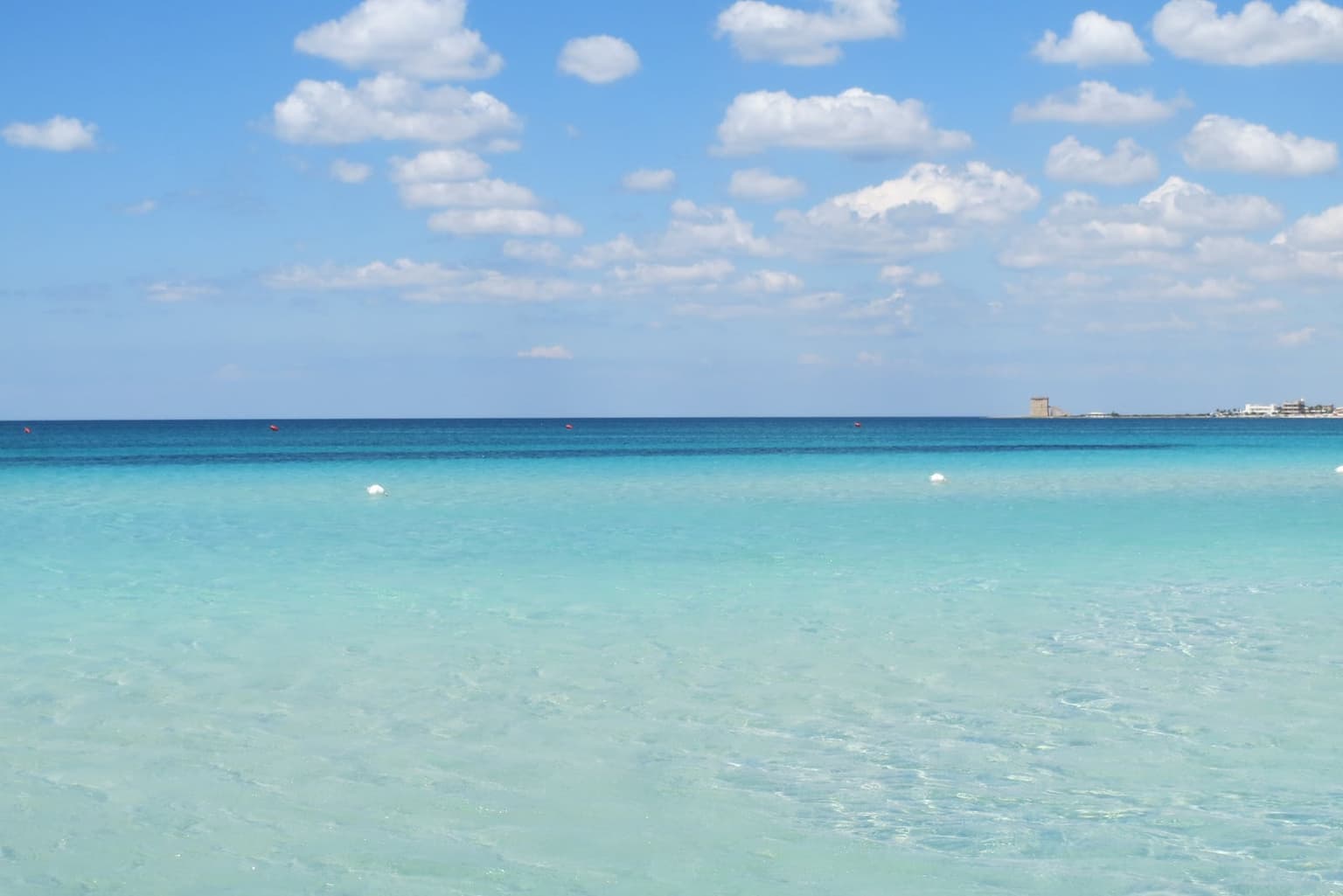
Its nickname, the "Maldives of the Salento," sells it harder than it needs to: this is a very good shallow-water beach, not the Indian Ocean. Pescoluse is 37 minutes from Gallipoli by car, and the Adriatic side is only 25 minutes away across the heel, at Marina di Novaglie.
Adriatic or Ionian today? Let the wind pick the side
In the Salento, locals pick the day's beach by the wind: with a north wind, the tramontana, they swim on the Ionian side, and with a southeasterly, the scirocco, they cross to the Adriatic, from the Lecce coast down to Otranto. Nobody official ever wrote it down.
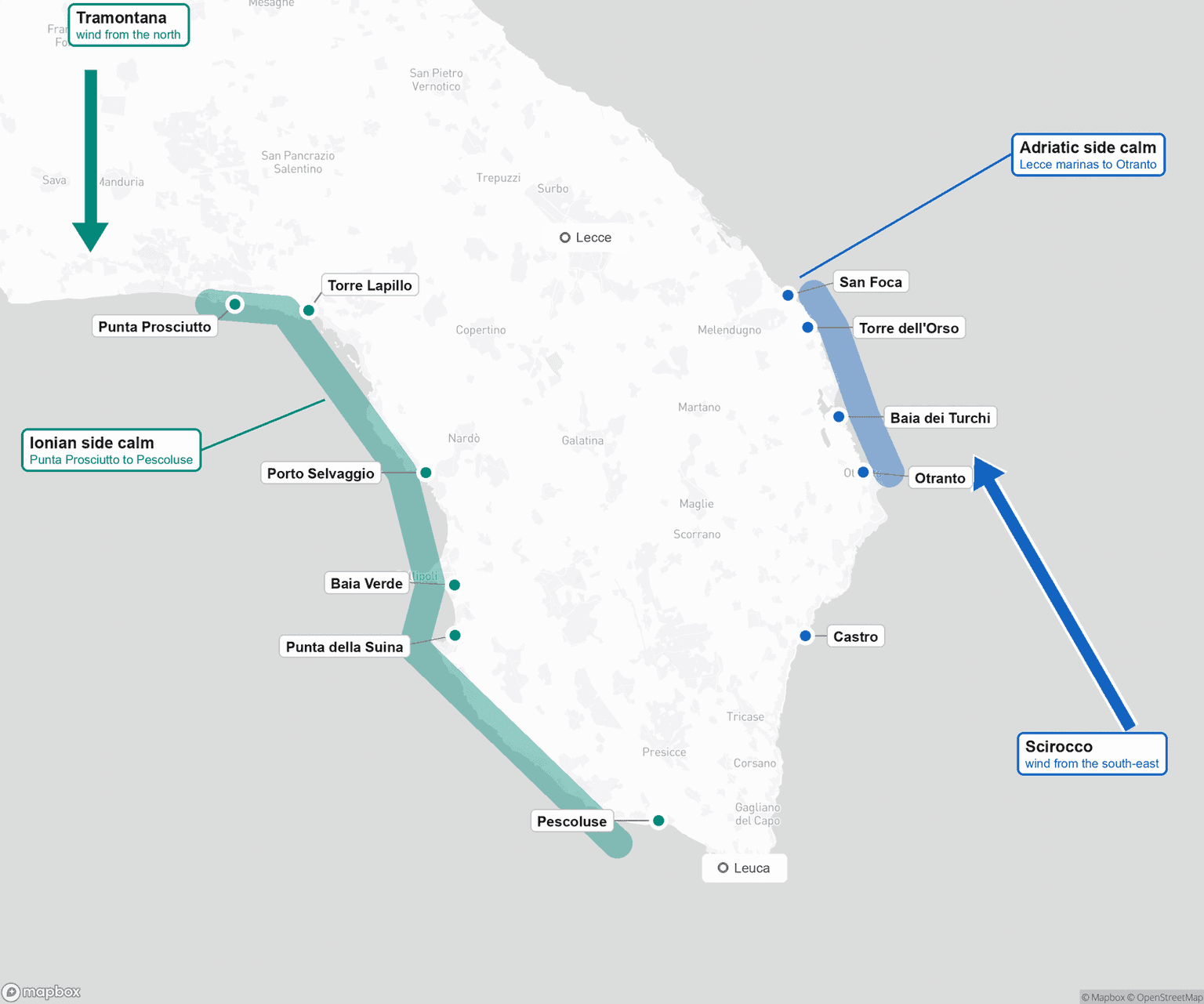
The rule has fine print. On the Ionian side, a northwesterly (the maestrale) keeps the water calm as well, as long as it is not blowing hard. A southwesterly (the libeccio) works like the scirocco. South of Otranto, the cliff coast down to Leuca can stay calm even in a tramontana. And when the scirocco blows, a few Ionian spots are sheltered more often than most: Punta della Suina, Sant'Isidoro and Pescoluse.
The rule is practical because the two coasts are close: Otranto to Gallipoli, sea to sea, is 52 minutes by car, and farther south the hop is shorter still. Once you're in, you can't tell the two seas apart, so the only difference worth the drive is which one is flat this morning. From a base in Polignano or Monopoli, none of this applies.
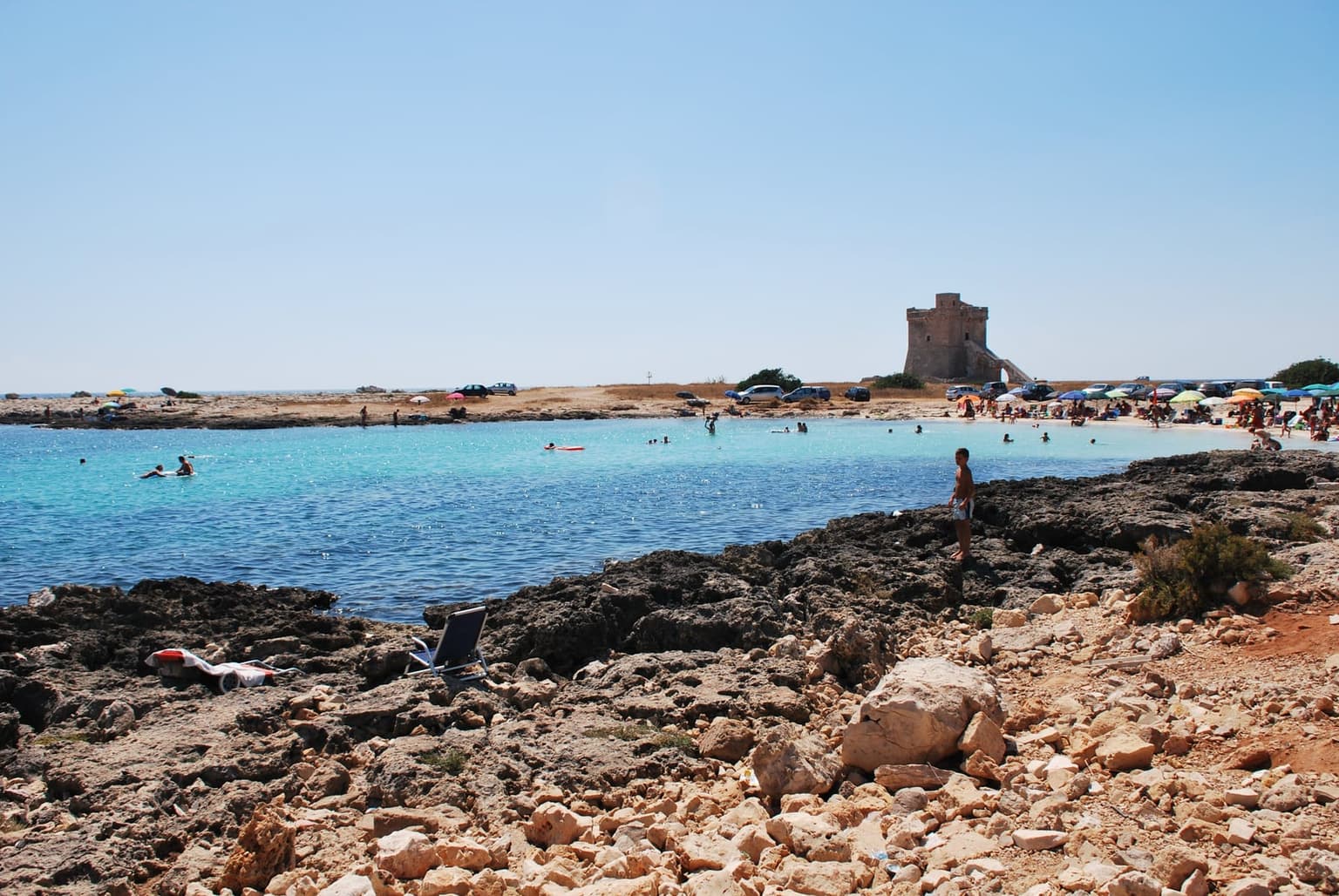
So check the wind in your weather app every morning, before you load the car rather than after you park it. I read it in Windy, which gave the truest picture for the Punta Prosciutto cape. With a north wind I head for the Ionian side, Punta Prosciutto or Gallipoli, and the water comes up flat and clear over fine, pale sand without a single stone, with a long, gentle slope in. I'm there before 09:00, because by noon there is no free sand left. With a scirocco the same sea turns cloudy from stirred-up sand and seaweed washes ashore, so I drive to the Adriatic, to Torre dell'Orso or south to Otranto. On a windy day, the difference between the two seas is huge.
On a rough day, stay out of the water on the rock coast, and stay back from the edge: in a storm the spray at Torre Sant'Andrea carries up to the highest viewpoints. The arches that make a calm morning are exactly where a heavy sea turns dangerous.
Vieste and the Gargano: a separate beach trip, not a day out
The Gargano's beaches, around Vieste on Puglia's northern spur, are a separate trip: Bari to Vieste alone is 2 hours 37 minutes by car, and the Valle d'Itria and the Salento sit farther away still. As a day out from either, it is mostly a day in the car. I'd give the Gargano its own nights or leave it for another trip.
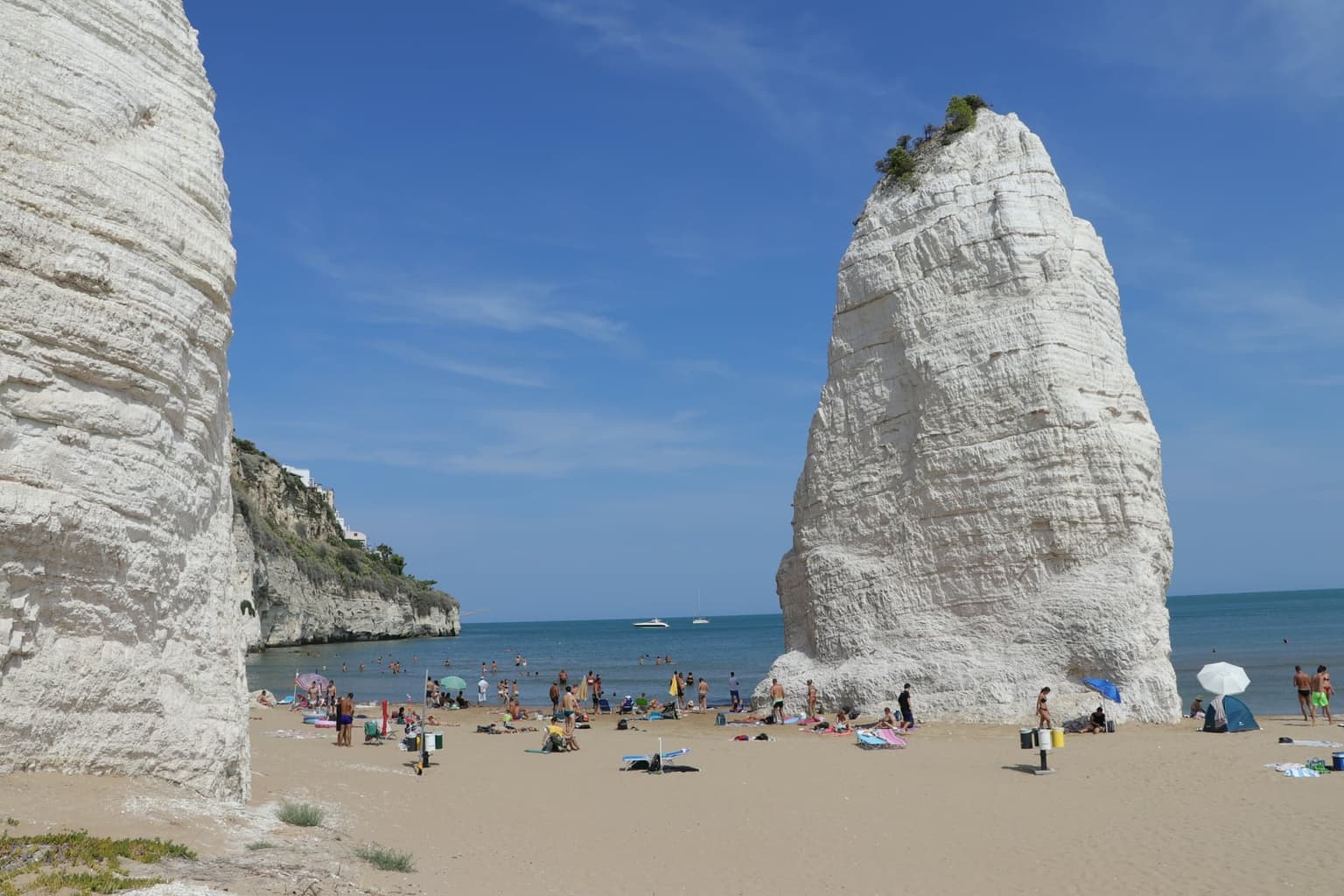
Vieste's town beach, the Spiaggia del Castello (also called Scialara), is a long, easy-to-reach sand beach with a shallow bottom, and it comes with its own landmark: Pizzomunno, a giant of white limestone standing on the sand.
Baia delle Zagare, on Mattinata's stretch of this coast, is a bay of pale sand under sea stacks. You reach it by sea, or by land through the hotel of the same name, which has an elevator cut into the rock. In 2026, public access by land ran on a small daily quota of free same-day passes, handed out in person and not bookable.
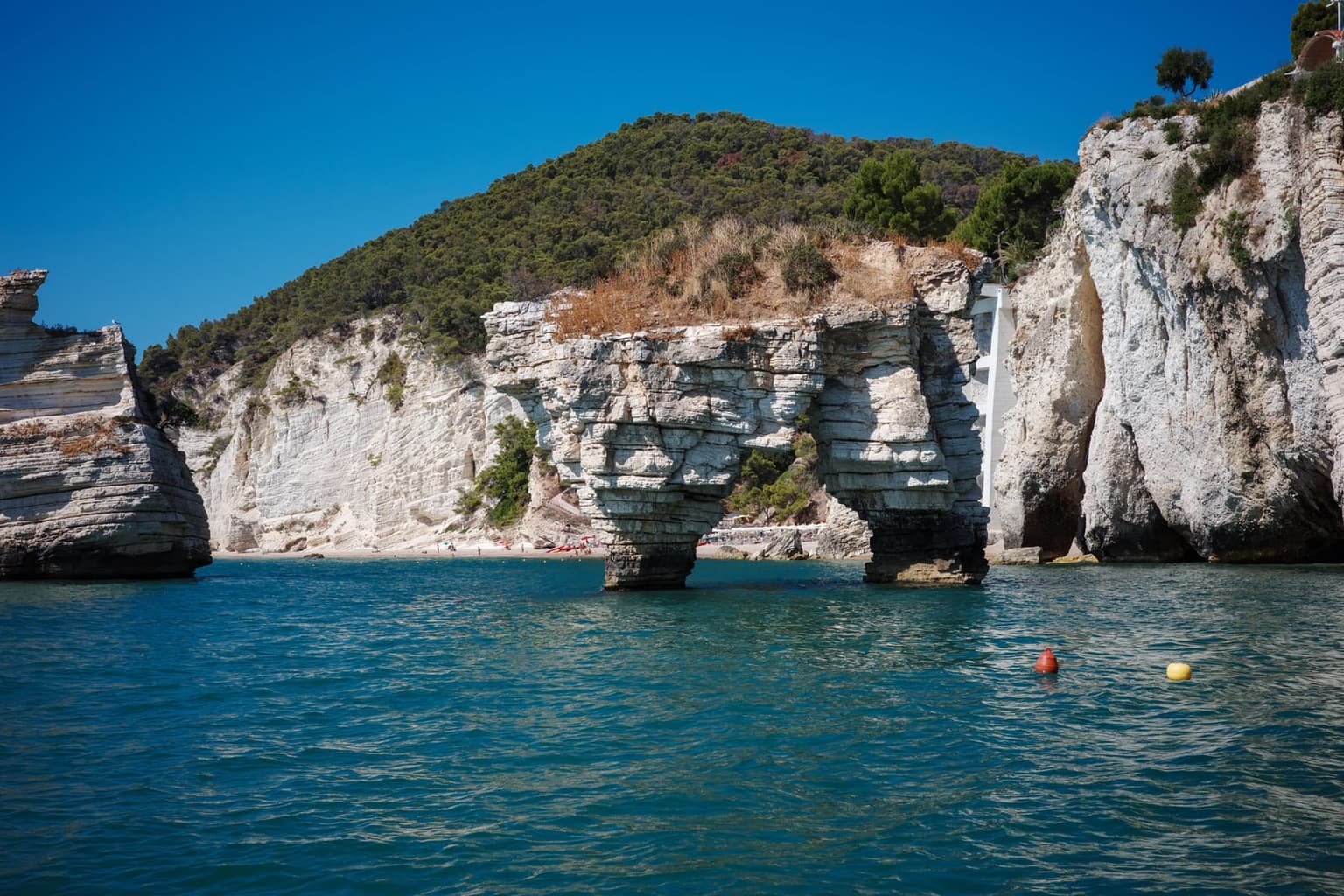
The easy way to see the stacks is the boat. Tours from Vieste take in the sea caves and the Zagare, with a swim stop at Vignanotica: about 3 hours, €30 for adults and €15 for ages 3 to 10 in 2026.
Vignanotica itself is coarse sand, gravel and smooth pebbles under white cliffs, a 10 - 15 minute walk down from the paid lots above the bay. Wherever you put the towel on this coast, look up first and stay off the foot of the cliffs: part of the cliff at Vignanotica collapsed in August 2024.
What a beach day in Puglia costs: lidos, free sand, and the rules
You never have to pay for a Puglia beach: by regional law, at least 60% of every coastal municipality's shore is free public beach, the spiaggia libera. What costs money is the lido, a stabilimento on the signs, which rents you an umbrella and two loungers by the day.
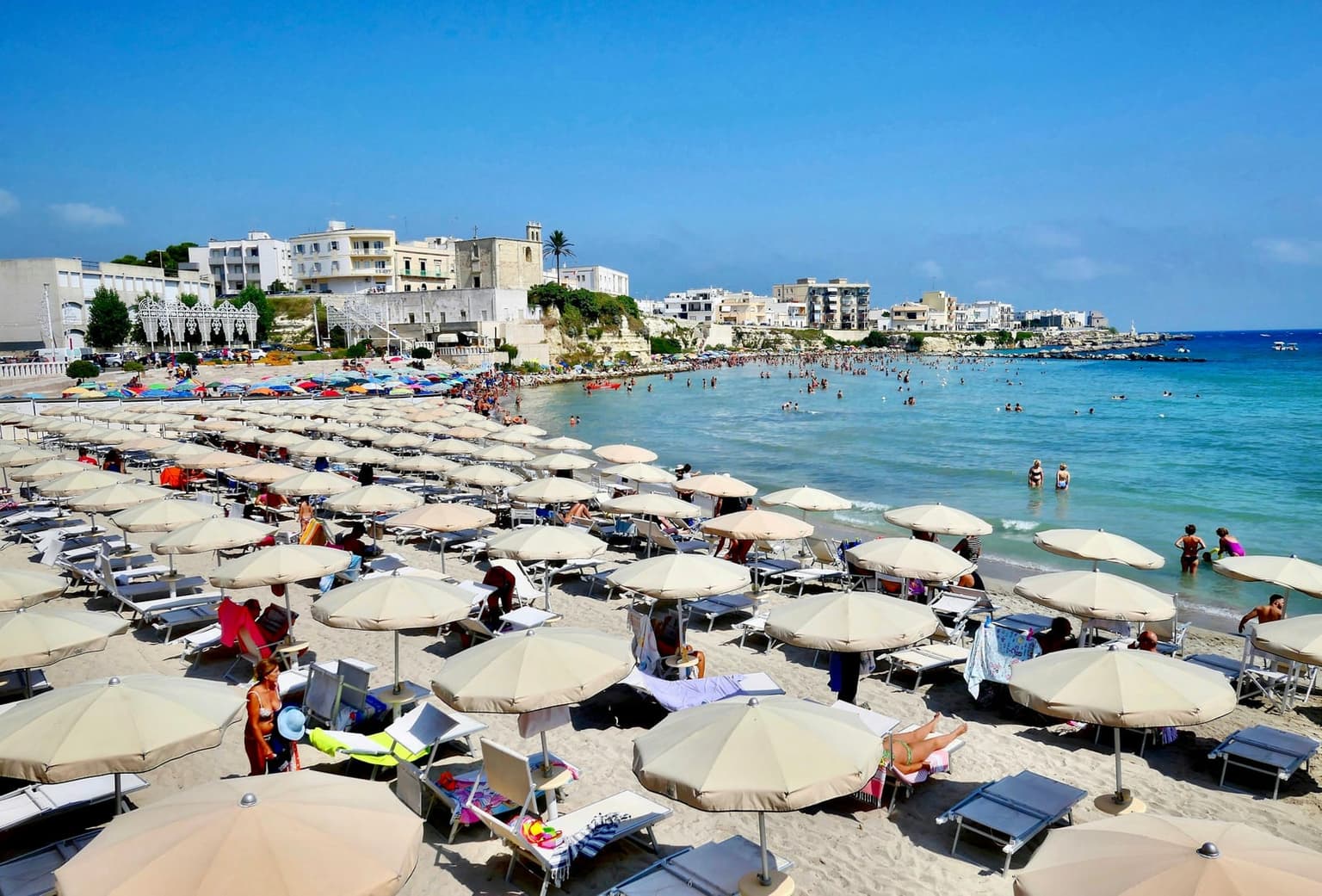
In 2026 lido rental ran from about €20 a day in June at the cheaper clubs to €60 and more in August at Porto Cesareo and Torre Lapillo.
| Where (2026, per day) | June | August |
|---|---|---|
| Torre Guaceto reserve lido | €35 | €40 |
| San Foca, Torre dell'Orso | €25 - €35 | €50 - €60 |
| Gallipoli | €18 - €30 | €40 - €60 |
| Porto Cesareo | €35 - €40 | €60 - €70 (Torre Lapillo up to €95) |
| Torre San Giovanni (Lido Il Molo) | €20 | €25 - €30 by row |
| Vieste (Punta delle Sirene) | €20 (to July 10) | €30 (mid-August weekdays) |
Where a club prices by row, as Lido Il Molo does, the front rows cost the most.
In 2026, lidos had to open from May 23 to September 13, at least 09:00 - 19:00. Outside those dates, opening was each lido's own choice, so a late-September lido is a gamble rather than a plan. At the Torre Guaceto lido, September costs what June does, and the month stays busy until Puglia's schools reopen (September 17 in 2026). If your July or August dates can still move, I'd settle the best time to visit Italy before pricing a single umbrella.
The beach rules are short. Your own food and drink are always allowed. The first 5 m from the water is for walking, so set up behind it. And nothing stays on a free beach after sunset: on July 28, 2026, Melendugno's town police removed 13 unattended loungers at Torre dell'Orso. The cheap way to do a free stretch is the local way, with a couple of folding chairs from a shop near the beach.
Install the EasyPark app before you go: it pays blue-line parking from your phone in Lecce and Porto Cesareo, and some pay machines at the wild beaches refuse cards and want exact coins.
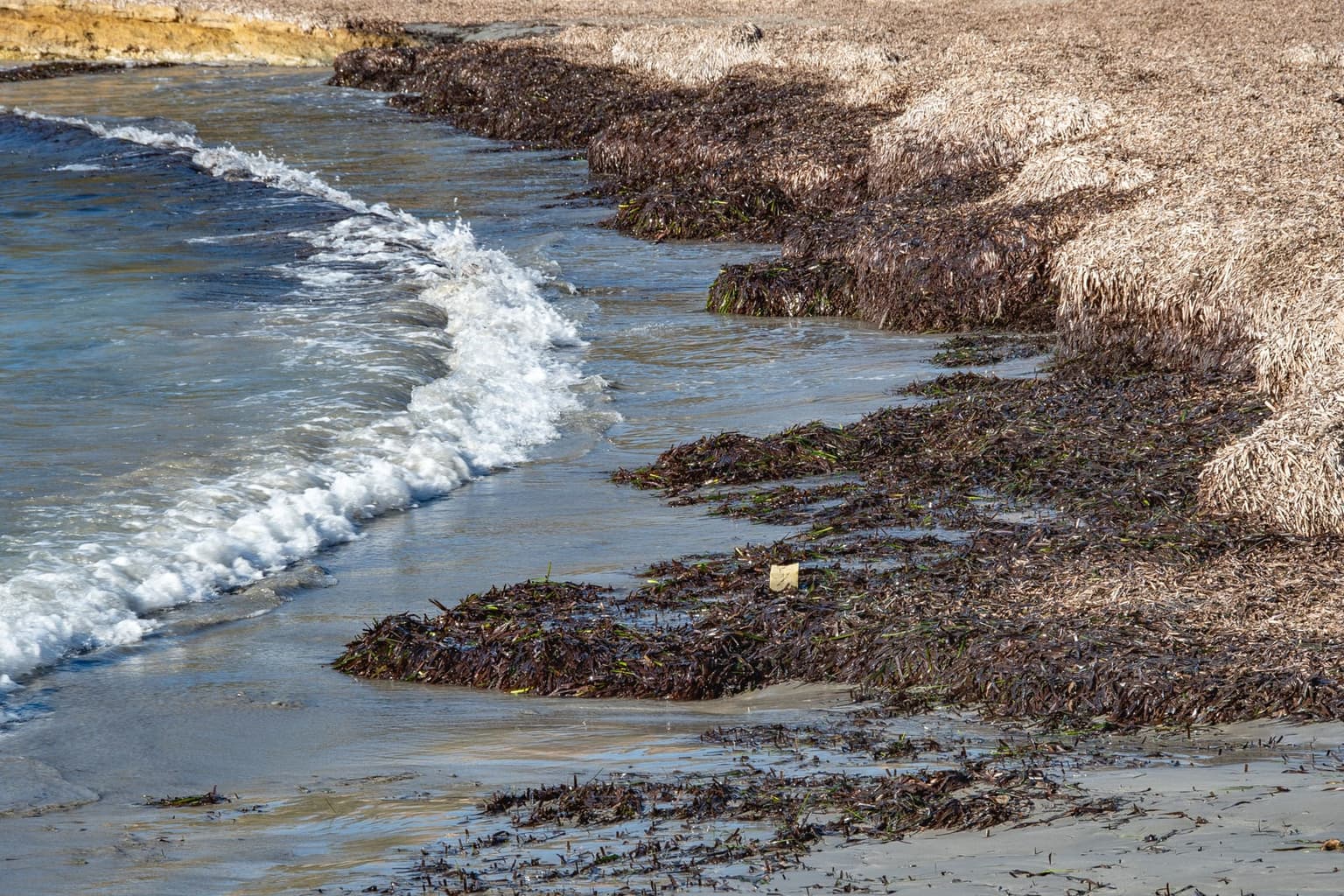
The dark mats of beached seagrass (Posidonia) on some beaches are left there on purpose, because removing them is banned. It is not a dirty beach, just an obedient one.
Where to base for Puglia beaches, and whether you need a car
For a Puglia beach trip, base in the Salento if you want sand and a choice of two seas, or in Monopoli if you will not drive. Pick the coast first and the hotel second:
- Lecce: a city base about 35 minutes by car from both Salento coasts.
- Otranto or Gallipoli: a town on one sea, with the other under an hour away.
- Pescoluse and the deep south: far from everything else as a base.
- Monopoli: the car-free base, about 26 minutes from Bari by regional train.
Otranto and Gallipoli are on that list for one reason: each puts a usable sand beach close to its old town, so the first swim of the day needs no car and no parking lot.
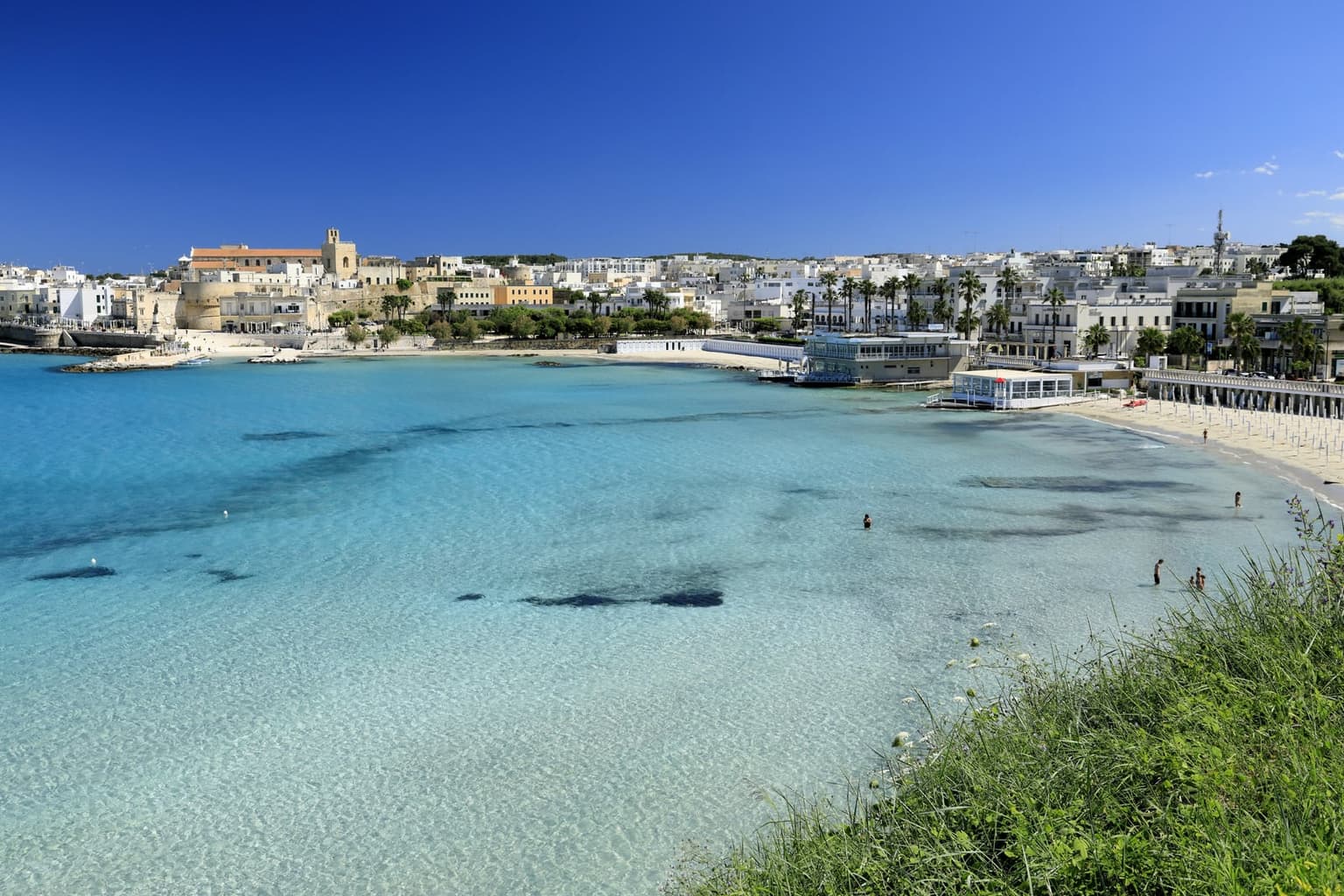
Book the town, not "Puglia": Otranto or Gallipoli for sand, Monopoli without a car. Then check each listing's walk to the beach rather than to the old town: only one of those walks happens every morning, carrying the towels.
The central coast works without a car: Bari's airport train reaches Bari Centrale in 17 minutes, and Trenitalia regional trains from there stop at Polignano a Mare and Monopoli. The Salento's wild beaches (Porto Selvaggio, Punta della Suina, Pescoluse, Baia dei Turchi) and the Gargano coves are car beaches in practice. Exploring this coast and refusing to drive it are two different trips. Pick one.
Pick the car up where you land. Bari to Lecce alone is about 1 hour 45 minutes by car, so for a Salento-only trip, check flights into Brindisi as well as Bari before you book the rental.
Without a car
The Salento works in part. Ferrovie del Sud Est (FSE) trains run Lecce to Gallipoli in about 1 hour 38 minutes on the autumn 2026 timetable. In 2026 the province's SalentoinBus ran June 13 to September 13 to the main marinas (San Foca, Torre dell'Orso, Otranto, Leuca, Gallipoli, Santa Caterina, Porto Cesareo), booked through Itineris. From Brindisi airport, a bus covers the 15 minutes to Brindisi station, where the trains stop. Vieste has no train: the Gargano railway ends at Peschici Calenella, with buses beyond.
Lines, timetables and online tickets are all on the Province of Lecce's own SalentoinBus page.
If you still will not drive, a private transfer swaps the bus-and-train chain for one car from the airport to the door of your base, at a price you know before you land.
Frequently asked questions
- Are Puglia's beaches sandy or rocky?
- Both, by coast. The long sand is mostly on the Salento's Ionian side, and on the Adriatic at Torre dell'Orso, Alimini, Torre Guaceto and Vieste. Polignano, Monopoli's southern coves and the coast from Otranto to Leuca are rock and pebble.
- Can you swim at the Grotta della Poesia?
- No. A standing Coast Guard ban covers swimming and diving, and the €5 ticket introduced in July 2026 buys only the view from the rim.
- Which Puglia beaches are best for small children?
- Shallow sand: Otranto's town beach, with its shallow-water patch; Pescoluse, shallow for the first meters; Punta Prosciutto; and Vieste's town beach. Not Polignano or the cliff coast south of Otranto, where the water is deep straight off the rock.
- Can you still swim in Puglia in late September or October?
- September, yes: the sea is typically about as warm as July, around 77°F (25°C). October drops to around 70°F (21°C). Lidos only had to stay open until September 13 in 2026, so after that, bring your own shade.
- Is the water in Puglia clean?
- Officially, very. In June 2026, Puglia's environmental agency (ARPA) rated 99.9% of the region's bathing waters excellent, first in Italy for the sixth year running.
Pack the beach bag the night before for either sea, water shoes included, so the morning holds one decision, and the wind forecast makes it.