George Mandrovny
The short answer: pick the village by the Sellaronda
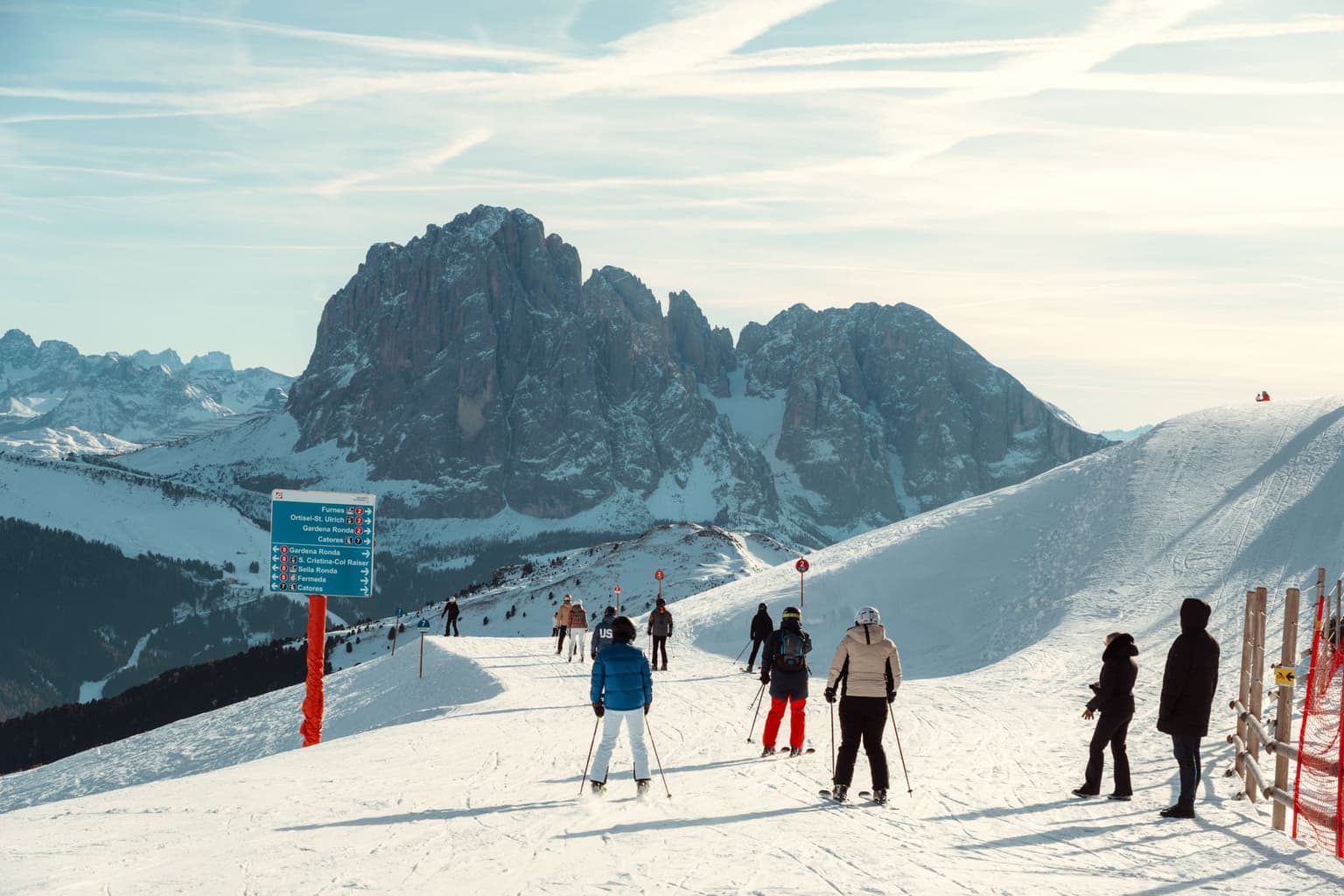
Val Gardena skiing starts with a question most people ask second: is the Sellaronda the point of the week? Answer it first and the Val Gardena ski resort narrows to one village. Selva if the circuit wins, because both directions leave from its own lifts. Ortisei if Seceda's long runs matter more, or the Alpe di Siusi ski area, which the tourist board calls "particularly popular with beginners and families." Either way, walk to a lift. The trap is a late start on the Sellaronda, which can strand you when the lifts close. It bites harder from Ortisei, where a lift-and-tunnel link to Ciampinoi comes first.
- Pass - the Val Gardena/Alpe di Siusi pass covers the valley's slopes and the Alpe di Siusi. The Sellaronda needs Dolomiti Superski.
- Runs - La Longia for the long one, Saslong and Cir for steep, the Alpe di Siusi and Monte Pana to learn on.
- Before day one - a helmet at every age, and third-party liability insurance bought online, because Val Gardena's pass offices don't sell it.
- When - the lifts run December 4, 2026 to April 4, 2027.
Selva, Santa Cristina and Ortisei share one valley and one area pass, but not one circuit. The Sellaronda leaves from Selva's doorstep. From the other two, there's a link out before it and a link back after, so I'd settle the circuit before opening a single hotel listing.
Selva, Santa Cristina or Ortisei: where to stay for skiing
The best village to ski Val Gardena from depends on the Sellaronda. Selva sits on the circuit, Ortisei holds Seceda and the cable car to the Alpe di Siusi, and Santa Cristina has the Col Raiser gondola and Monte Pana. Below is the Val Gardena ski map cut down to that decision: which lifts leave from which village, and where the circuit actually starts.
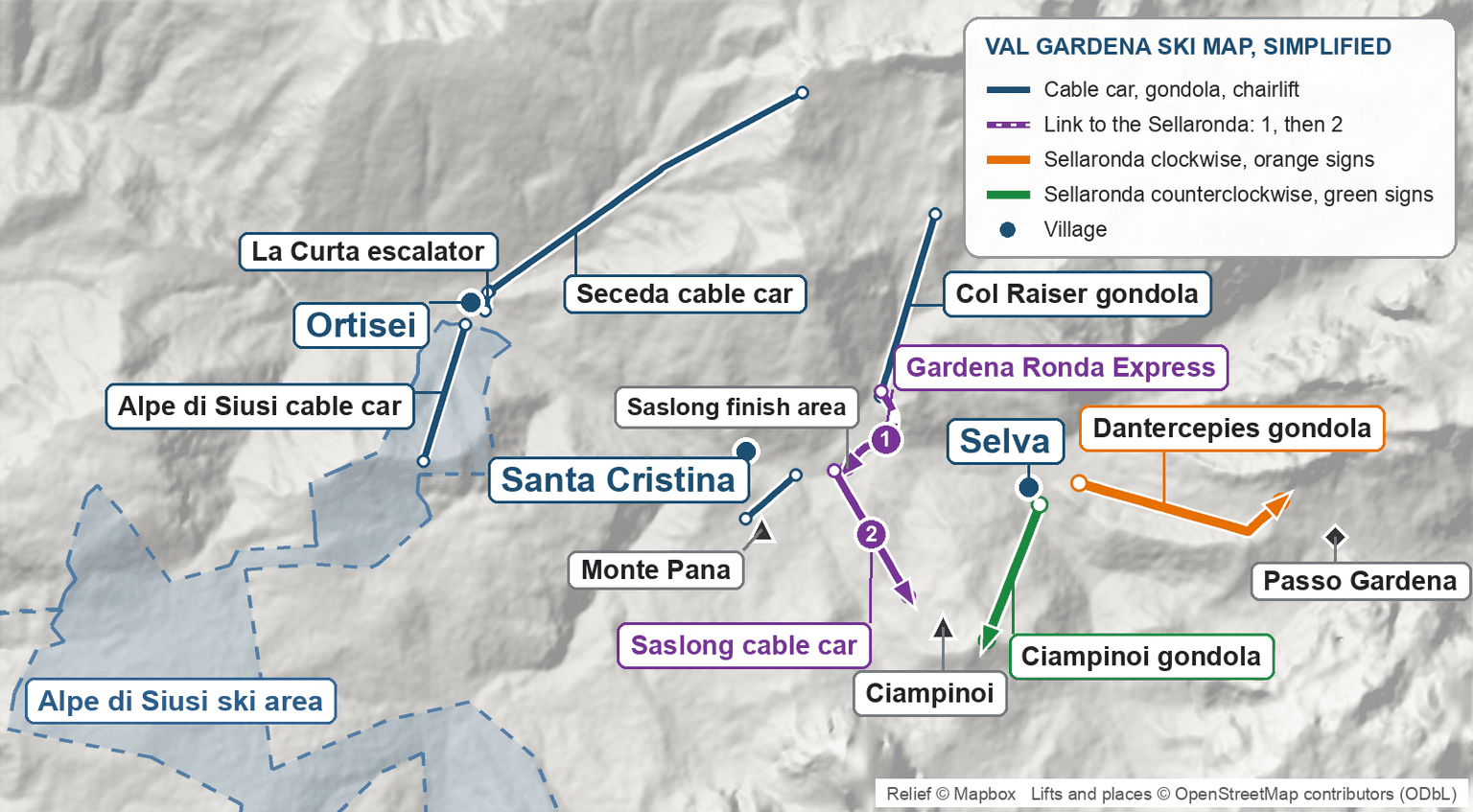
Selva di Val Gardena (Wolkenstein in German) is the Sellaronda village. The tourist board calls it "the ideal starting point," and both directions of the circuit leave from its own lifts, so a circuit day starts in the village instead of after a morning commute across the valley. Selva also has two old race runs, Cir and Ciampinoi no. 3, whose numbers wait for the runs section.
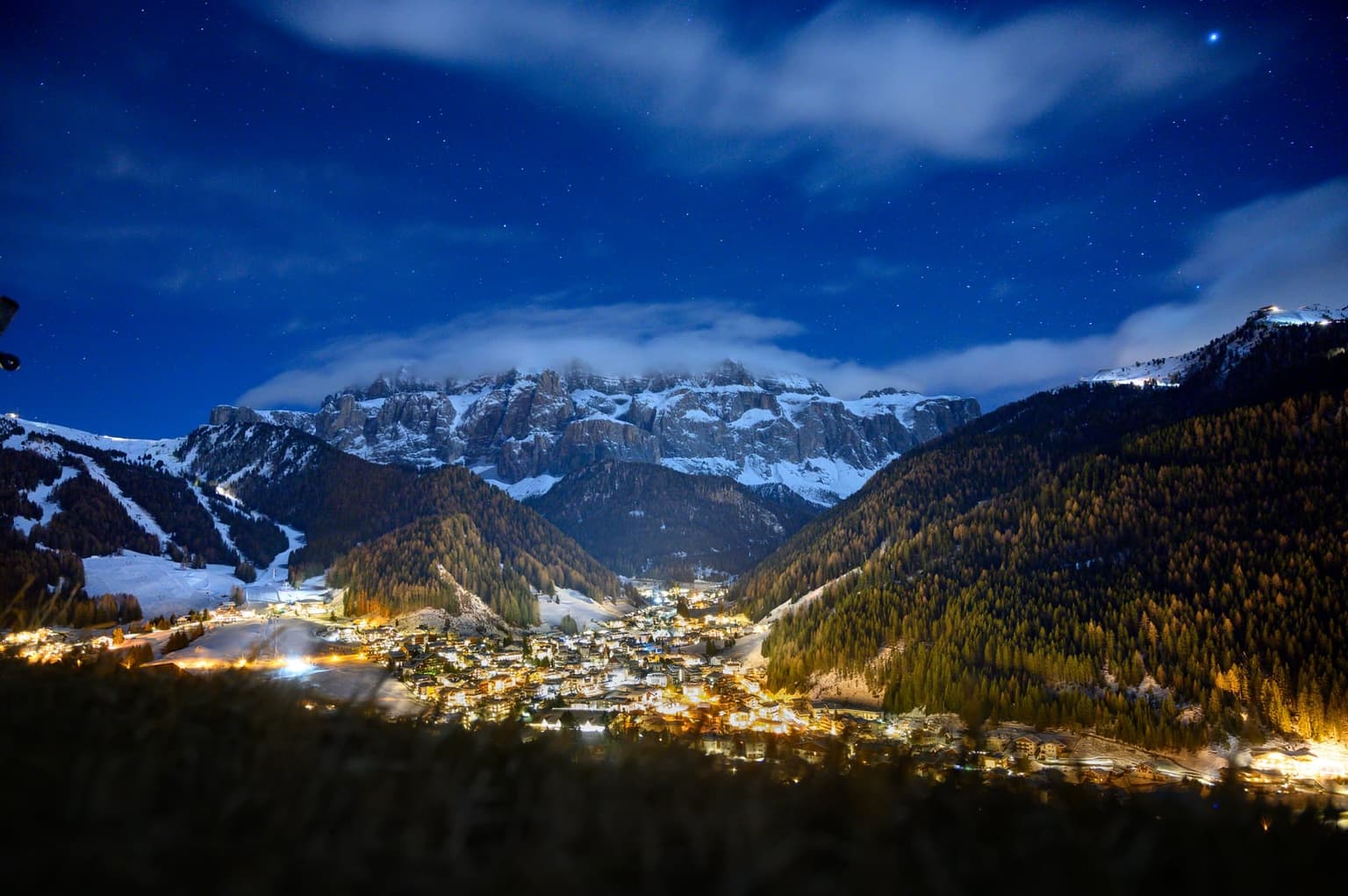
Santa Cristina (St. Christina) is not on the circuit, so a Sellaronda day from here starts with a link, laid out in the next section. Besides the Col Raiser gondola, it has a run down from Seceda that the lift company there bills as a "descent to S. Cristina," so the day ends in the village. Monte Pana sits above it, one of the two places the runs section sends beginners.
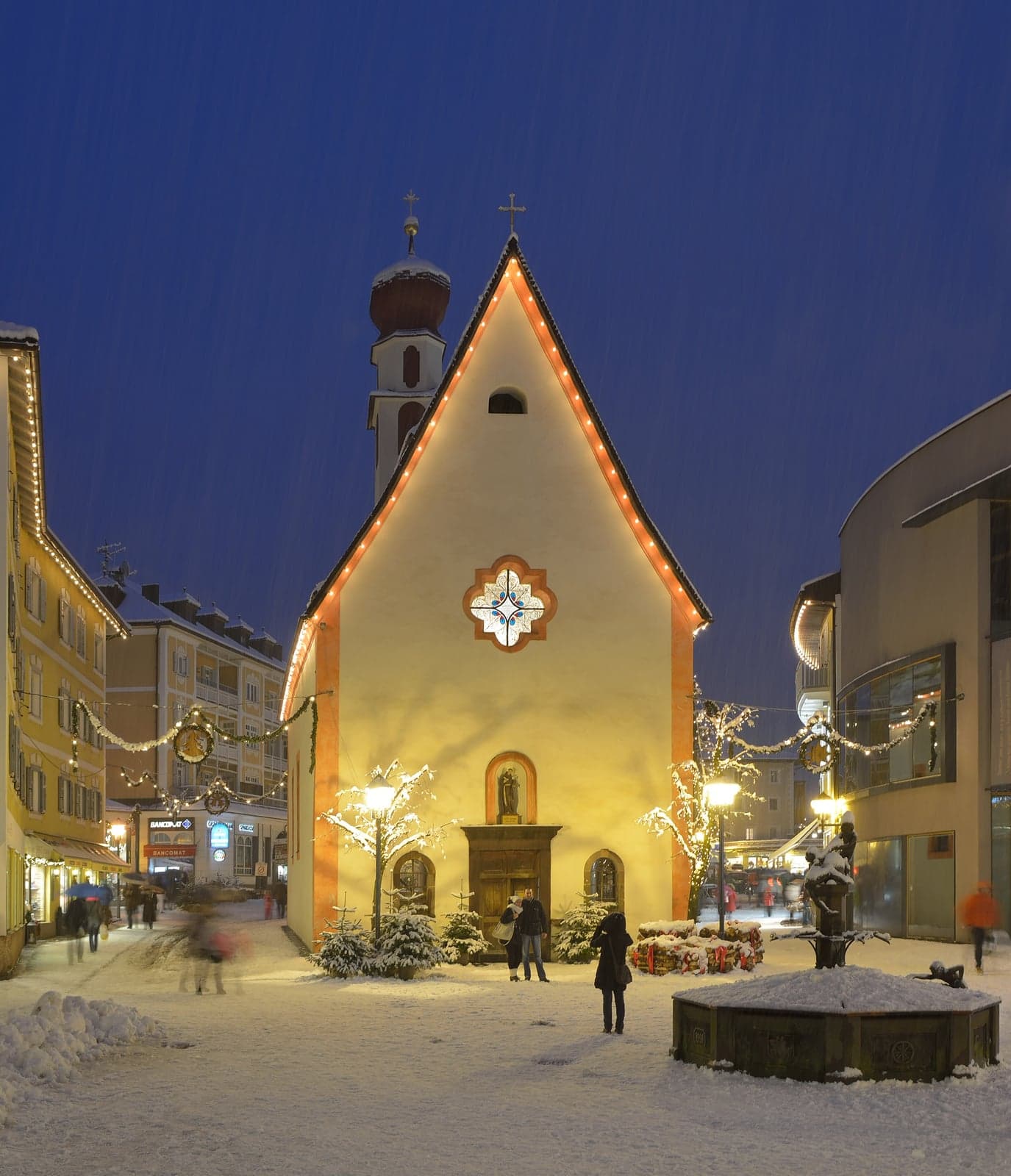
Ortisei (St. Ulrich) has two cable cars, Seceda and Alpe di Siusi, linked by the "La Curta" escalator. La Longia finishes here, and the Alpe di Siusi one rides up to the other beginner area. The catch is Santa Cristina's: Ortisei is off the circuit, so a Sellaronda day starts with a link. If Seceda and La Longia are why you came, sleep within walking distance of the Seceda cable car: being on the long run first thing, or skiing it home as the day's last run, is the best argument Ortisei has.
Its other argument comes after skiing. In the evening Ortisei stays a real, lively town with its pedestrian streets open, while Santa Cristina next door goes completely quiet. For the Sellaronda itself, I stay in Selva, where the circuit starts without a bus transfer. A mixed group belongs in Ortisei, which has the better walking and a cable car straight up to the flat plateau of the Alpe di Siusi.
Whichever village wins, sleep where you can walk to a lift. All three make that easy, and if a hotel's answer is a shuttle, ask how often it really runs before you build a morning around it. If some people in your group don't ski, their week runs on a different plan, and a non-skier's winter day in the valley is where it starts.
When you book, filter by the walk to your lift: the Ciampinoi or Dantercepies gondola in Selva, the Col Raiser gondola in Santa Cristina, the Seceda or Alpe di Siusi cable car in Ortisei. Check for a ski room or boot room, and read the minimum-stay terms before you fall for the photos: in high season they can run to a full week.
Is the Sellaronda worth a day, and where do you start it?
The Sellaronda is a ski circuit around the Sella massif over four passes (Campolongo, Pordoi, Sella and Gardena), skied on a Dolomiti Superski pass. For an intermediate who starts early, it's worth one day of the week.
The case for it is geography: one day, four Ladin valleys and three Italian provinces on skis, and the tourist board calls it "ideal for skiers with average skills." That holds. A skier happy on blues who starts early and doesn't crawl down every run makes it around. It's big, too: two weeks out of Val Gardena still leave corners unexplored. The case against is the skiing. Much of the day is lift to lift on mellow connecting runs, and Val Gardena's own long runs are the better skiing. I'd ski it once and give the valley the rest.
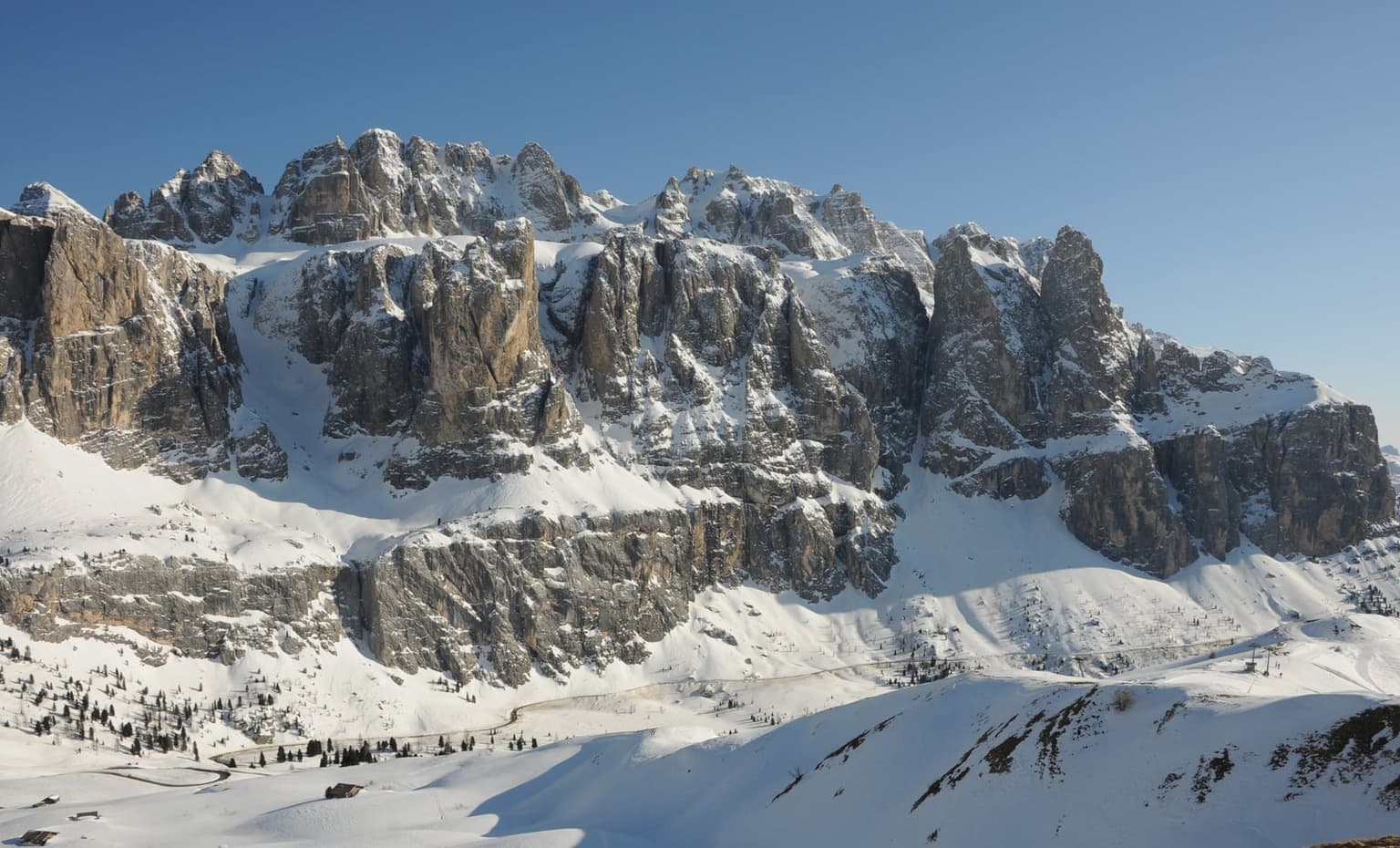
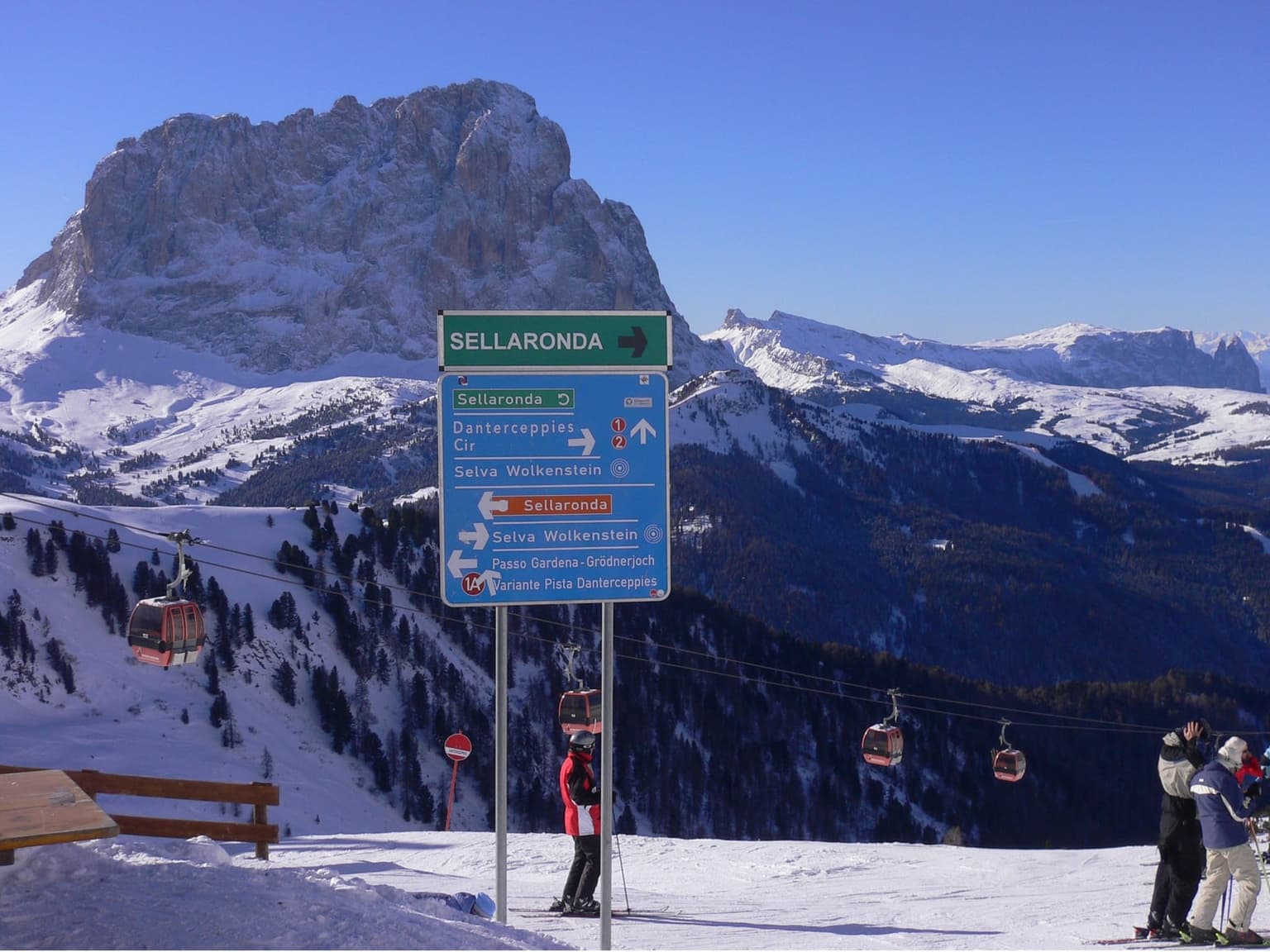
From Selva, clockwise means the Costabella chairlift and the Dantercepies gondola up to Passo Gardena, then down to Colfosco. Counterclockwise means the Ciampinoi gondola up the mountain of the same name, then down to Plan de Gralba. Pick a direction by where you want lunch, not by reputation. Then follow the signposts, orange for clockwise and green for counterclockwise, and settle which color is yours before breakfast: a junction in mid-afternoon is a poor place for color theory.
From Ortisei or Santa Cristina, a link comes first, and the tourist board's own ski loop runs it. From Ortisei, go up to Seceda and ski the Gardenissima down to the Col Raiser gondola's valley station, where the run finishes. The Gardena Ronda Express starts there, an underground funicular to the Saslong finish area, and the Saslong cable car takes you up to Ciampinoi. From Santa Cristina, the link starts at the Ronda Express. Coming home, the loop runs "Ciampinoi > Ruacia > Gardena Ronda Express > Seceda > Ortisei" to Ortisei and "Ciampinoi > S. Cristina" to Santa Cristina.
⚠️ Warning
Be on the circuit by 10:00 at the latest, the tourist board advises, or risk not getting back before the lifts close. From Ortisei or Santa Cristina, the links out and home share that lift day, so leave earlier.
The other big day is the Marmolada: over Passo Gardena or Passo Sella to Arabba, then the Porta Vescovo cable car toward the Marmolada. It's a Superski day too. On a busy week, one lift line on that day can run to an hour.
A guided day takes the navigating and the pacing off you, and the pace decides whether you beat the last lifts home. Look for a named Sellaronda day with a start time and a stated ski level. Skip any tour that won't say which direction it runs or where it starts.
Val Gardena pass or Dolomiti Superski: which one you need
The Val Gardena/Alpe di Siusi ski pass covers 79 lifts and 181 km of slopes, but not the Sellaronda. For the circuit, you need Dolomiti Superski.
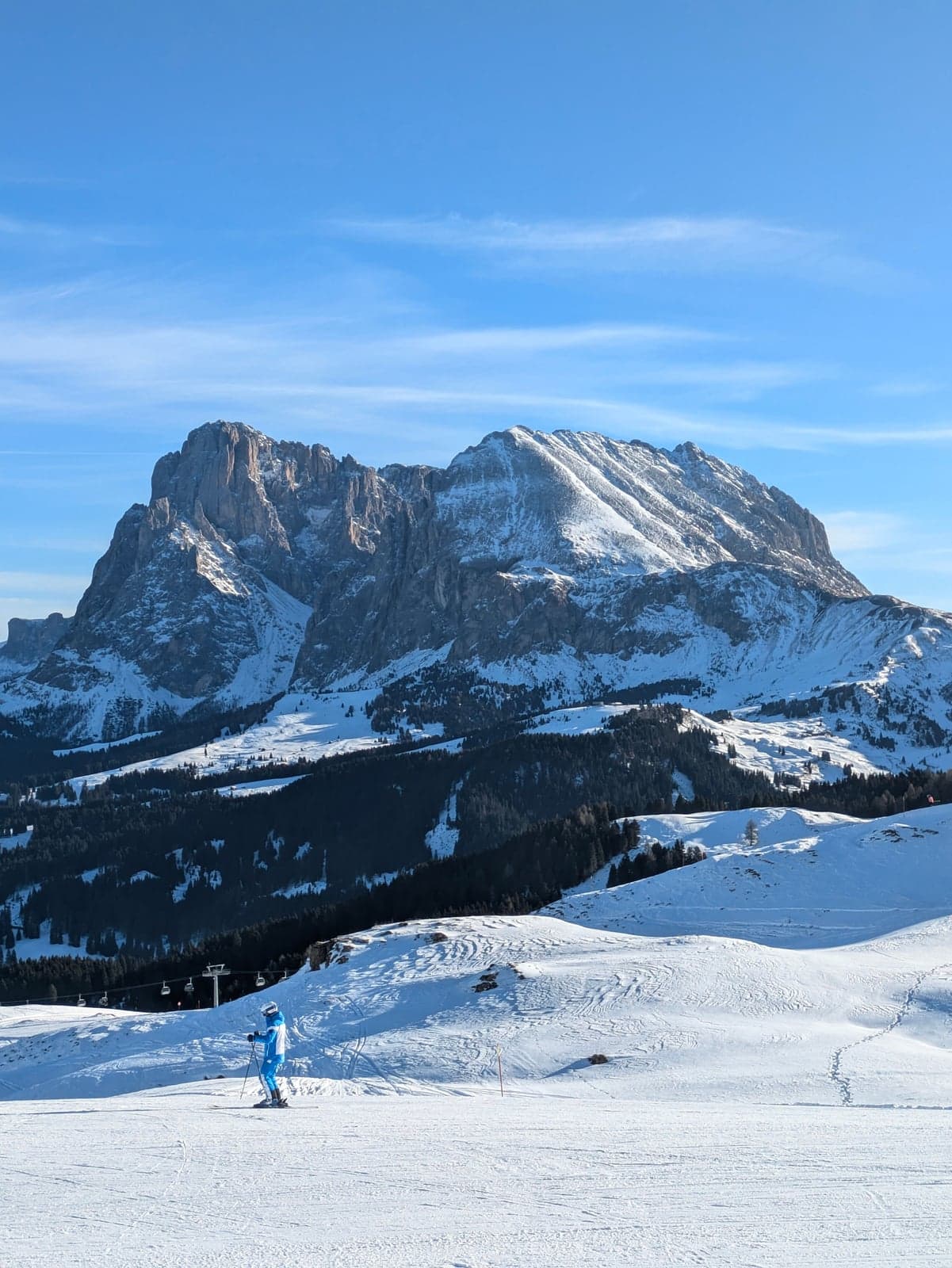
Together, the valley and the plateau make what the Alpe di Siusi tourist board calls "the largest ski area in the Dolomiti Superski ski carousel." The area pass stops at the head of the valley, on two of the Sellaronda's four mountain passes, which puts you on the circuit's doorstep without the ticket to go around it.
| Pass | Covers | Sellaronda and Marmolada day |
|---|---|---|
| Val Gardena/Alpe di Siusi | Val Gardena to Passo Sella and Passo Gardena, plus the Alpe di Siusi | No |
| Dolomiti Superski | 12 valleys, 1,200 km of slopes | Yes |
Adult Superski costs €80 or €89 a day in 2026-27, depending on the week, and €407 / €453 for six days. Children born 2019-2023 get a free pass, one per accompanying adult buying a pass for the same days at the same time (season passes, value cards and a few special tickets excluded). Juniors born 2009-2018 pay €56 or €62 a day.
I'd let the plan pick the pass, not the price. Last season's 5% online discount applied to passes bought at least two days before use, and the live prices for your dates are in the online ski pass shop.
Passes sell at both Ortisei cable car valley stations (Seceda and Alpe di Siusi), in the center of Santa Cristina and at the Ciampinoi valley station in Selva. Ikon Pass holders get up to seven days here with no blackout dates. Ikon Base gives up to five, blacked out December 26 - 30, January 16 - 17 and February 13 - 14. Ikon confirms direct-to-lift access, but holders still need the liability insurance below.
Val Gardena runs by level: La Longia, Saslong, Cir and the easy slopes
Val Gardena's long run is La Longia, from Seceda down to Ortisei, which the tourist board bills as "the longest ski slope in South Tyrol." The steep ones are the Saslong World Cup downhill and Selva's Cir. Beginners start on the Alpe di Siusi or at Monte Pana.
| Run | From - to | Length, drop | Pitch |
|---|---|---|---|
| La Longia | Seceda to Ortisei | 10.5 km, 1,273 m | 18% average |
| Gardenissima | Seceda to the Col Raiser gondola valley station | 6 km, 1,033 m | 19% average |
| Saslong | Ciampinoi to Ruacia | 3.75 km, 830 m | 24.95% average, 56.9% steepest |
| Cir | Dantercepies to Vallunga | 2.75 km, 675 m | 27.76% average |
| Ciampinoi no. 3 | Ciampinoi to the Frëina dome, Selva | 2.38 km, 677 m | 29.67% average |
| La Pilat | Alpe di Siusi to Ortisei | 4.7 km, 778 m | 16% average, 60% max |
Those top two rows are the week's best skiing for most people. La Longia starts under the Odle ridge and doesn't quit until it reaches the village, long enough that the run itself is the outing, and it ranks with the best in the Dolomites. The Gardenissima leaves from the same top and is short only by La Longia's standards.
I skied La Longia at the end of January, around four in the afternoon, with almost nobody left on the run. Halfway down it drops into a narrow canyon, and I slid past huge rocks and frozen blue waterfalls. In that gorge I could hear only the rhythmic scrape of my skis on the crust, and the frosty air burned. The run ended right at the edge of Ortisei, where I clicked out of my bindings by a small bridge and a minute later was on a busy street in town.
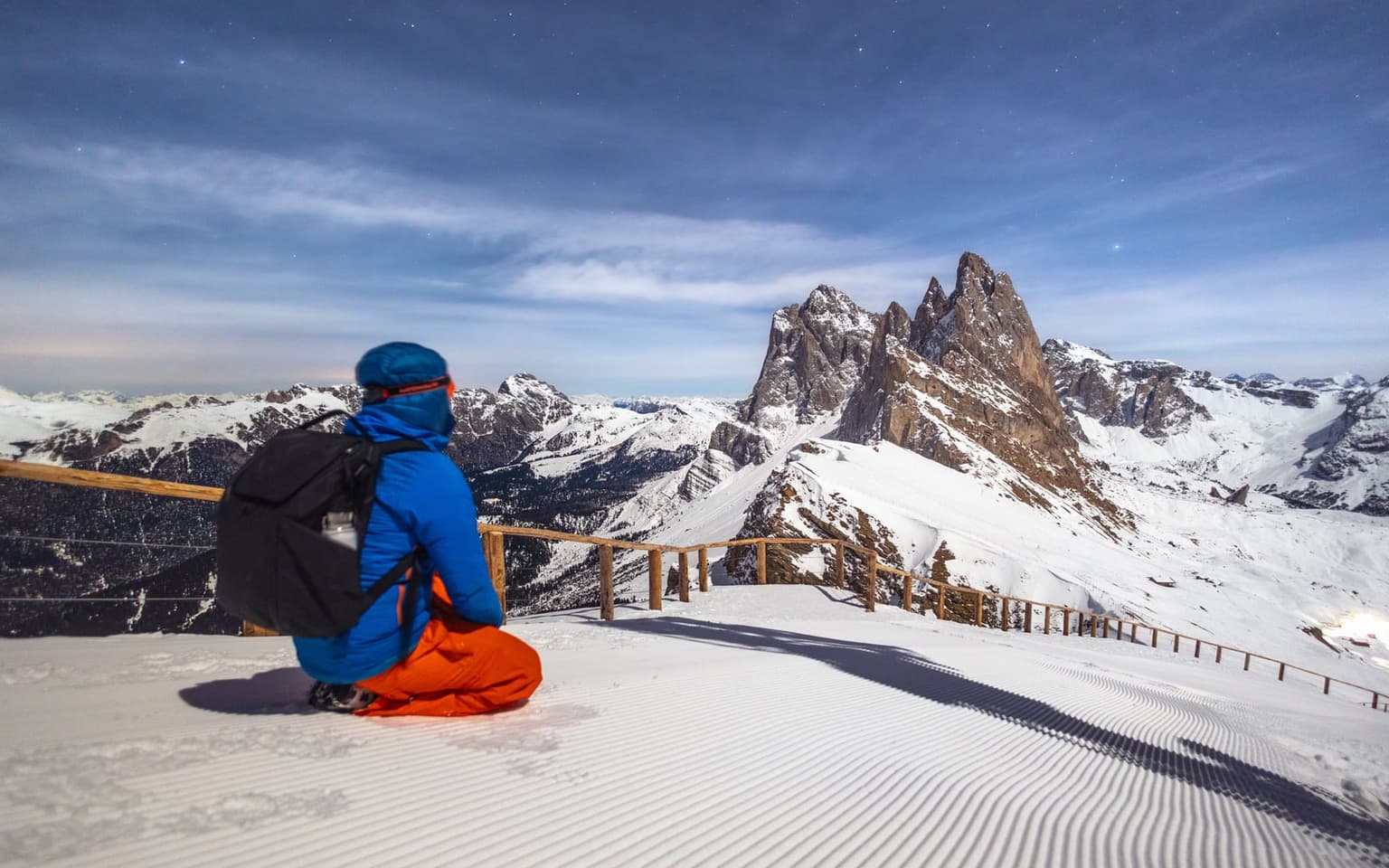
The Saslong is the course of the yearly FIS World Cup men's speed races, the run confident skiers come to say they've skied, and its steepest pitch in the table is the number to respect. Cir and Ciampinoi no. 3 were both raced in 1970, Cir as a women's downhill and Ciampinoi no. 3 as a giant slalom. La Pilat is the trap. The tourist board's own ski loop skis it from the Alpe di Siusi down to Ortisei, so it looks like the natural way home from the beginners' plateau. It's a former off-piste downhill through a rocky forest, and no place for a beginner.
For a confident intermediate, the red La Longia is the one run in the valley not to skip. The warning goes to beginners: don't ski back down to Selva on the runs from Ciampinoi after three in the afternoon. By evening I found the snow there scraped off completely, down to hard ice and huge moguls, and I watched exhausted people falling there again and again.
Beginners have two places to start. The Alpe di Siusi ski area, up the cable car from Ortisei, is the one the tourist board calls "particularly popular with beginners and families." Settle how you're getting back down to Ortisei before you ride up, because La Pilat isn't the answer. The answer is the cable car you rode up: it carries skiers back down to the village. Just catch it before the lifts close.
From Santa Cristina, the S. Cristina - Monte Pana chairlift rides up to Monte Pana, which the tourist board says "offers several easy practice slopes." Its snowpark, at the foot of the Sassolungo, is "ideal for families, children and skiing beginners," with practice lifts and funslopes, runs shaped with turns, waves and tunnels. Between the two areas, the tourist board's loop rides a ski bus from Saltria, on the Alpe di Siusi, to Monte Pana. Last season that bus took no ski passes: €5 one way, €9 round trip, and no credit cards. Bravo, on Mont de Sëura in the Monte Pana area, is the giant slalom reserve slope, with constant changes in gradient: not the next step after the practice slopes.
Lift lines, race week and when to ski Val Gardena
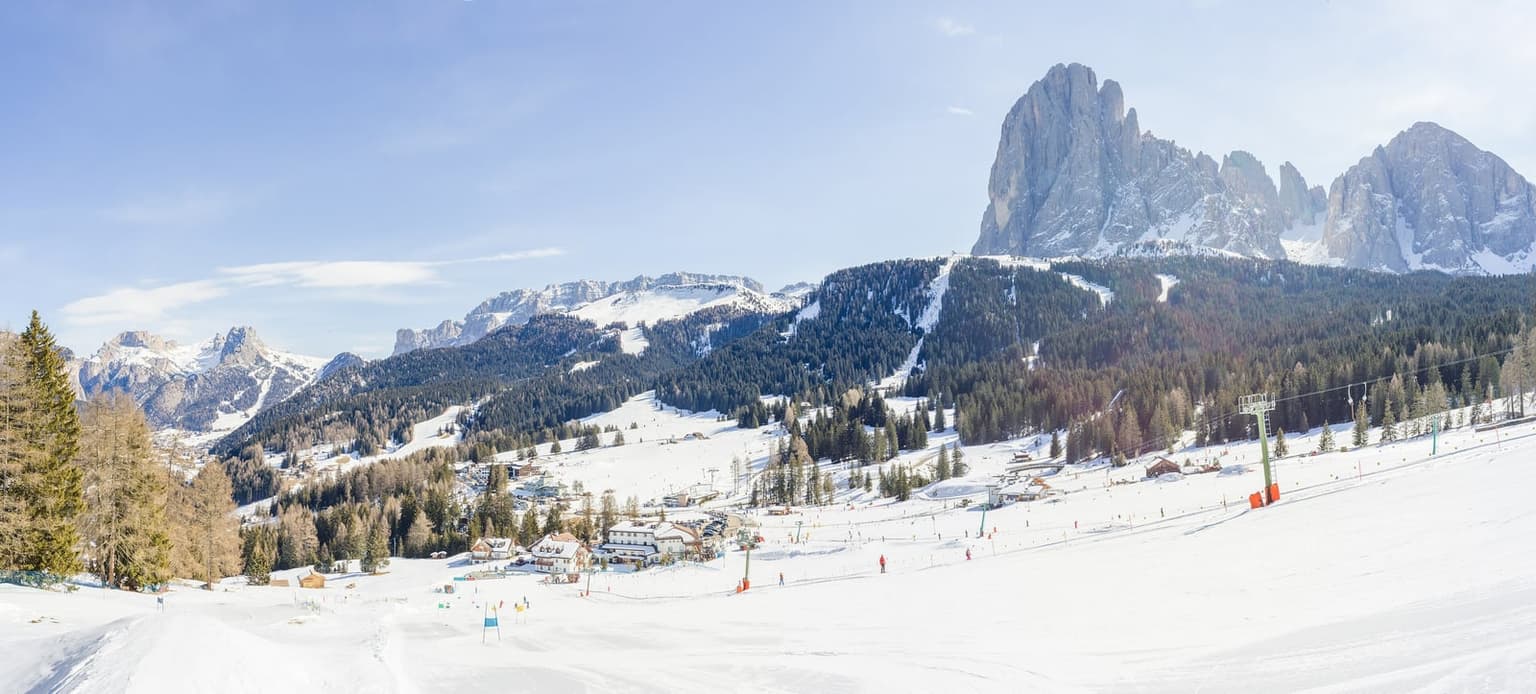
Val Gardena's lifts run from December 4, 2026 to April 4, 2027. Inside that season, Dolomiti Superski's high-season weeks, its higher price band, are December 20 to January 9 and January 31 to March 20.
Don't mistake the weeks before December 4 for a quiet early ski week: the lifts don't turn until then. If you're coming at the very start, ask whether your hotel and its restaurant are open yet. An early-December week also lands inside South Tyrol's Christmas-market season. Every other window and its price band is laid out in the season calendar for the whole region.
Mid-December has one fixed date. The 59th Saslong Classic brings the World Cup speed races to the Saslong on December 18 and 19, 2026, a Friday and Saturday, the two days right before high season starts. Race week changes the Saslong side of the valley, so check the organizer's race-week program before you book those days.
The 2026 Saslong Classic program, training days included (saslong.org)
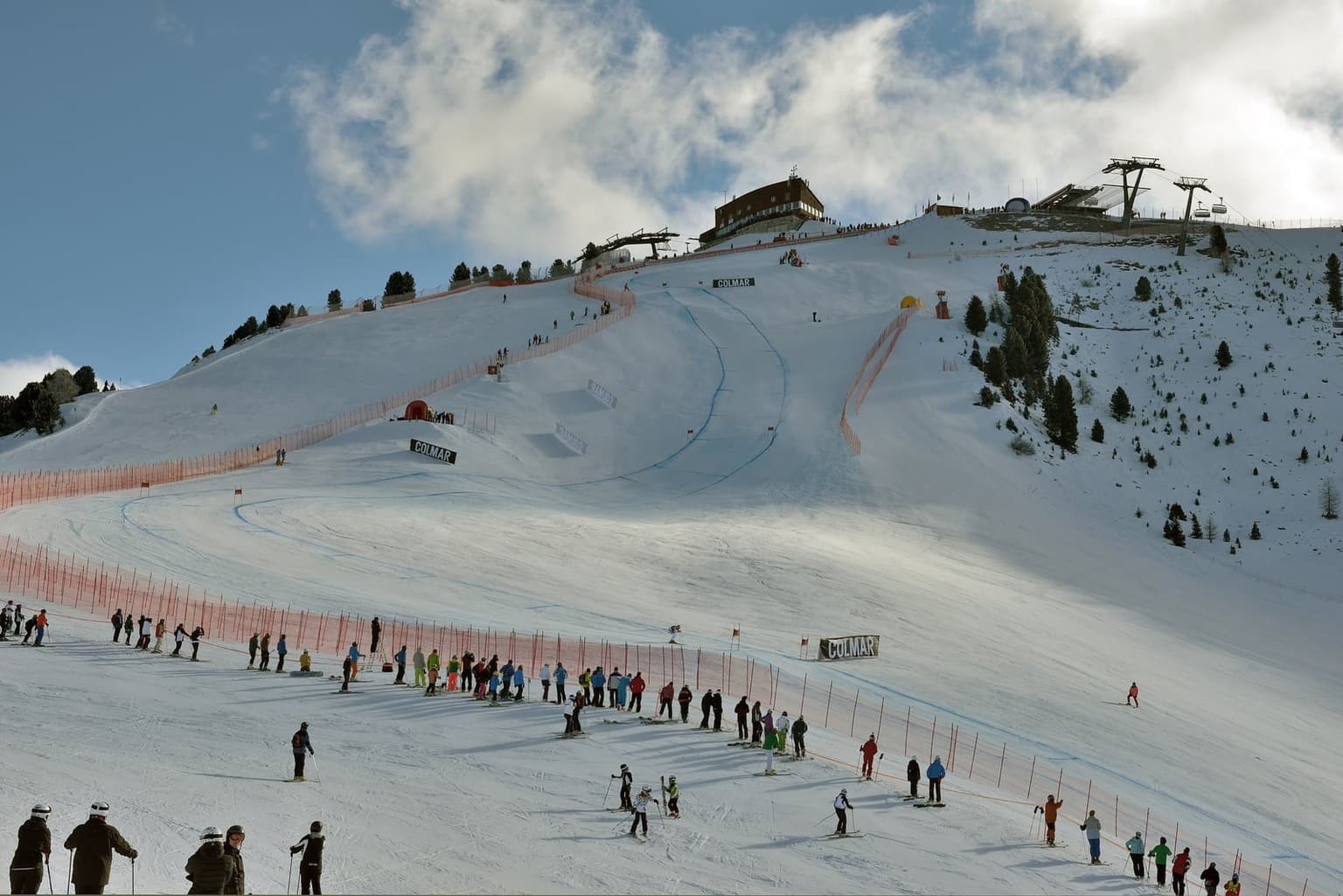
The Seceda cable car in Ortisei pulls a long morning line, so be there at or near opening, not after a second coffee. At the other end of the day, the main run back into one of the villages can get chopped up, full of moguls and crowded, with everyone skiing home on whatever legs they have left. And on a busy week, one lift with a short line can still load packed cabins, and a short wait is not the same as room to breathe. I'd fix all three the same way: up early, down before the rush, and, if the dates are yours to choose, a week outside high season.
Before day one: helmet, insurance, lessons and rental
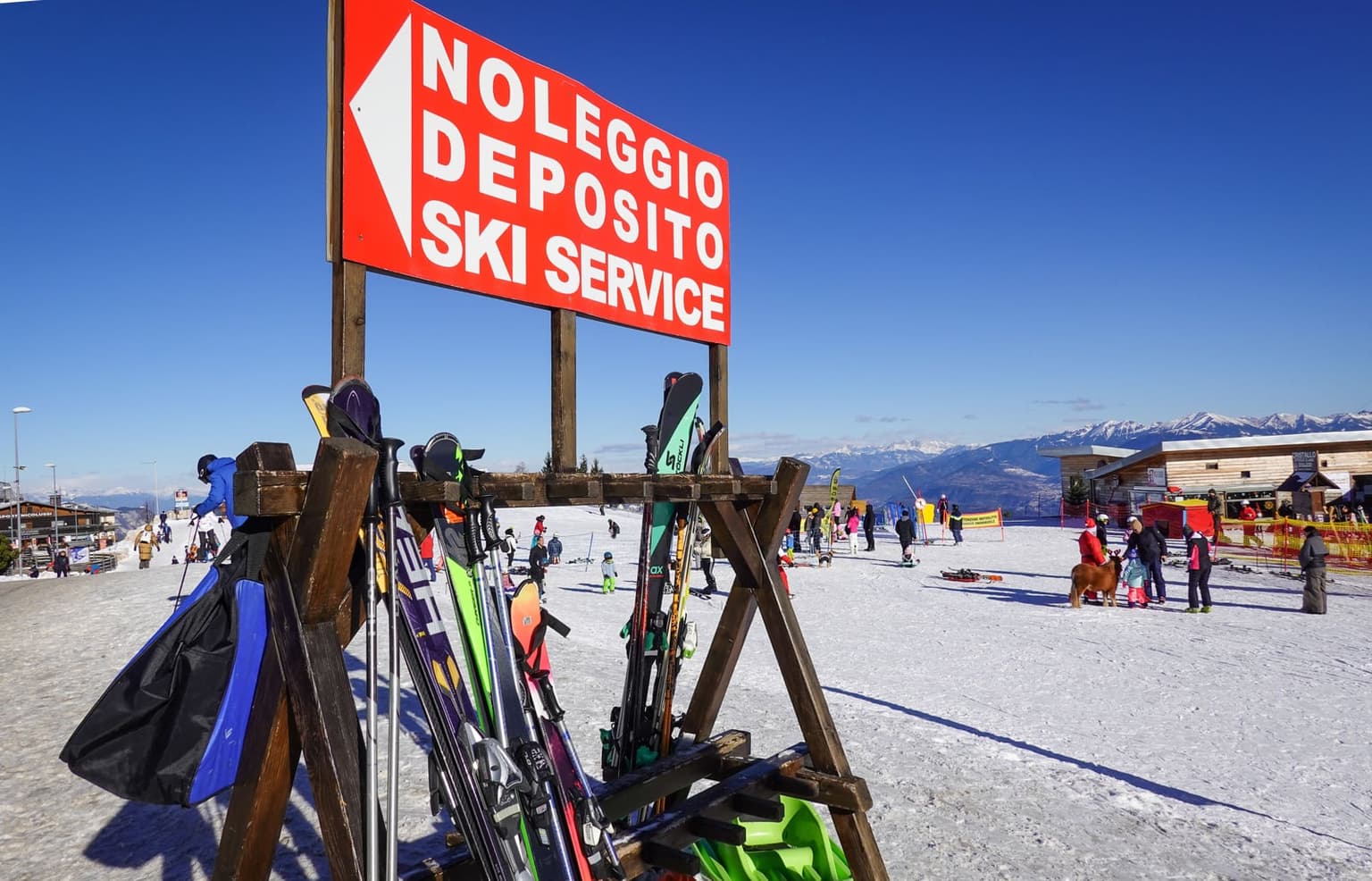
Every skier in Val Gardena has to wear a helmet, whatever their age, and has to carry third-party liability insurance, which the valley's ski pass offices don't sell. The helmet is the easy half.
Under-18s have had to wear one since 2022, and the 2025-26 season extended the rule to everyone on skis, a snowboard or a sled. If you don't pack one, the valley's rental shops will rent you one.
The insurance rule has applied since January 1, 2022, and it asks for liability cover, the kind that pays for damage you cause to someone else. ITASNOW ski insurance is sold online, and its policy terms say the Basic package "offers third party liability cover and reimbursement of expenses," with medical and emergency care capped at €300 a claim. Val Gardena's tourist board recommends the German ski association's DSV insurance, "covering public liability and ski theft." Past the law, the board's own argument for insuring is what a helicopter rescue and a hospital bill cost. If you're on Medicare, it usually doesn't cover care outside the U.S.
ITASNOW's online shop for its Basic and Plus packages (itasnow.it)
⚠️ Warning
Val Gardena's pass offices won't sell you liability insurance. Buy it online before your first ski day, and check that it runs for every day you ski, Ikon days included.
Book lessons early. Ortisei's ski school prices them dynamically, with a rise 30 days before the start and another at 7. In Selva, the Ski & Snowboard School 2000 runs adult group courses Sunday to Friday, 10:30 - 13:00, four to eight people a group. Six days cost €309, or €364 in the school's high season (December 20 to January 9, January 31 to March 6), ski pass not included. That season ends two weeks before Superski's, so March 7 onward is back at the regular price. The cheapest private lesson is any hour between 13:00 and 17:00: €59, or €64 in high season. For its adult and children's groups, the school requires a Val Gardena pass at its Green level and Dolomiti Superski from Blue up.
Ski & Snowboard School 2000's group courses and 2026-27 prices (scuolasci-selva.it)
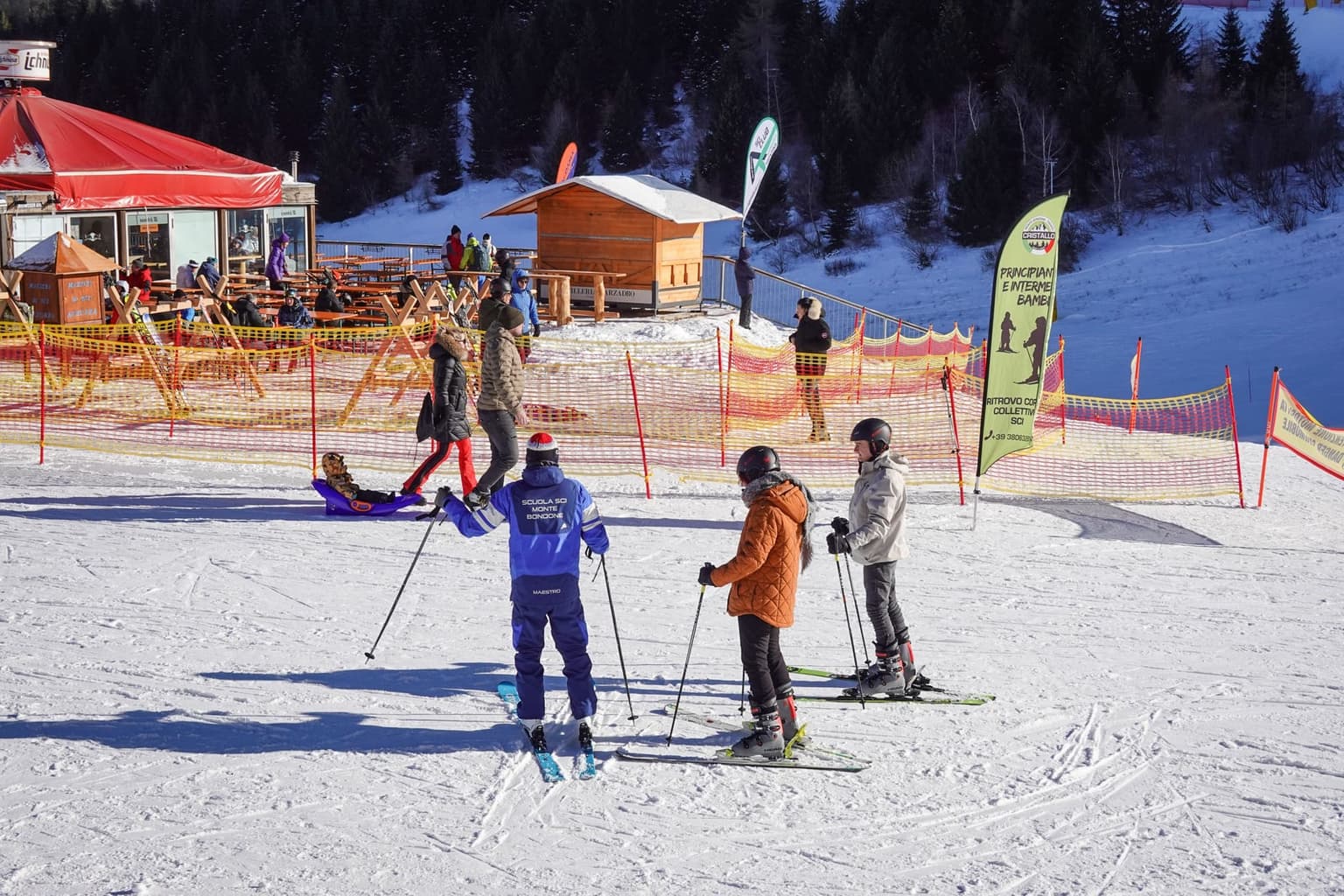
Val Gardena Sport's shops in Santa Cristina and Selva take 10% off when you book online at least two days before the rental starts, and Sport Gardena in Ortisei gives 10% online. Six days in 2026-27 start at €128 for skis plus €69 for boots in Santa Cristina and Selva, and at €187.50 for skis and boots together in Ortisei. Ski & Snowboard School 2000 also rents lockers at its depot next to the Ciampinoi cable car in Selva, with an automatic drying system and heated racks for boots, gloves and helmets, at €31 a person for six days. I'd take that over clomping through town in ski boots twice a day.
Val Gardena Sport's online rental booking, with Santa Cristina or Selva pickup (valgardenasport.com)
Getting to Val Gardena and around without a car
A ski week in Val Gardena works fine without a car. Sleep within a walk of a lift, let the valley's ski buses cover the rest, and come up the valley on bus 350 from Bolzano or by a transfer that takes your skis.
The Val Gardena Guest Pass covers the valley and local ski buses for guests of member accommodations, except the Night Bus and the Saltria-Monte Pana line, the bus between the two beginner areas in the runs section. Ask before you book whether your hotel is a member. This is the valley where I'd leave the car at home: each village has its own lifts, so a car would spend the week parked, and you'd stop missing it by Tuesday.
If you drive anyway, plan on winter tires or snow chains: South Tyrol requires them on signposted roads in snow and ice, and road owners can apply that rule for the whole ski season. It also pays to ask your hotel where to park before you steer into Ortisei's center. Before you pick an airport, compare the routes in from Venice, Milan and Innsbruck, winter driving included.
For the transfer, book a fixed price for the whole car, give the hotel's street address rather than just the village name, and declare skis and boot bags when you book. If the quote has no line for luggage, ask before you pay, not at the curb with two ski bags.
FAQ
- Is it better to stay in Selva, Santa Cristina or Ortisei for skiing?
- Selva if the Sellaronda is the point, since both directions leave from its lifts. Ortisei for Seceda, La Longia and the cable car up to the Alpe di Siusi ski area, popular with beginners and families. Santa Cristina for Monte Pana and the Col Raiser gondola.
- Can you ski the Sellaronda from Ortisei?
- Yes. Ride up to Seceda, ski the Gardenissima down to the Col Raiser gondola's valley station, take the Gardena Ronda Express from there to the Saslong finish area, then the Saslong cable car up to Ciampinoi. The tourist board advises being on the circuit by 10:00, and from Ortisei the link out and the link home share the circuit's lift day, so leave early.
- Do I need the Dolomiti Superski pass or the Val Gardena pass?
- The Val Gardena/Alpe di Siusi pass covers the valley's slopes and the Alpe di Siusi. The Sellaronda and a Marmolada day need Dolomiti Superski.
- Is Val Gardena good for beginners?
- Yes, at Monte Pana above Santa Cristina or on the Alpe di Siusi ski area, up the cable car from Ortisei. The trap is the way back down to Ortisei: La Pilat looks like the natural route but is a former off-piste downhill through a rocky forest. Ride the cable car back down instead.
- Do you need a helmet and insurance to ski in Val Gardena?
- Yes. A helmet is required at every age, and every skier needs third-party liability insurance. Val Gardena's pass offices don't sell it, so buy it online before your first ski day.
Settle the Sellaronda first, let it pick the village, then book the bed nearest your lift. In ski boots, every extra minute of that walk counts double.