George Mandrovny
The short answer: one side of town per day
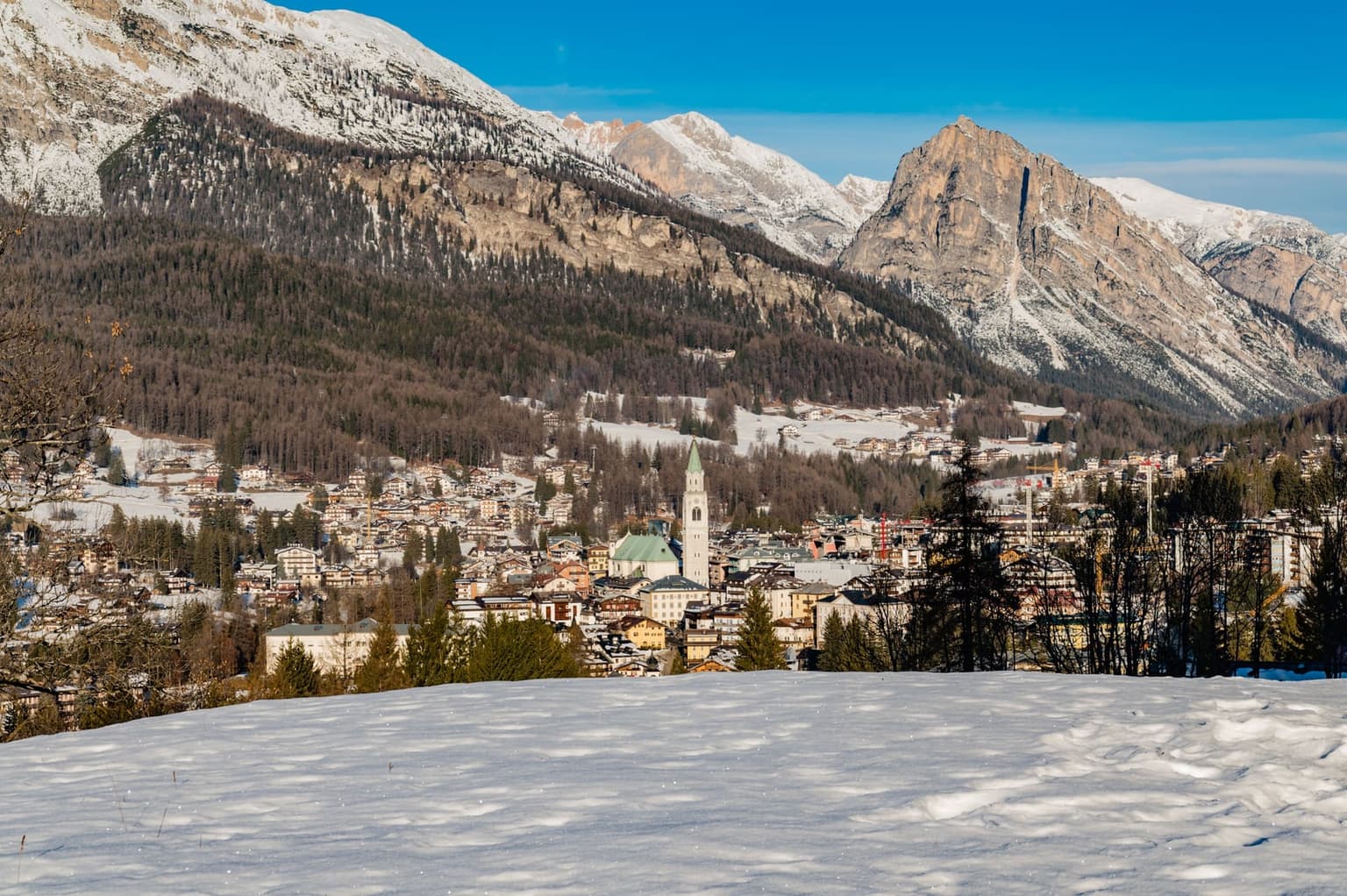
Skiing in Cortina d'Ampezzo means two sides with the town between them: Tofana, 5 Torri and Lagazuoi to the west, linked by the Cortina Skyline gondola, and Faloria and Cristallo to the east. To ski in Cortina the easy way, sleep in the center within walking distance of a valley station, ski one side per day and take the ski bus when you switch. The trap is the Armentarola, the Lagazuoi run into Alta Badia: it runs one way, and the way back to Passo Falzarego is a taxi or the paid ski bus from Armentarola.
- Pass - the Cortina pass covers Cortina, including the Skyline and the Lagazuoi down to Armentarola, plus San Vito and Auronzo-Misurina. The Sellaronda needs Dolomiti Superski.
- Runs - the Olympia delle Tofane if you ski steep, Faloria-Cristallo, popular with expert skiers, and Pocol's gentle slopes to learn on.
- Before day one - a helmet for everyone, and third-party liability insurance, which the ski pass doesn't include.
- Race week - the women's World Cup is on the Olympia January 15 - 17, 2027.
Cortina has slopes for every level, and the town sits between them: charming at dinner, less so in ski boots. So the bed and each day's plan start from one question: which side?
How Cortina's ski areas connect: Tofana, 5 Torri, Lagazuoi and Faloria
Cortina d'Ampezzo's ski areas sit on both sides of town. West of it, Tofana, 5 Torri and Lagazuoi form one system, linked by the Cortina Skyline gondola since December 2021. East of it lie Faloria and Cristallo, the Faloria cable car leaving from the center.
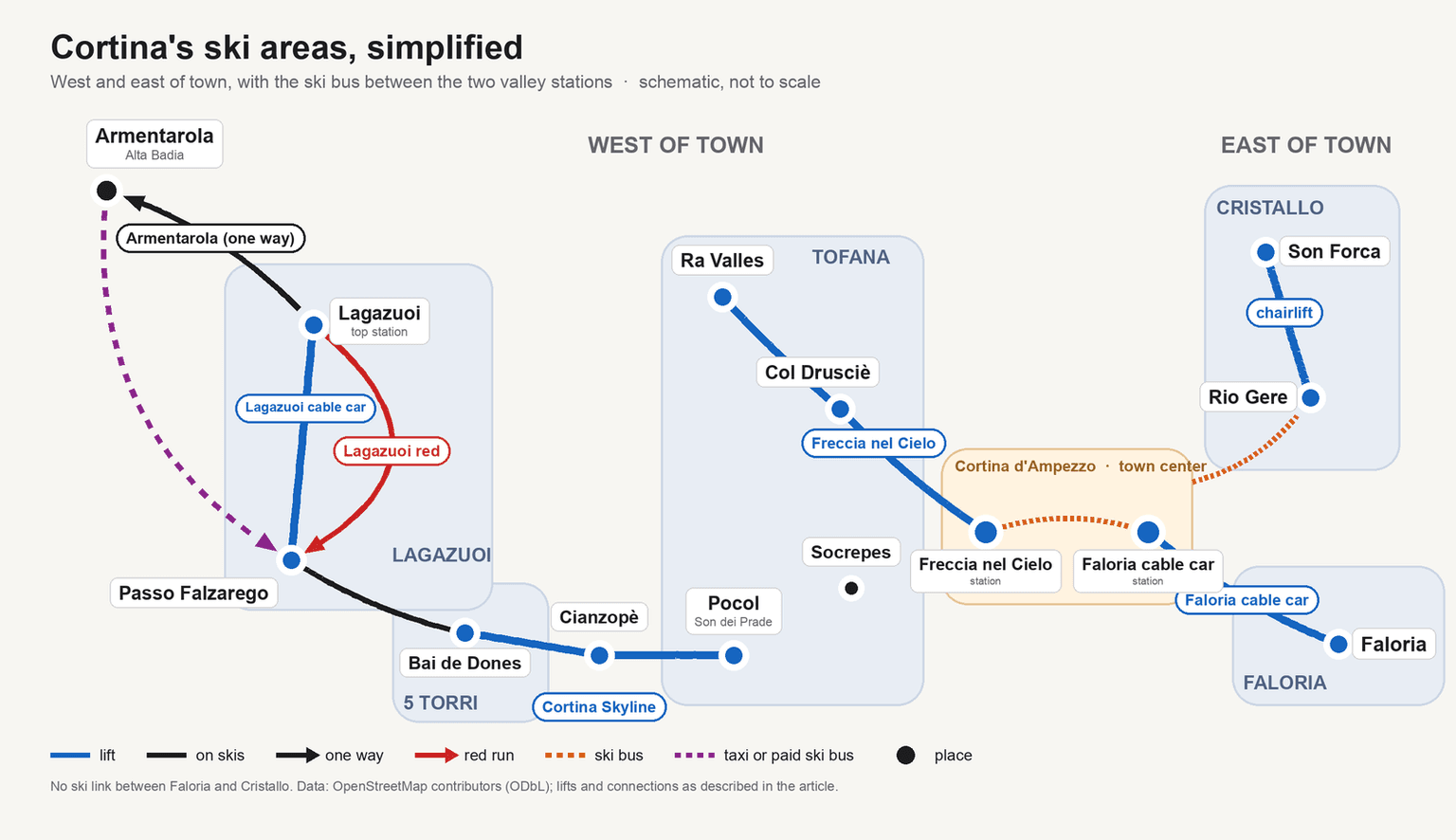
On the west side, the Freccia nel Cielo climbs from the center up the Tofana, its first stretch the Col Drusciè gondola, opened in 2020. Last season the first ride left Cortina at 08:15 and the last ride from Ra Valles was at 16:30. From Pocol, the Skyline runs Son dei Prade - Cianzopè - Bai de Dones in about 15 minutes, both ways, into the 5 Torri area. From there you reach Passo Falzarego and the Lagazuoi on skis, through lifts and slopes: the start of the Armentarola day below.
The Cortina Skyline gondola's page at its lift operator (impianticortina.it)
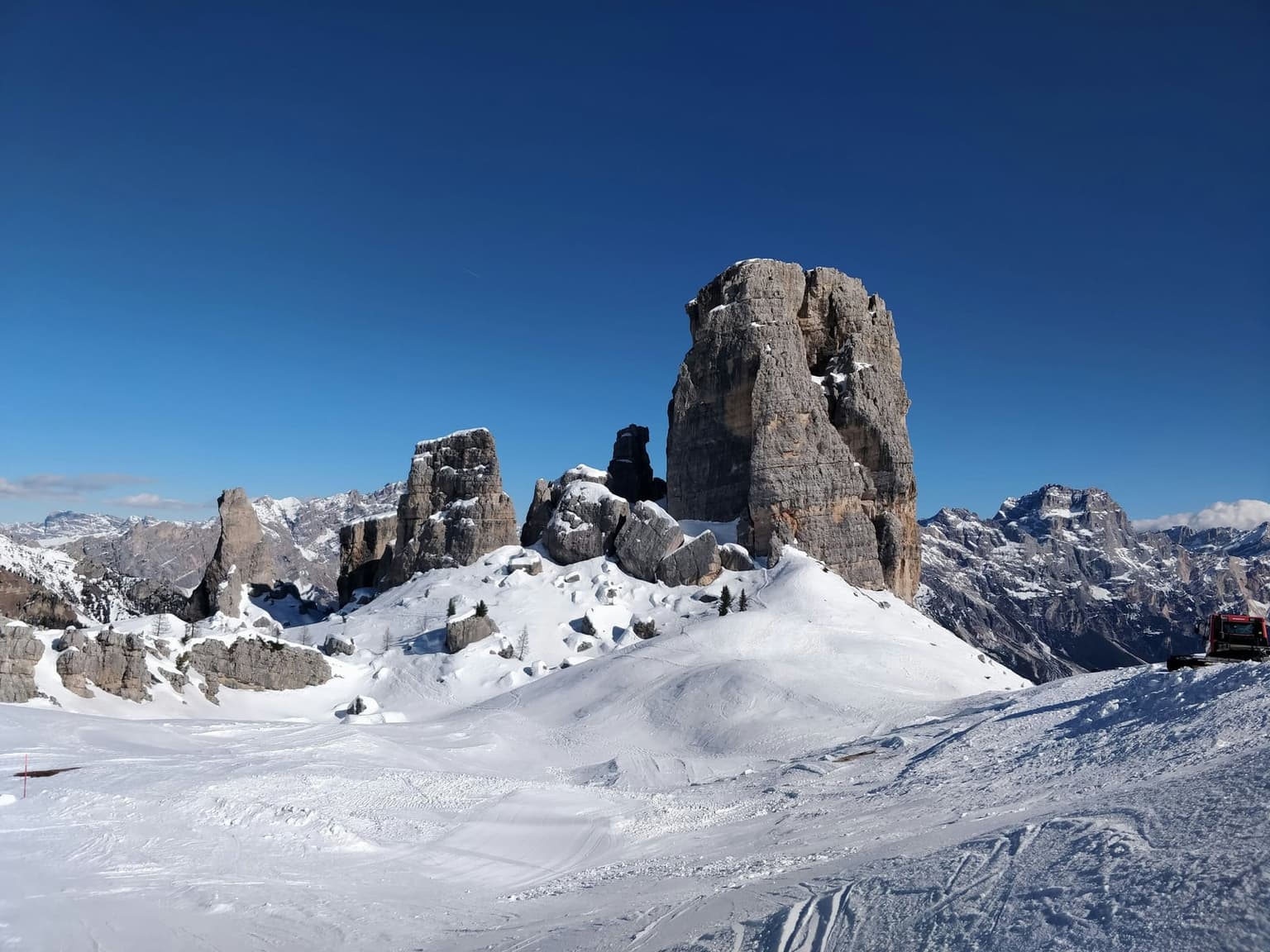
East of town, the Faloria cable car rises straight out of the center, a 2,519 m ride that climbs 897 m. The Cristallo side has the Rio Gere - Son Forca chairlift, and last season, outside the Olympic weeks, the S38 ski bus ran from town to the Rio Gere ski area hourly, 08:45 - 12:45 and 14:45 - 17:45.
Between the two: the ski bus. With both valley stations in the center, you switch between Tofana and Faloria in town. Last season, outside the Olympic weeks, the S34 Centro - Faloria Cable Car - Freccia nel Cielo linked the two stations every 15 minutes from 08:30 to 17:30, and its operator bills it as the bus connecting Cortina's two main ski areas. Ski-bus travel to and from Cortina was free for as long as your ski pass was valid.
Dolomiti Bus's ski-bus page, with the Cortina lines and their timetables (tourism.dolomitibus.it)
So pick a side in the morning and stay on it. A midday switch trades good skiing hours for time in town, and either mountain fills a day. Lunch wherever the morning left you: Cortina's slopes are lined with alpine lodges.
On the Tofana side, mine was Rifugio Pomedes, right on the piste: you ski up and leave your skis at the entrance to the terrace. I had the casunziei ampezzani, the local half-moon ravioli, and they came out fast. Prices ran a little above the valley average, and an outside table at lunch cost about ten minutes of waiting, but the view of the neighboring peaks paid for both.
Is all this worth it, next to Val Gardena? For more than a day, yes: Cortina is big enough to fill a week. Val Gardena is a fair answer too, and the base decides the week, so choose the ski area before the hotel. A group that mostly wants easy groomers should also look at Alta Badia. Cortina's case is two mountains with the town between them, and a ski bus linking their valley stations. The other half lives in my guide to Val Gardena skiing.
When I skied Cortina in February 2024 and Val Gardena in January 2023, the difference was seamlessness. In Val Gardena you move between areas all day without once unclicking your bindings. Cortina pays you back for the bus in empty runs: no crowds on the descents, and snow that hadn't been skied out by afternoon. The switch from Tofana to Faloria through town wore me out. From the last run to boarding the next lift took about fifty minutes, most of it waiting for the ski bus and sitting in traffic in the center. I wouldn't repeat a midday switch. Give each side a full day. For a week, I'd send anyone after maximum kilometers and easy transfers to Val Gardena. Cortina is for strong skiers who want steep terrain and empty, sporty runs, and can live with the bus waits.
Where to stay for skiing in Cortina: which side of town
For a week on both mountains, stay in the center, within walking distance of the Freccia nel Cielo station or the Faloria cable car, with the ski bus between them. Sleep on the Tofana side, at Pocol or Socrepes, only if that side is your whole week.
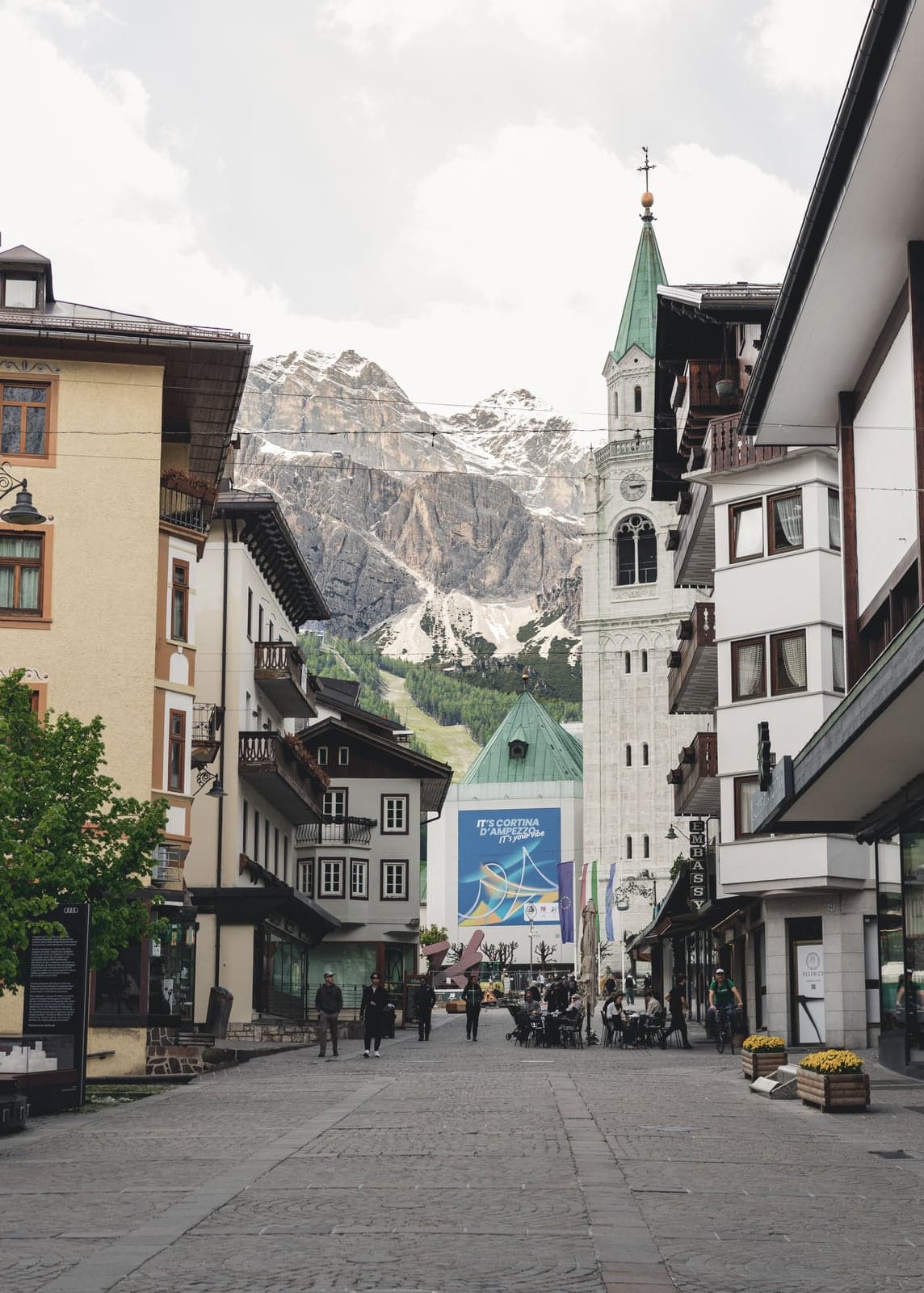
In the center, the walk to the lift is the whole point, so when a Cortina d'Ampezzo hotel bills itself as ski-in, ski-out, ask what that means: a walk in boots to a valley station (and how long), or a ski-bus stop by the door. The center charges for it, in a town that was never cheap, and I'd still pay: in the outskirts, the alternative is a bus at both ends of every ski day.
Pocol and Socrepes. The Tofana side's own doorstep: the Skyline to 5 Torri starts at Pocol, and Pocol's gentle slopes are where first-timers begin. The cost is the evening. Last season, outside the Olympic weeks, the S33 Centro - Socrepes - Pocol ran every 30 minutes from 08:15 to 17:15: a timetable built for the ski day. Before you book, ask the hotel how guests get into town for dinner.
The outskirts and San Vito di Cadore. Cheaper beds farther out cost a commute each way, every day, boots on or skis on your shoulder. San Vito di Cadore is on the Cortina pass too. Out here, ask the hotel how guests reach the valley stations in the morning and get back in the evening.
A hotel's own ski shuttle may run only a few times a day, so ask how often before you count on it. Book the February and holiday weeks early. If you plan to arrive before the lifts open, ask whether the hotel and its restaurant will be open yet. The region's lift season and its pricier weeks are laid out in Dolomites in winter.
When you search, check the walking distance to either valley station or to a stop on the ski-bus line, and look for ski storage, a ski room or a boot room, so wet boots don't spend the night next to your pillow. Then read the minimum-stay terms before you fall for a listing.
Lagazuoi and the Armentarola: the one-way day into Alta Badia
The Armentarola is the Lagazuoi piste into the Badia Valley, and the Cortina pass is valid down to Armentarola. It is a one-way day: the way back to Passo Falzarego is a taxi or the paid ski bus from Armentarola.
Worth a day? Yes, unless this is your first week on skis. Alta Badia's tourist board calls the groomed Armentarola "accessible even to intermediate skiers" and recommends it from Christmas to Easter; the Lagazuoi cable-car operator calls it "the most famous slope in the Dolomites", not a modest claim around here. The Lagazuoi and 5 Torri side is Great War ground, its rocks dotted with trenches, tunnels and emplacements.
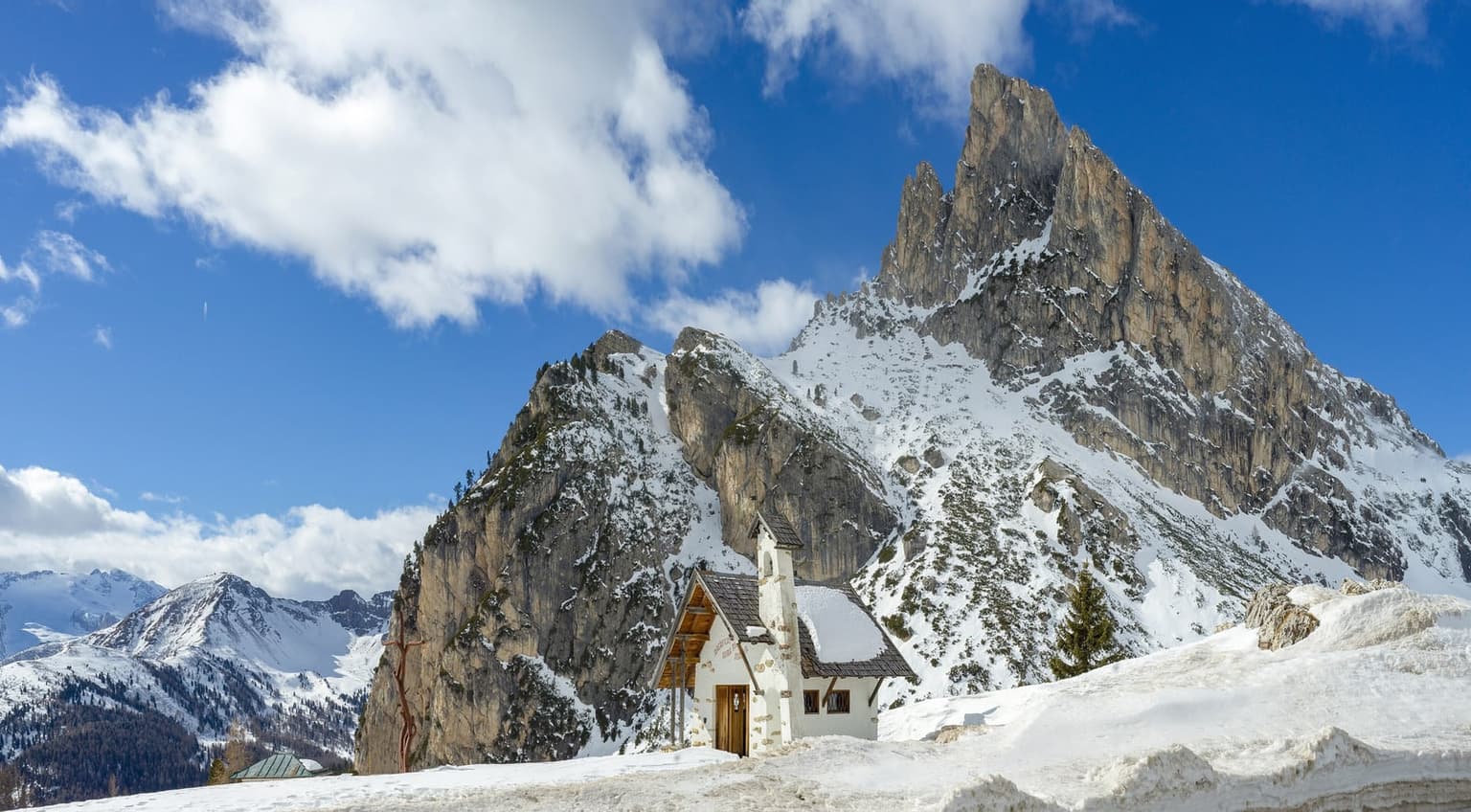
Once you've skied over to Passo Falzarego via the Skyline (above), the Lagazuoi cable car takes you up to its top station in three minutes (the ride, not the time to budget). At the top, pick one of two pistes. The Lagazuoi red, 3.5 km and 600 m down, returns to Passo Falzarego; Alta Badia suggests it as a warm-up, which means a second ride up. The Armentarola drops 1,130 m into Alta Badia, gentler through the Lagazuoi valley, then down a steep canyon for its last section. Alta Badia puts the descent at about 30 minutes to Sas Dlacia, where Noriker horses tow you up to the Armentarola ski lift for €5 a person, 09:30 - 16:00.
The Lagazuoi cable car's opening dates, timetable and last runs (lagazuoi.it)
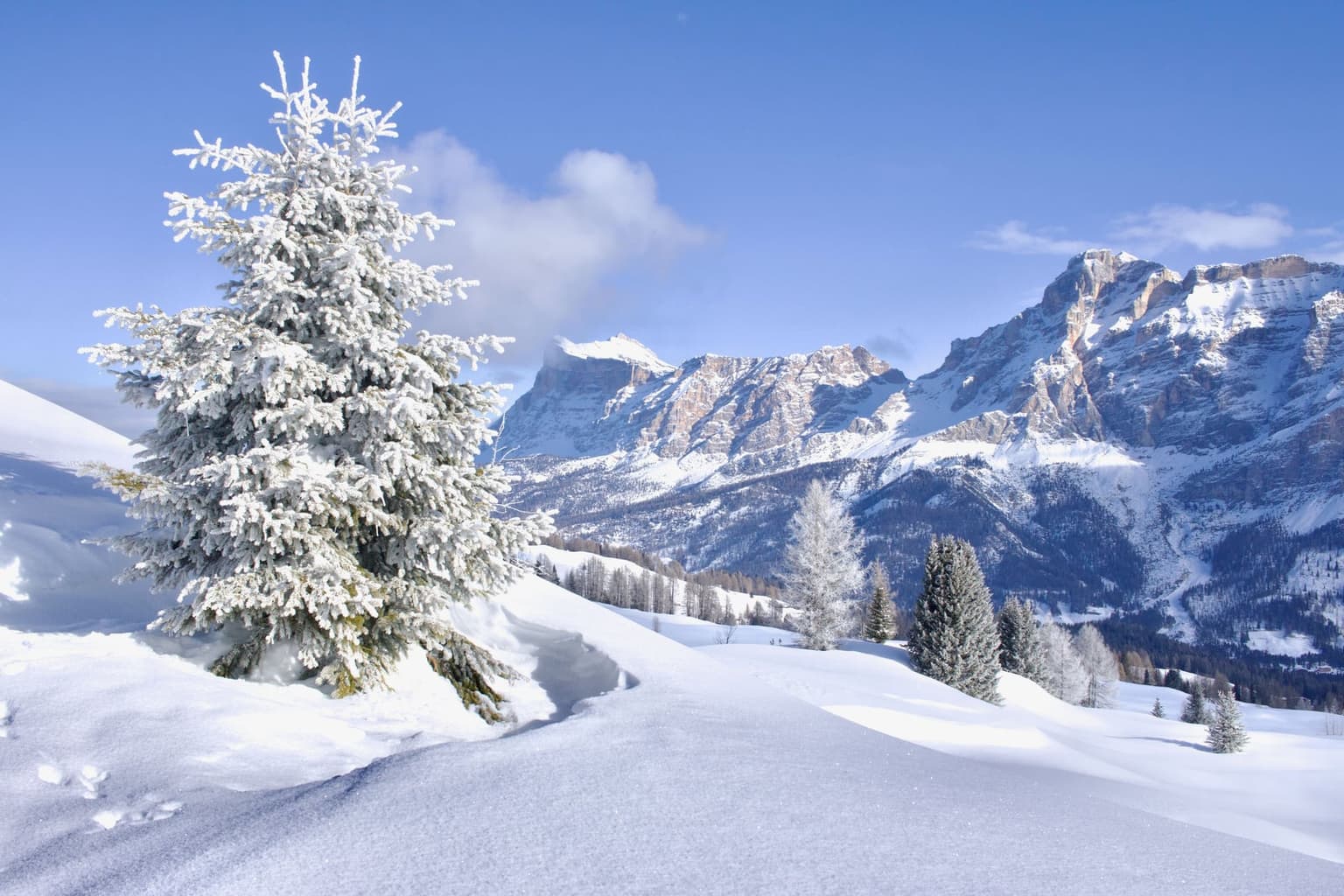
From there, the Armentarola ski lift takes you into the Alta Badia ski area. Back toward Cortina, a taxi to Passo Falzarego leaves from Hotel Armentarola or Capanna Alpina, €8 a person with a €40 minimum, about 20 minutes; or take Alta Badia's paid ski bus to the pass. From the pass you ski over to 5 Torri, and the Skyline carries you back to Pocol. Too late for the lifts? Last season, outside the Olympic weeks, the S37 ski bus made one late-afternoon trip from Passo Falzarego to Cortina.
⚠️ Warning
Plan the way back before you go up. The horse tow doesn't run if the route is closed or in heavy snow, and Alta Badia's ski bus from Armentarola to Passo Falzarego and horse-drawn sleigh rides aren't included in the ski pass.
I skied the Armentarola in February 2024. It stays with me for its length and its gentle, rolling slope: the run winds through an isolated valley right beside huge frozen waterfalls, and it feels like a long, relaxed tour more than a descent. The taxi back up the switchbacks to Passo Falzarego took about fifteen minutes. If you're wavering, give the day to it: I haven't skied anything like that silence, far from the lift network.
Fairly experienced skiers can carry on from Passo Falzarego: Cortina's winter guide starts a Sellaronda itinerary here, by the Lagazuoi cable car, toward the Gardena, Sella, Pordoi and Campolongo passes. Plan it as a Superski day (next section).
A guide takes three hard parts off your hands: finding the way from the Skyline to the pass, pacing the day against the last lifts, and the ride back to Falzarego. Look for a tour that names its return transport and the level it expects, and skip one that won't say whether the taxi or bus is included.
Cortina pass or Dolomiti Superski?
For a week on Cortina's own slopes, the Cortina pass is enough. Dolomiti Superski is for the days you ski beyond Cortina's area, like the Sellaronda from Passo Falzarego, so the pass question here is mostly a Sellaronda question.
The run down to Armentarola fits on the Cortina pass; the ride back to Passo Falzarego doesn't (see the previous section's warning).
| Pass | Covers | Sellaronda |
|---|---|---|
| Cortina pass | Cortina, including the Skyline and the Lagazuoi down to Armentarola; San Vito di Cadore; Auronzo-Misurina; 120 km of slopes in all | No, Superski only |
| Dolomiti Superski | 12 valleys, Cortina included; 1,200 km of slopes in all | Yes |
An adult Superski pass costs €80 or €89 a day in 2026-27, depending on the week, and €407 / €453 for six days.
For a week in Cortina, I'd buy the Cortina pass and treat San Vito and Auronzo-Misurina as the change of scenery it already pays for. If the Sellaronda is one day out of six, add a Superski day ticket to a Cortina pass for the other days and compare that with six days of Superski. Skipass Cortina sells its pass online, on its website or in the Dolomiti Superski app; price your dates there.
Skipass Cortina's online shop for day and multi-day passes (skipasscortina.com)
Cortina runs by level: the Olympia delle Tofane, Faloria and the easy slopes
On Cortina's Tofane ski area, confident skiers head for the Ra Valles and Pomedes technical descents and the Olympia delle Tofane. East of town, Faloria-Cristallo is popular with expert skiers. A few Tofane runs by name, from the lift operator's slope list:
| Run | Color | Length, drop |
|---|---|---|
| Tofanina | Blue | 3,418 m, 418 m |
| Olimpia (slope 21) | Blue | 1,506 m, 209 m |
| Vallon di Pomedes | Red | 927 m, 204 m |
| Canalone | Red | 2,040 m, 618 m |
| Labirinti | Black | 683 m, 248 m |
The Olympia delle Tofane owes its name to the 1956 Winter Olympics, when Austria's Toni Sailer won the men's race on it. The women's World Cup has raced here every January since 1993, and the 2026 Olympic women's downhill was held in Cortina on February 8, 2026, on the run the Tofana lift operator had announced for it; American Breezy Johnson won. It opens with the Schuss, a wall with a gradient of up to 64%, then the Duca d'Aosta jump, the Gran Curvone and the Scarpadon. Mind the name: the Olimpia in the table is a short blue, not this run.
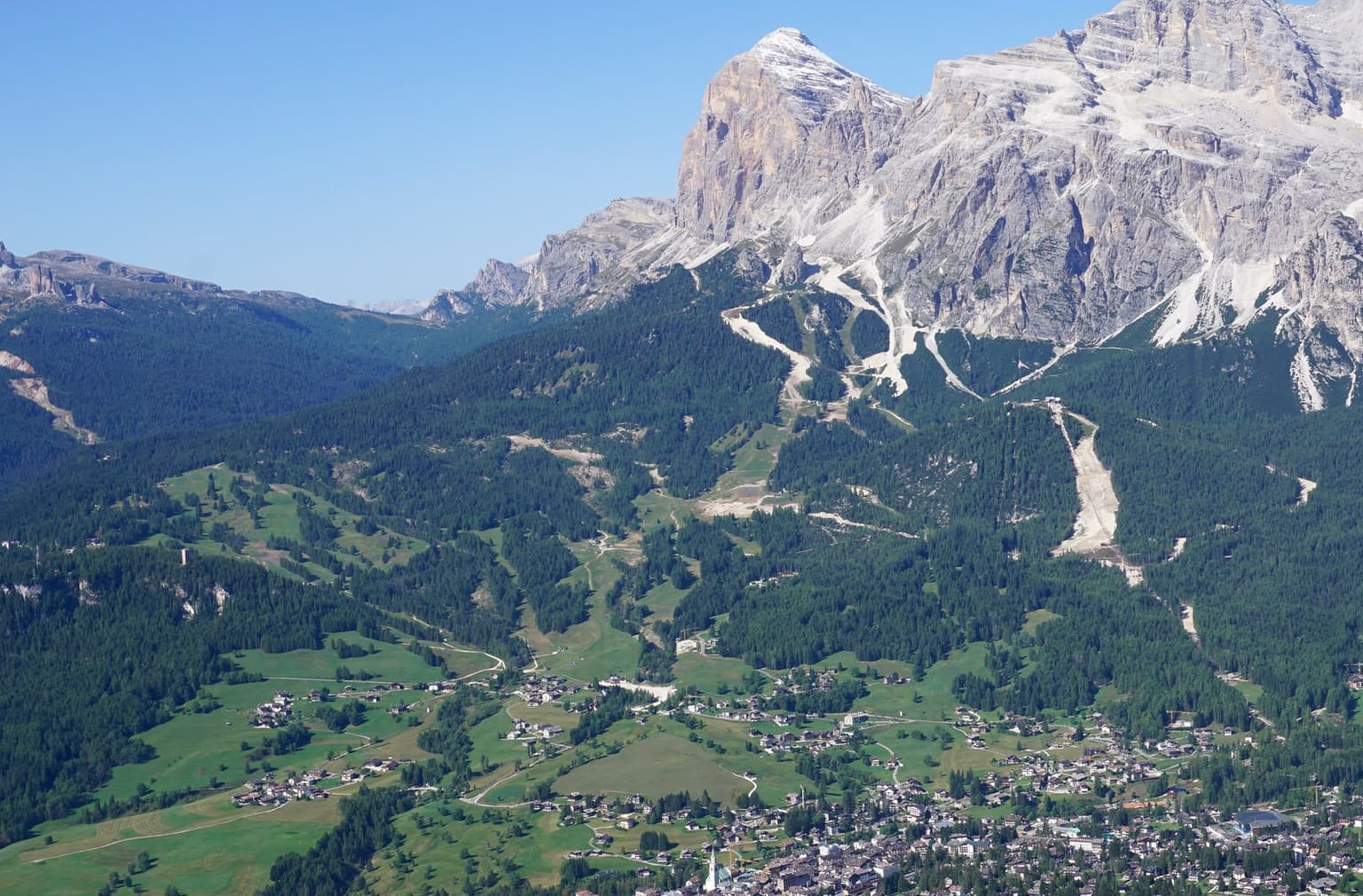
In February 2024 I stood at the top of the Olympia delle Tofane and looked down into a stone corridor between huge sheer walls. The slope fell away so steeply that the sight of it took my breath away. I told myself to hold my edges hard and not panic on the first drop. In the first seconds after I pushed off, it felt like free fall, with the wind in my face. What I hadn't expected was the silence: no one else on the run, on perfect morning snow.
The women's World Cup is back on January 15 - 17, 2027. For the January 2025 races the lift operator announced its whole area skiable except the Olympia track, and during the World Cup, access to the slopes runs under a mobility plan. That was last time's arrangement, not a 2027 promise: if you're booking race week, I'd read the 2027 plan before paying.
Faloria-Cristallo's slopes catch the morning sun, and on a cold January day that is the difference between a first run you enjoy and one you endure. Cortina's winter guide singles out its historic runs: the Vitelli, where the 1956 Olympic giant slalom was raced; the Canalone Franchetti, no relation to the Tofane-area Canalone in the table; Stratondi; and the Scoiattolo, new in 2018 as the resort's thirteenth black run.
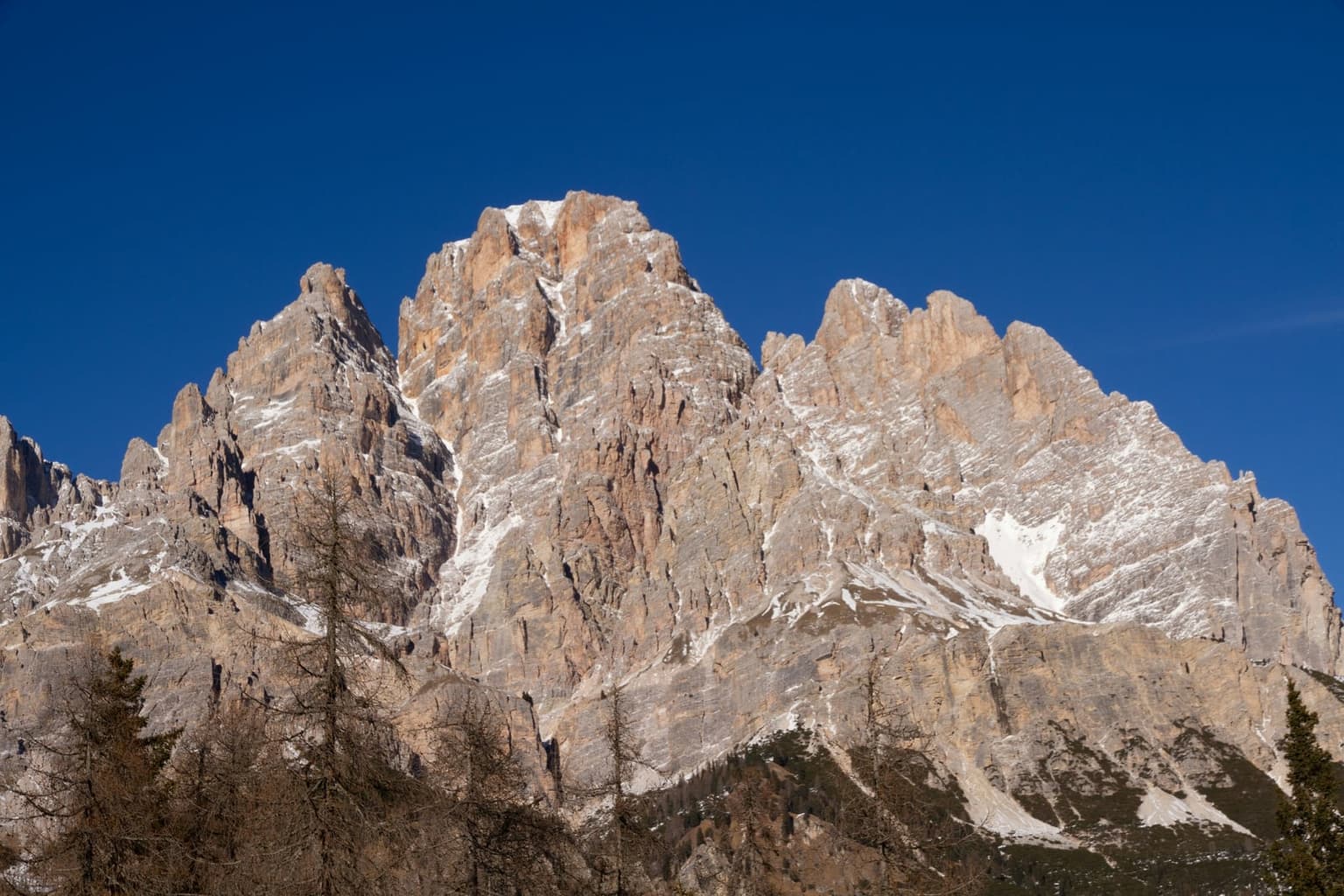
When I skied Faloria in February 2024, the sheer Cristallo walls glowed bright pink in the late light and loomed right over the runs. The snow was perfect and the slopes were empty, a long way from the crowded Sellaronda. The one drag was the uphill: the chairlifts were old and slow, and they wore me out.
For a first week on skis, Cortina's winter guide calls Pocol's gentle slopes perfect for anyone new to the sport. At Socrepes, a new 10-seat gondola replaced two chairlifts for the 2025-26 season, a ride of under four minutes. Children get their own start: Scuola Sci Cortina's beginner course, from age 4, meets at the Campo Scuola Baby at Socrepes, a short blue of 413 m. The next step up is the Tofanina from the table, "an easy slope" in the lift operator's words, at the top of the Piè Tofana chairlift. Adult lessons come in the next section.
Helmet, insurance, lessons and rental in Cortina
Since the 2025-26 season, everyone on Cortina's slopes must wear a helmet, "regardless of age or discipline": skiers and snowboarders, and anyone doing telemark, freestyle or sledding. And since January 1, 2022, third-party liability insurance has been mandatory to ski at Italian resorts. It's "not included in the ski pass," but you can buy it for a single day.
Many household policies already include this coverage, so ask your insurer first. If yours doesn't, the Val Gardena guide walks through the liability-insurance options and how to buy one online.
⚠️ Warning
Get third-party liability coverage in place before your first morning on the lifts, and check that it runs for every day you ski, not just the first.
Book early for Scuola Sci Cortina's 2026-27 high season, December 20 to January 9 and February 7 to March 6. A private "hour" there is 55 minutes: €80 in high season and €70 in low, each €10 less in the 14:00 - 16:00 slot, plus €20 per extra student. The school's adult group course, for ages 14 and up at all levels, runs Monday to Saturday, 10:00 - 12:50: six sessions for €550 in high season or €500 in low, rental, pass and insurance not included. At Scuola Sci Azzurra, a private hour is €85, €75 from 14:00 to 16:00, and group courses take students up to 18 only, so adults book privately. Socrepes Sport, at the start of the Tofana-Pocol lifts, is close to a meeting point of both schools; confirm yours when you book.
Scuola Sci Cortina's alpine ski lessons, with 2026-27 prices (scuolascicortina.com)
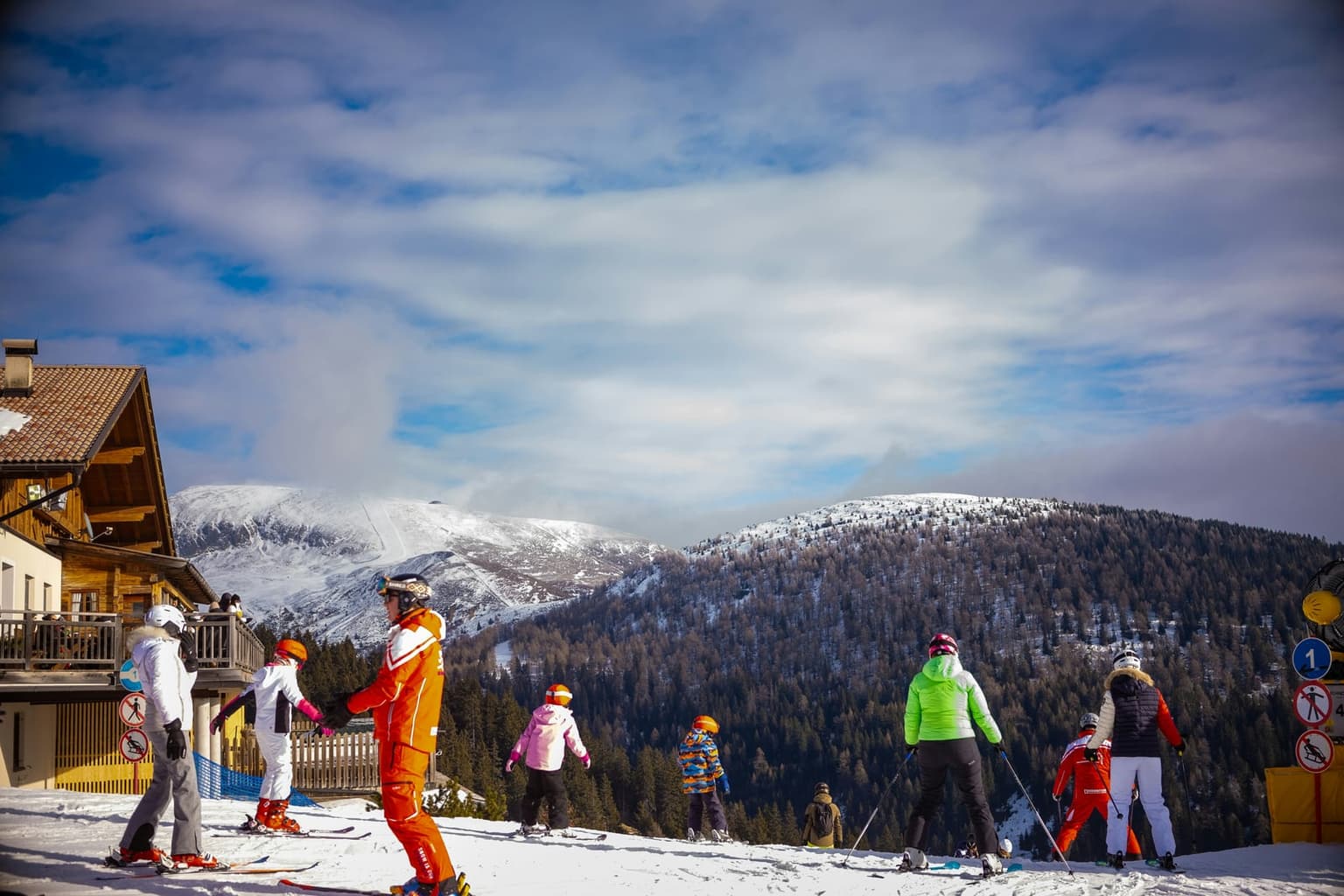
At Jgor Ski & More, 2026-27 rental for six days runs €161, €198 or €224 for skis and poles (intermediate, advanced or expert), €95 for boots and €40 for a helmet and liner, 5% less if you book online; storage is free for its customers. I'd rather not carry skis through town every morning: last season the ski room at the Freccia nel Cielo station, open daily 08:15 - 18:00, charged €51 for six days in a two-pair locker. Socrepes Sport has ventilated lockers too.
Jgor Ski & More's online rental booking (jgorskiandmore.com)
Getting to Cortina for a ski week without a car
A Cortina ski week works without a car, and I'd plan one that way. Sleep near a valley station or a ski-bus stop and you won't miss having one: for a mountain town, Cortina is well served by transit. From Venice, the Cortina Express coach runs to town (not to be confused with Dolomiti Bus, which runs the ski buses). If it gets you in before check-in, ask the hotel to hold your bags. The arrival routes from Venice, Milan and Innsbruck cover which airport to pick, the coach departures and winter driving.
If you drive anyway, Cortina's municipal pay lots charge from 09:00 to 20:00 between December 1 and April 30: the car keeps costing while you ski.
The door-to-door alternative is a private transfer from Venice Marco Polo. Book a fixed price for the whole car rather than per person, give the hotel's street address, not just "Cortina," and declare skis and boot bags up front, so the car that turns up has room for them.
FAQ
- Are Cortina's ski areas connected?
- Tofana, 5 Torri and Lagazuoi are, by the Cortina Skyline gondola. Faloria and Cristallo lie east of town; last season the S34 ski bus, free with your ski pass, linked the Tofana and Faloria lifts in the center.
- Can you ski from Cortina to Alta Badia?
- Yes, by the Armentarola, a one-way run from the Lagazuoi to a horse tow and the lift into Alta Badia; you return to Passo Falzarego by taxi or the paid ski bus from Armentarola. The Sellaronda from Falzarego is a Superski day.
- Is Cortina good for beginners?
- Yes: Pocol's gentle slopes for first-timers, then the Tofanina, an easy blue. For children, Scuola Sci Cortina's beginner course, from age 4, meets at the Campo Scuola Baby at Socrepes.
- Do I need Dolomiti Superski or the Cortina pass?
- For a week on Cortina's own slopes, the Cortina pass is enough: it covers the whole Cortina area, Skyline and Lagazuoi down to Armentarola included, plus San Vito and Auronzo-Misurina. The Sellaronda needs Dolomiti Superski.
- Is skiing in Cortina better than Val Gardena?
- Cortina, if you want the Olympia delle Tofane and Faloria-Cristallo's technical slopes, popular with expert skiers, on two mountains with the town between them; last season a ski bus linked their valley stations. Val Gardena is a fair answer too; the base decides the week, so choose the ski area before the hotel.
Pick your side of town, ski one mountain a day, and plan the Armentarola's way back before you go up, not at Sas Dlacia at 16:00.