George Mandrovny
Is Lecce worth visiting? Stay past dark, at least one night
- Give Lecce at least one night. The baroque old town is the draw, and its best hour is the evening, when the center fills up and stays lively late.
- The trap: a long midday break. A day trip sees the old town at its quietest and leaves before the evening. Start early, eat lunch before the break, and stay past dark.
- From Bari Centrale, the train takes about 1 hour 20 minutes to 2 hours, depending on the train; from Brindisi airport, the SITA bus takes 40 minutes.
- Without a car, Gallipoli is a direct train on FS Sud Est, the local railway, and Otranto a train plus a bus on working days. On FS Sud Est, Leuca is not a day trip, since nothing comes back the same day.
Lecce, Puglia, is a baroque city of about 95,000 people, and yes, it is worth the trip, as long as the trip includes a night. A day trip gets the quiet half of Lecce's day and leaves just as the good half begins.
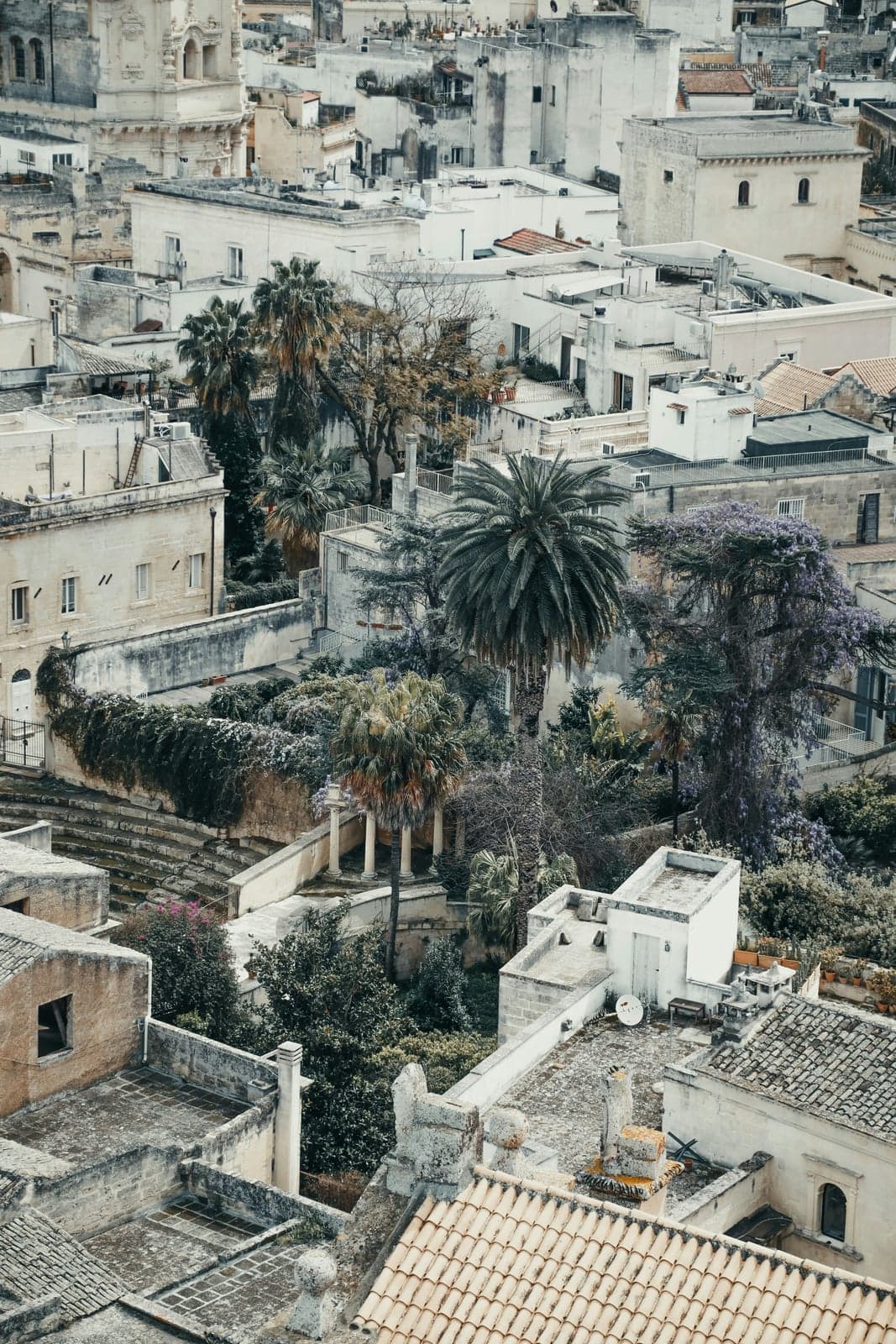
The yes first. For art, food, and history, Lecce is the pick over Bari, and it doesn't feel overrun by international tourists. It is lovely to look at and easy to take in. Now the honest no: it is small, and with this much baroque elsewhere in the region, it can feel less special once you have seen the other towns. Seen by day alone, it can also underwhelm, and that one is fixable.
For the city alone, one night is the minimum, and more is better. As a base for the Salento, Puglia's far south, add a night for each day trip you plan. From Monopoli, up the coast, Lecce is rather far for a day trip, so split the trip into two bases: a few nights there for the things to do in Monopoli, and the rest here.
Sleep in the old town or a short walk from it, so the aperitivo, the pre-dinner drink, is a stroll down the street and not an outing. Get a room with A/C. With a car, ask about parking before you book.
Filter the listing by the walk to the old town and by A/C; a room far out turns every evening into a commute.
The baroque old town: Santa Croce, Piazza del Duomo, and one church ticket
The best things to do in Lecce, Italy, start with the old town itself: streets of pale local stone in the 17th-century style the city calls Lecce Baroque, with the Basilica di Santa Croce at its heart and Piazza del Duomo as the other set piece. The baroque here isn't one church to check off; it's the whole old town, street after street.
The main churches share one ticket, the LeccEcclesiae circuit, valid for 15 days: the cathedral and the Antico Seminario, with its cloister and sacred art museum, plus San Matteo, Santa Chiara, and Santa Croce. Buy it online, at the central ticket office inside the Antico Seminario (Piazza del Duomo 5), or at Santa Croce. The facades cost nothing to look at; going inside takes the ticket. Check prices and hours on the circuit's site.
The circuit's hours and ticket prices (chieselecce.it)
Between churches, the plan is barely a plan. Come in through Porta Napoli, the triumphal-arch gate that leads straight into the historic center, then walk slowly and let the streets pick the route. Somewhere around the third baroque facade, the city's nickname, the Florence of the South, stops sounding like a slogan.
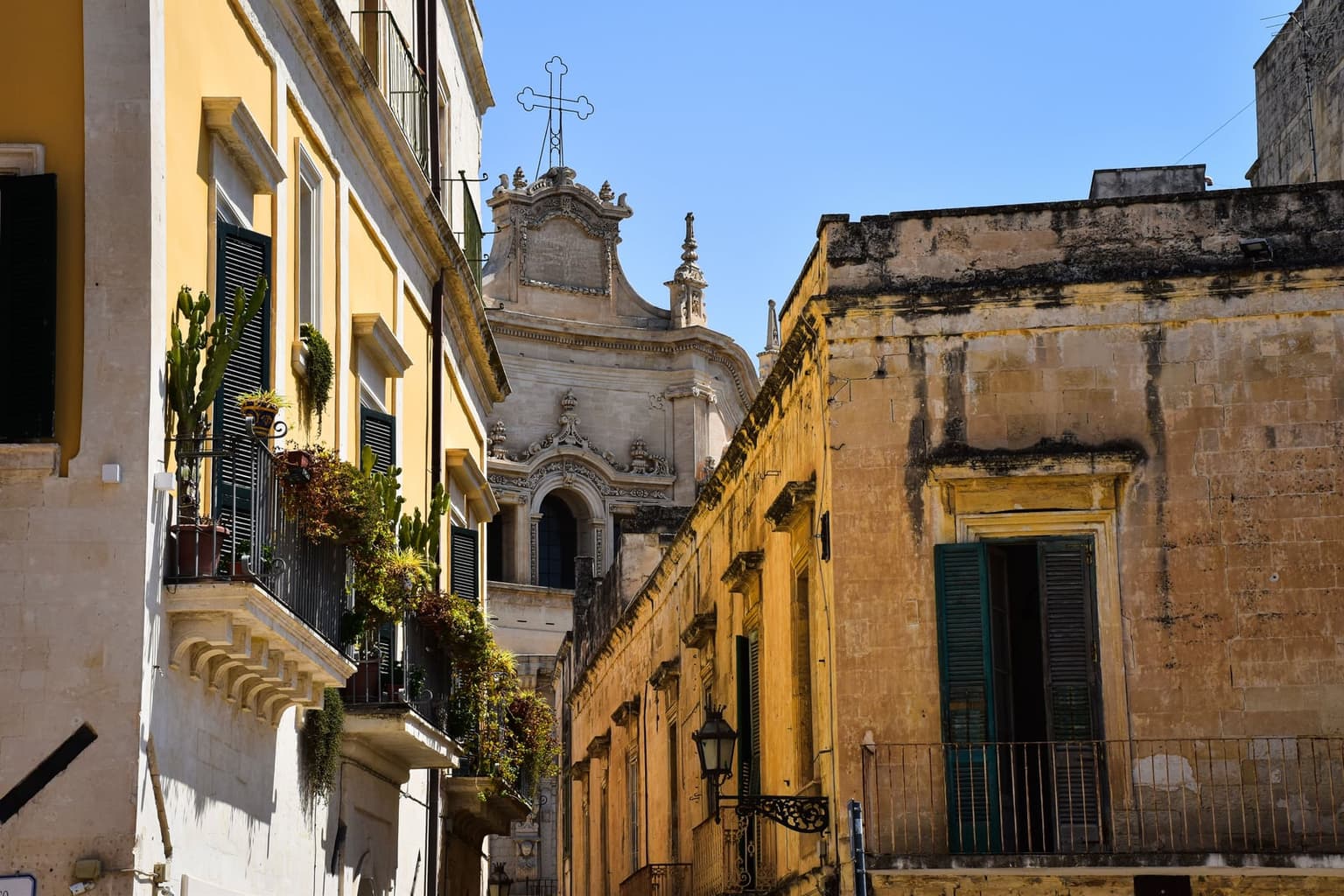
Santa Croce is the most significant example of Lecce Baroque. Its foundation stone was laid in 1353 by Gualtieri VI of Brienne, Count of Lecce; its architects and artists include Gabriele Riccardi, Francesco Antonio Zimbalo, and Giuseppe Zimbalo, and it became a basilica only in the early 20th century, under Pope Pius X. Beside it stands the Palazzo dei Celestini, the former convent, now the seat of the Province and the Prefecture. Stand in front of the church and look up: the rose window first, then the inlays on the tympanum and the balcony, with sculpture crowding the facade between them. Your neck gives out well before the facade does.
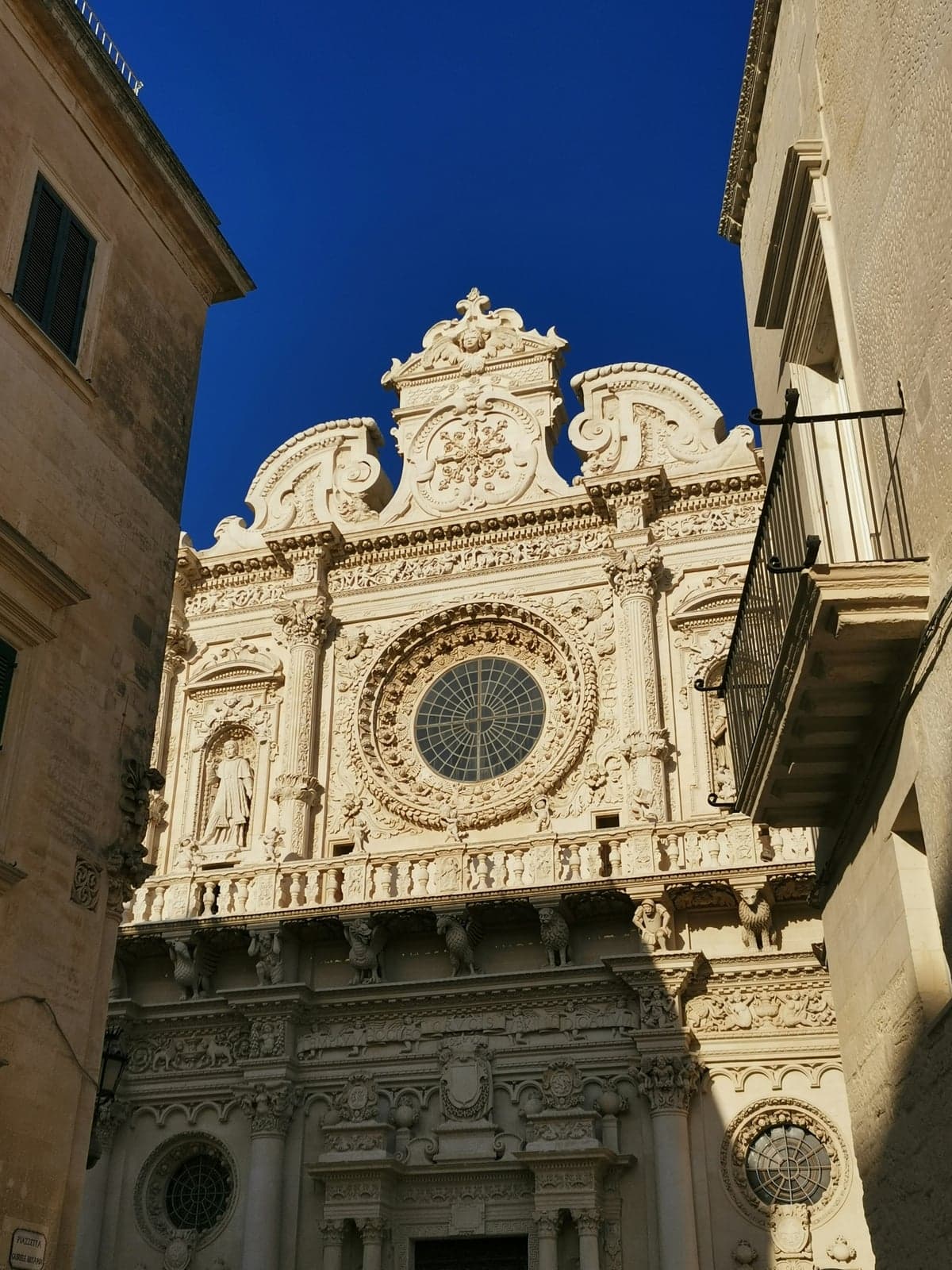
On Piazza del Duomo, the cathedral comes with a bell tower and two facades, one very sober and the other richly decorated, as if the building couldn't decide and kept both. See it by day, then come back at sunset and again after dark; by day you've seen only half of it.
Beyond the churches: the Roman amphitheater, Museo Faggiano, and the castle
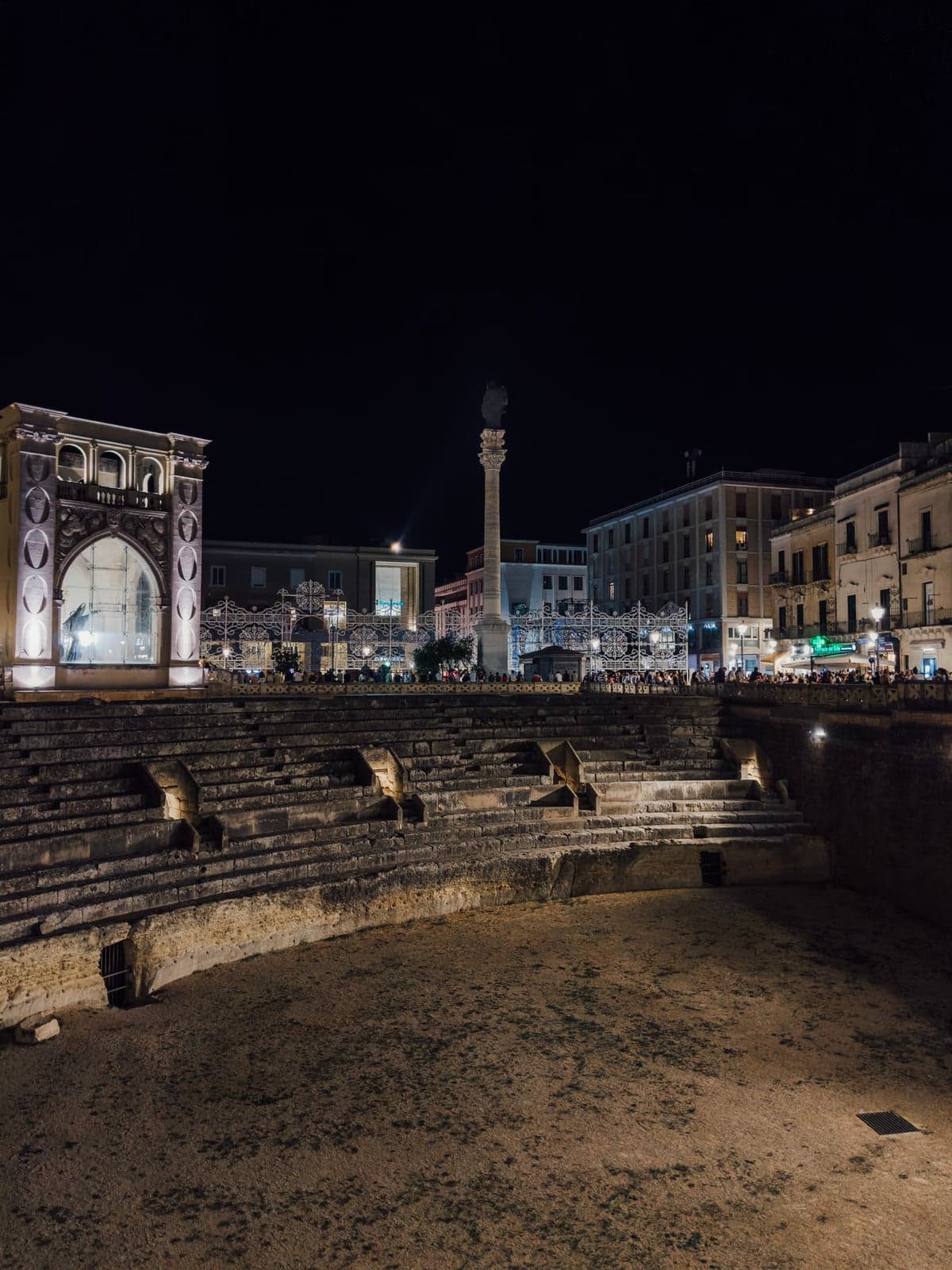
Lecce's Roman amphitheater lies in Piazza Sant'Oronzo, the main square, and you look down on it from street level: about a third of it is visible. The baroque gets the attention, but the older Roman layer fills the south half of the square, which is a lot of square for a footnote.
The rest of it lies under the square and the buildings facing it. It probably dates from the age of Augustus, it held 12,000 to 14,000 people, and the digging that unearthed it began in 1900. The column of Sant'Oronzo, 29 meters high, stands in the same square. Check the current hours before you go.
The amphitheater's hours and tickets, on the Ministry of Culture's page (cultura.gov.it, in Italian)
Monday is the wrong day for two of the three paid sights below: the amphitheater is closed to visitors on Mondays, and the castle opens only Tuesday to Sunday.
| Sight | Full ticket | Open | When and how |
|---|---|---|---|
| Roman amphitheater | €5 | Tuesday - Sunday | summer 15:00 - 21:00, winter 10:00 - 17:00 |
| Castello Carlo V | €10 | Tuesday - Sunday | guided tour only, about 50 minutes, at fixed times |
| Museo Faggiano | €5, as listed | daily, as listed | 09:30 - 20:00, as listed |
The surprise of the old town is Museo Faggiano, a private house-museum at Via Ascanio Grandi 56. In 2001 its owner, Luciano Faggiano, broke up the floors to change the sewer pipes and found far more than pipes: a floor he dates as probably Messapian (5th century BC), a medieval grain silo, and a 15th- or 16th-century cistern. By his account, the house was once a convent of nuns. Few plumbing jobs end as a museum. Check its site before you go.
Museo Faggiano's prices and opening hours (museofaggiano.it)
Castello Carlo V, Charles V's 16th-century castle, opens only to guided tours, and there are afternoon tours too. Inside is the Cartapesta Museum, devoted to papier-mâché (cartapesta), a traditional Lecce art. Papier-mâché is also one of the city's crafts to take home, along with wrought iron, terracotta, and the pale local stone. Of the four, the stone and the iron are the two to weigh before you pack.
Castello Carlo V's tour times and online tickets (ilcastellodilecce.it, in Italian)
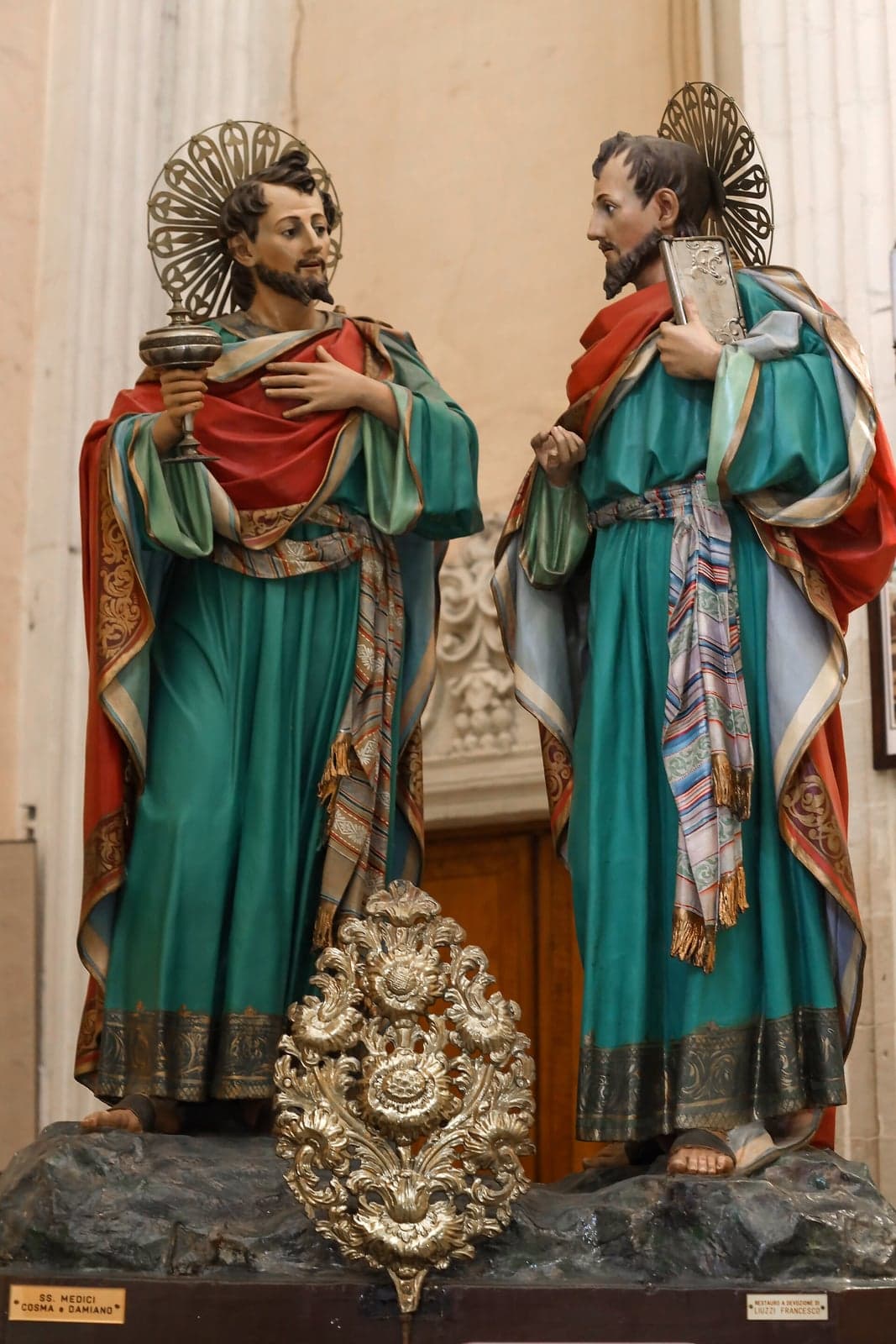
After the museum in the castle, I looked into one of the old workshops on Via Vittorio Emanuele II. The room smelled of glue and old paper, and the maker was pressing the folds of a statue's robes into shape with red-hot irons while I watched. The big saints are too fragile for a suitcase, so I came home with a small peasant figure for a nativity scene: almost weightless, and surprisingly hard to the touch.
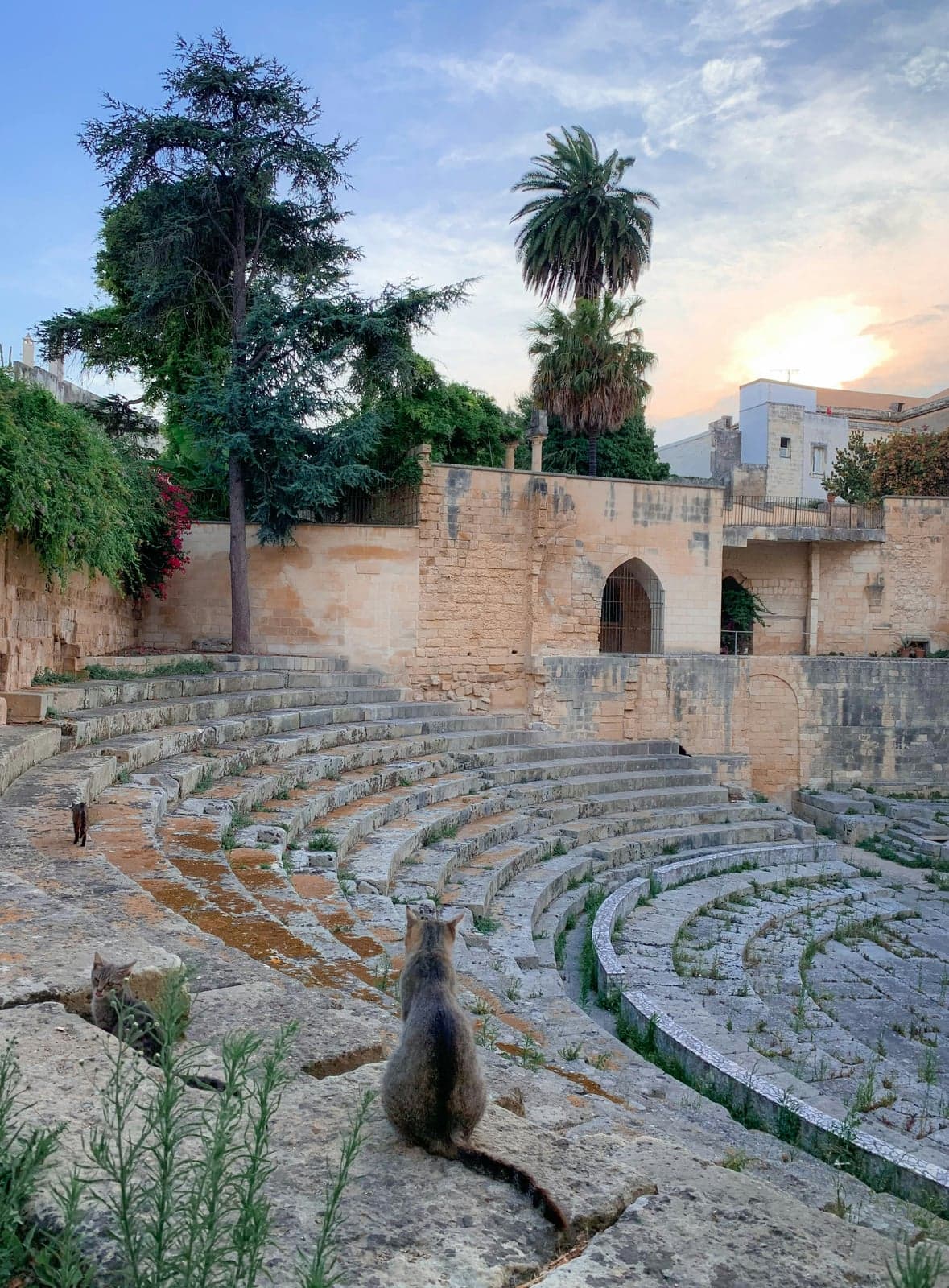
A second Roman site, the theater, is small and once staged tragedies and comedies; it is worth a look after the amphitheater has you hooked.
What to eat in Lecce: the pasticciotto, the rustico, and dinner
In Lecce, learn two local pastries by name. The pasticciotto, shortcrust pastry filled with custard, is the sweet one; the rustico, puff pastry filled with béchamel, mozzarella, and tomato sauce, is the savory one you eat standing up. Dinner here, picked with care, can be the meal of the trip.
Only a few cafes in town make the traditional pasticciotto, the heavy kind, so a good one takes some looking, which in this town is no hardship. For pasticciotti and taralli to take home (taralli are Puglia's ring-shaped snacks, sweet or savory), find a local grocery store, not a souvenir or specialty shop: the quality is fine, and the price is lower.
For the benchmark pasticciotto, I send everyone to Natale Pasticceria, on Via Trinchese just off Piazza Sant'Oronzo, or to the historic Caffè Alvino, on the square facing the amphitheater. I had mine standing at the counter for breakfast, still warm from the oven, with the Lecce iced coffee: espresso over ice with latte di mandorla, a sweet almond syrup. The crumbly shortcrust, with a hint of lard, cracked at the first bite, and inside was a lot of thick, hot custard.
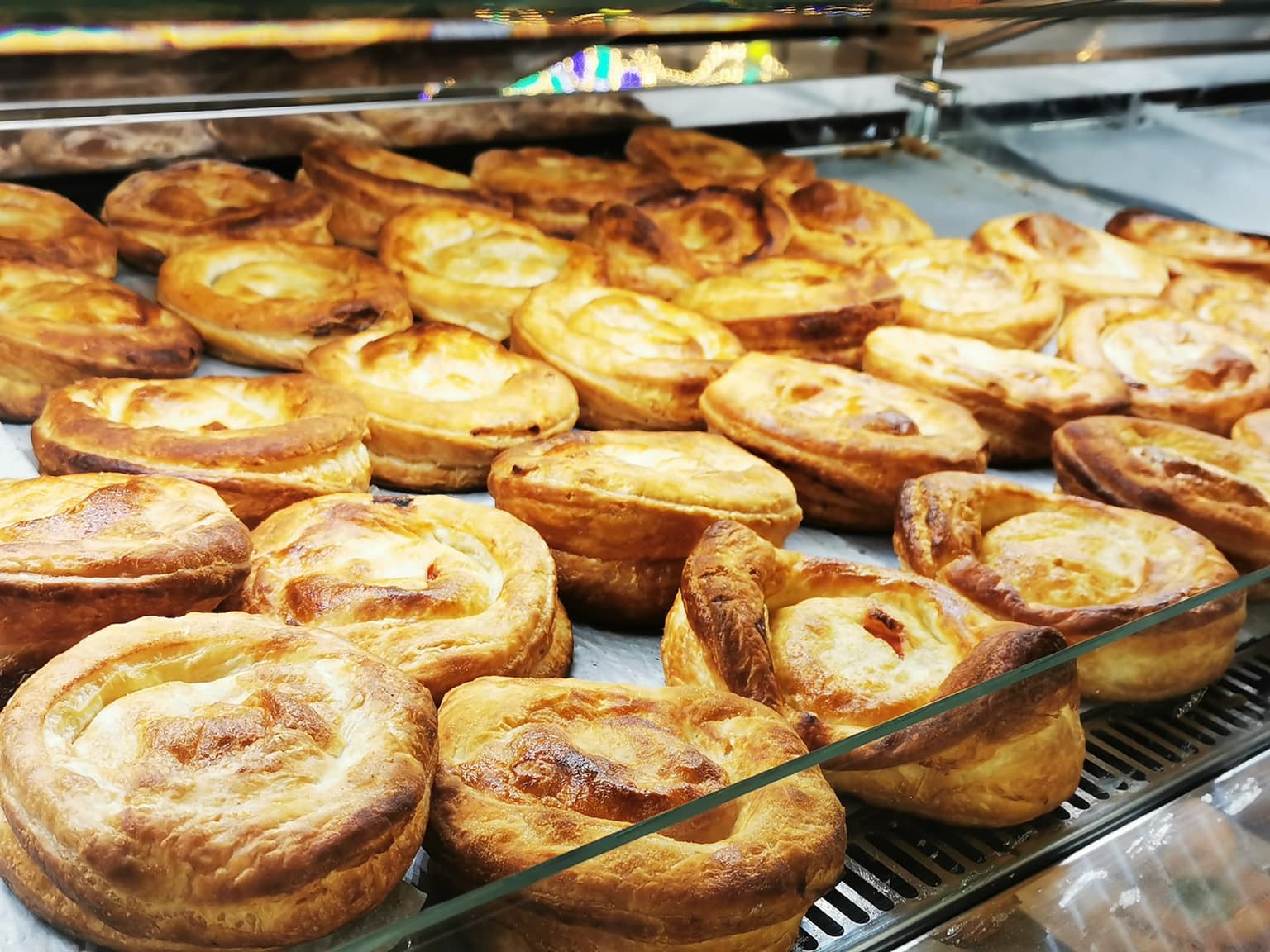
The rustico has gone up in price: about €2.50 in the old town on average, in a recent survey by the consumer group Adoc Lecce, reported in May 2026. The group worries that you can't tell a frozen, reheated rustico from a fresh one. Buy rustici where you can see them come out of the oven.
Finding the best restaurants in Lecce, Puglia, starts with choosing carefully: in the Salento, the meals that disappoint tend to be the expensive ones on the seafront. I ate well at two places. Trattoria Le Zie, just outside the center on Via Costadura, cooks like a home kitchen and needs a booking; order the ciceri e tria, pasta with chickpeas, part of the pasta fried crisp in oil. Alle due Corti, a traditional Salento restaurant at Corte dei Giugni 1, felt honest, noisy, and cozy, a family place with no tourist airs and quick service; the dish there is the orecchiette with spicy meatballs and ricotta forte, a sharp, fermented ricotta. Its site lists it as closed on Sundays, so check before you go.
The long midday break is the natural slot for a cooking class, which turns the quietest hours of Lecce's day into useful ones. Look for a small group, local dishes made by hand, and an afternoon start; the price and the length are on the listing.
Lecce's quiet afternoon, and the evening that pays for it
Lecce's old town takes a long break in the middle of the day: expect shops and cafes to close from early afternoon until evening, and the streets to empty out. Then the center fills up again and stays busy well into the night. The town works a split shift, and the evening shift is the one worth staying for.
Eat lunch before the break starts: in the dead hours food gets hard to find, gelato included. Not every afternoon is that empty, and on a busy day the center stays full right through. Either way, the paid sights in the table above all list afternoon hours, so the break suits the amphitheater, a castle tour, or Museo Faggiano. The pausa, as the midday break is called, is a Puglia habit, not a Lecce quirk.
On a day trip, stay at least until dinner, and know that dinner here starts late. If the timetable forces a trade, give up the morning, never the evening. The last regional train back to Bari Centrale leaves at 21:17 on weekdays, 21:53 on weekends and public holidays: know that before you sit down, not when the check arrives.
The evening starts with the passeggiata, the slow stroll before dinner, with an aperitivo somewhere along the way; the old town has no shortage of bars to break it up. Aim the stroll at Piazza del Duomo for sunset. Then dinner, and on a busy night a table can be hard to find, so book ahead.
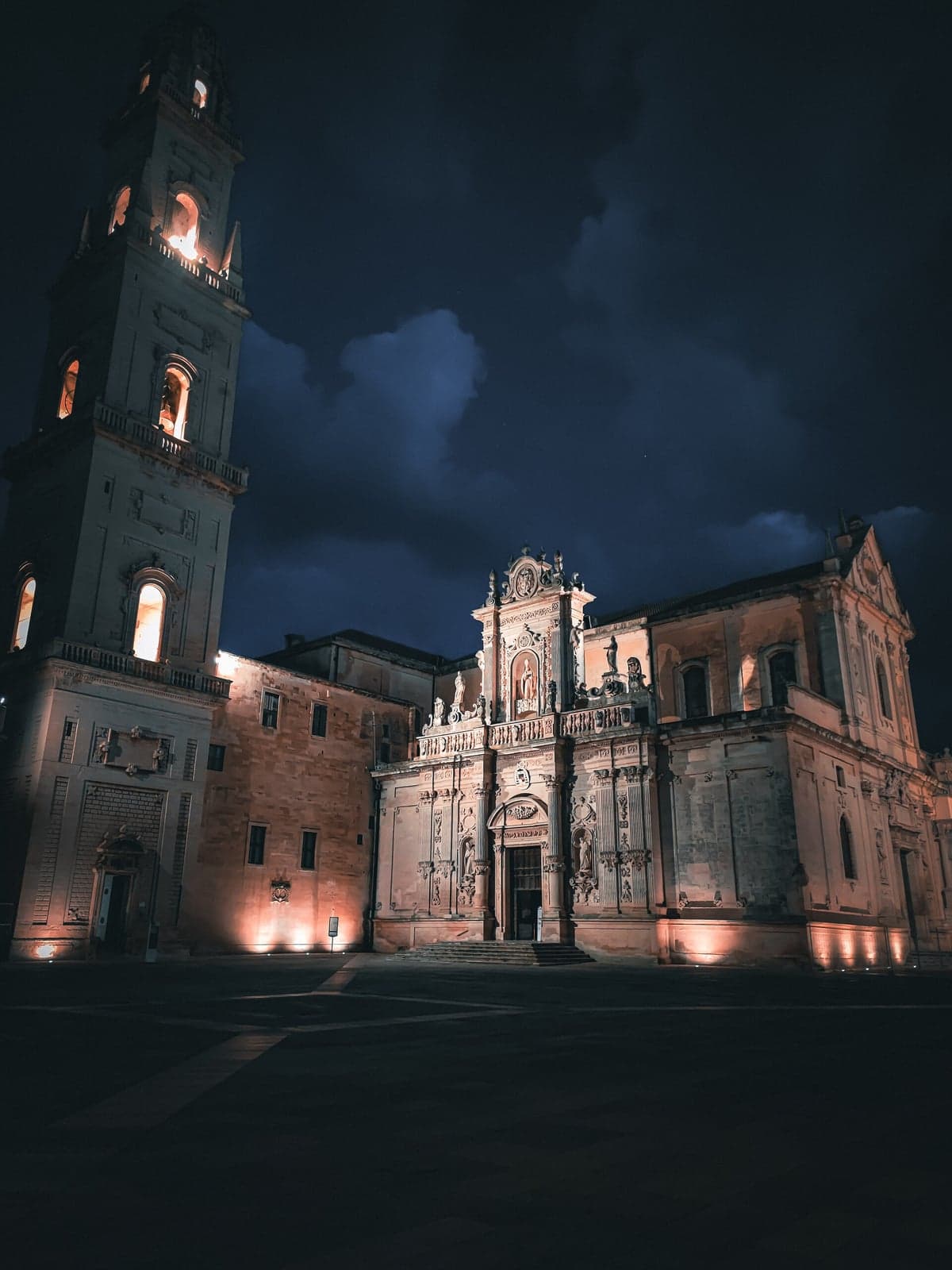
After dark Piazza del Duomo is lit, and the pale stone holds the light: the cathedral's richer facade and the bell tower above it stand out against the night sky, and the carving you looked up at by day turns to light and shadow. Back in the streets, the old town is full. Voices carry off the stone, the bars are busy, the stroll is still going, and nobody seems in a hurry to go home. It stays that way very late.
This is what the night buys. A day trip catches the start of it over dinner and spends the rest on the train back.
Day trips from Lecce: Gallipoli, Otranto, and Leuca
Without a car, Gallipoli and Otranto are day trips on FS Sud Est: Gallipoli is a direct train, and Otranto a train to Maglie plus a bus on working days. Out for the day, back for Lecce's evening: that is what the base is for.
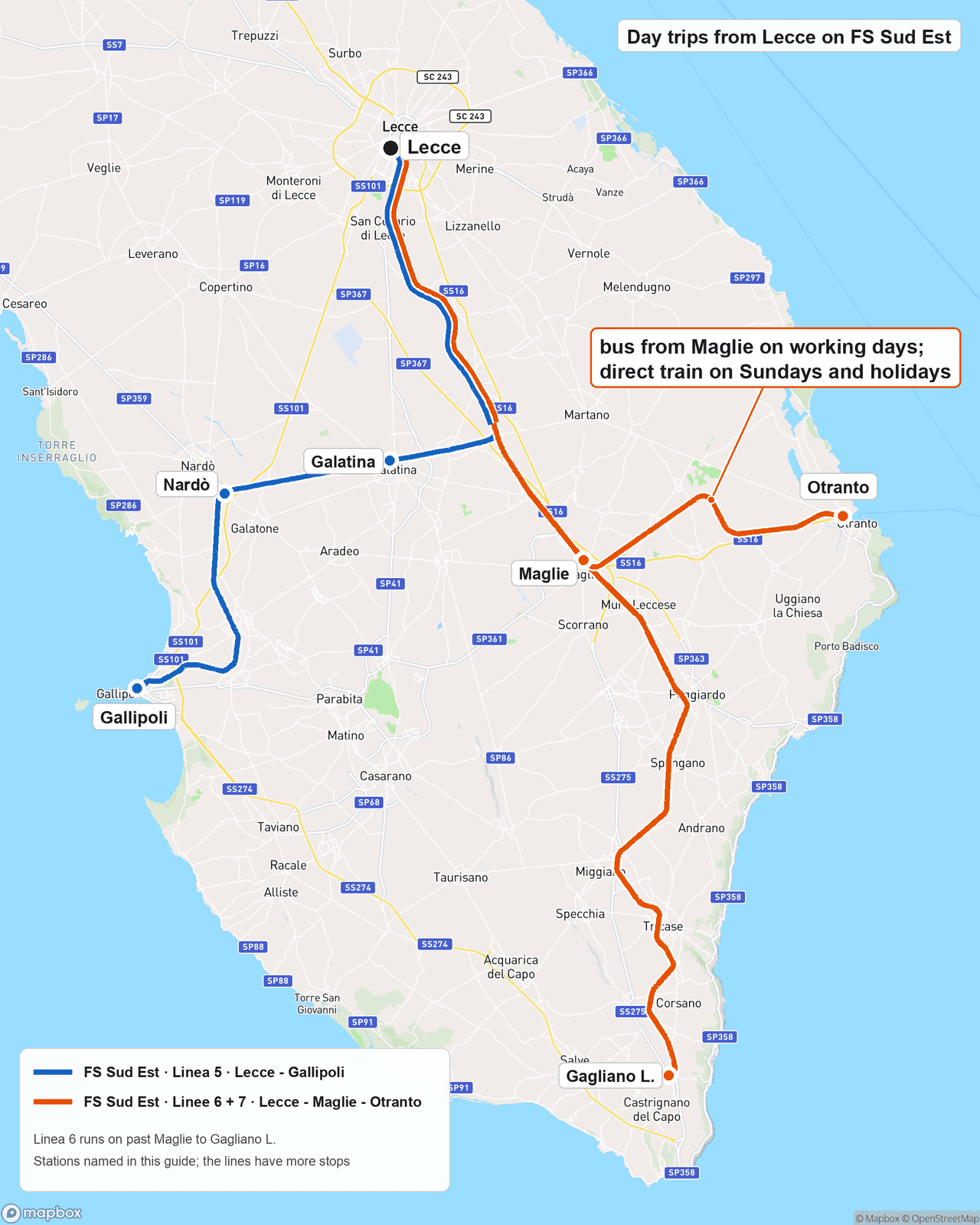
The railway is thin, so check the day's runs before you plan anything around them, and check twice on a Sunday, when even thin gets thinner.
FS Sud Est's timetables: Linea 5 for Gallipoli, Linea 6 e 7 for Otranto (fssudest.it, in Italian)
| Day trip | How | Time from Lecce | Runs |
|---|---|---|---|
| Gallipoli | direct train, Linea 5 | about 1 h 40 - 2 h (working days) | 8 each way on working days, 2 on Sundays and holidays |
| Galatina, Nardò | stops on the Gallipoli line | Galatina 49 - 57 min, Nardò 1 h 6 - 13 min (working days) | the Gallipoli trains |
| Otranto | train to Maglie, then bus (working days); direct train (Sundays and holidays) | with the bus, about 1 h 35 min on the 6:54 or 10:40 train, which meets the bus at Maglie; up to about 2 h 50 on other connections (working days); direct, about 1 h 25 min (Sundays and holidays) | 2 direct each way on Sundays and holidays |
Galatina and Nardò make good stops on the way. On working days, the last train all the way back to Lecce leaves Gallipoli at 20:14; on Sundays and holidays, the day is 12:02 out and 18:32 back.
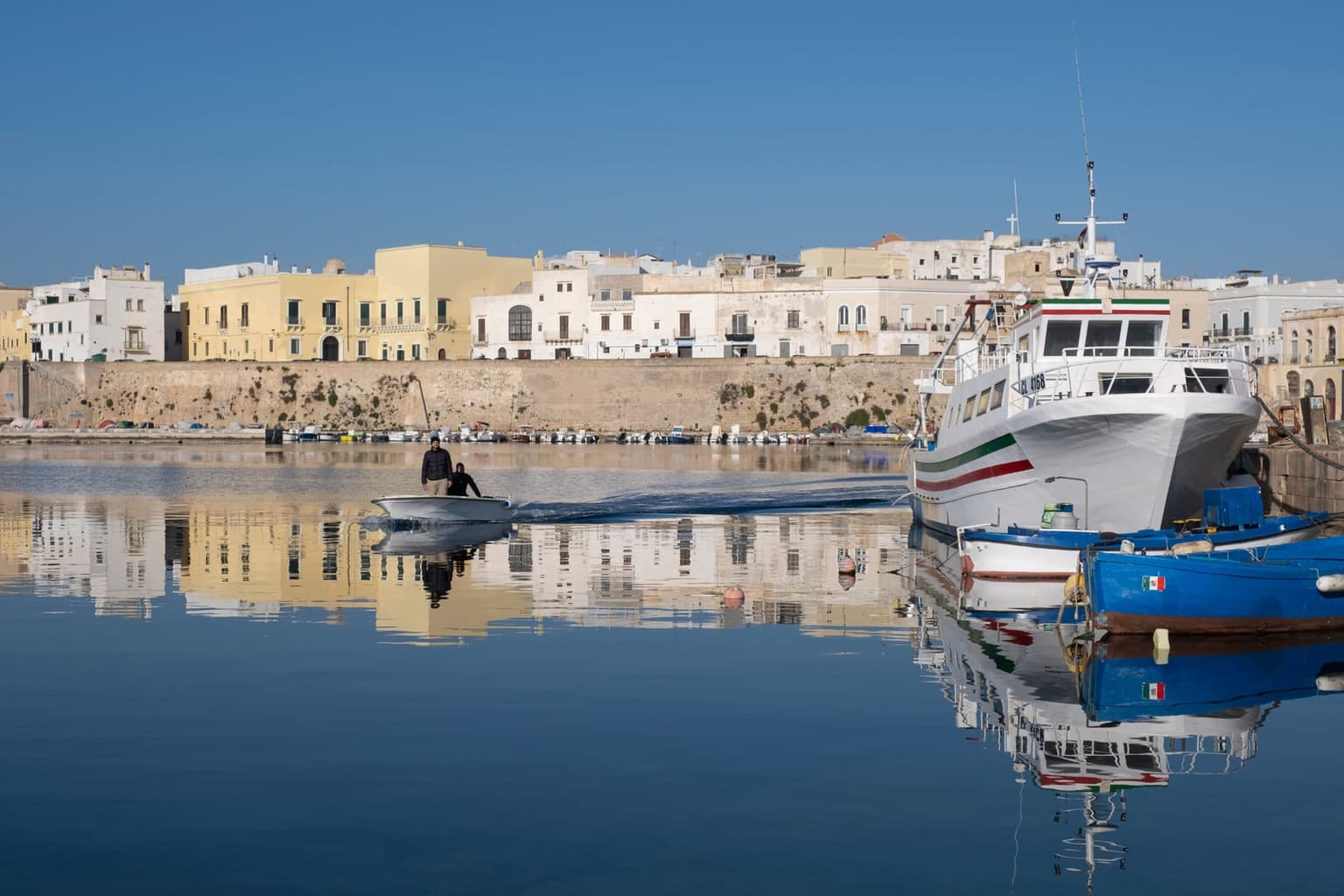
Otranto is the seaside pick of the two: a fortified town on the coast, with a lovely shoreline around it. On Sundays and holidays, the direct trains do the work: out at 10:30, back at 13:30 or 20:02.
Santa Maria di Leuca is the Salento's southernmost point: a lighthouse, the basilica "at the ends of the earth," and the headland between the Adriatic and the Ionian. On FS Sud Est it is not a day trip: the operator gets you there on school days, arriving mid-afternoon, but its only buses out of Leuca leave at 06:15 and 06:25, and nothing runs to Leuca on Sundays and holidays. Plan it as a drive, and stay for the sunset from the lighthouse hill.
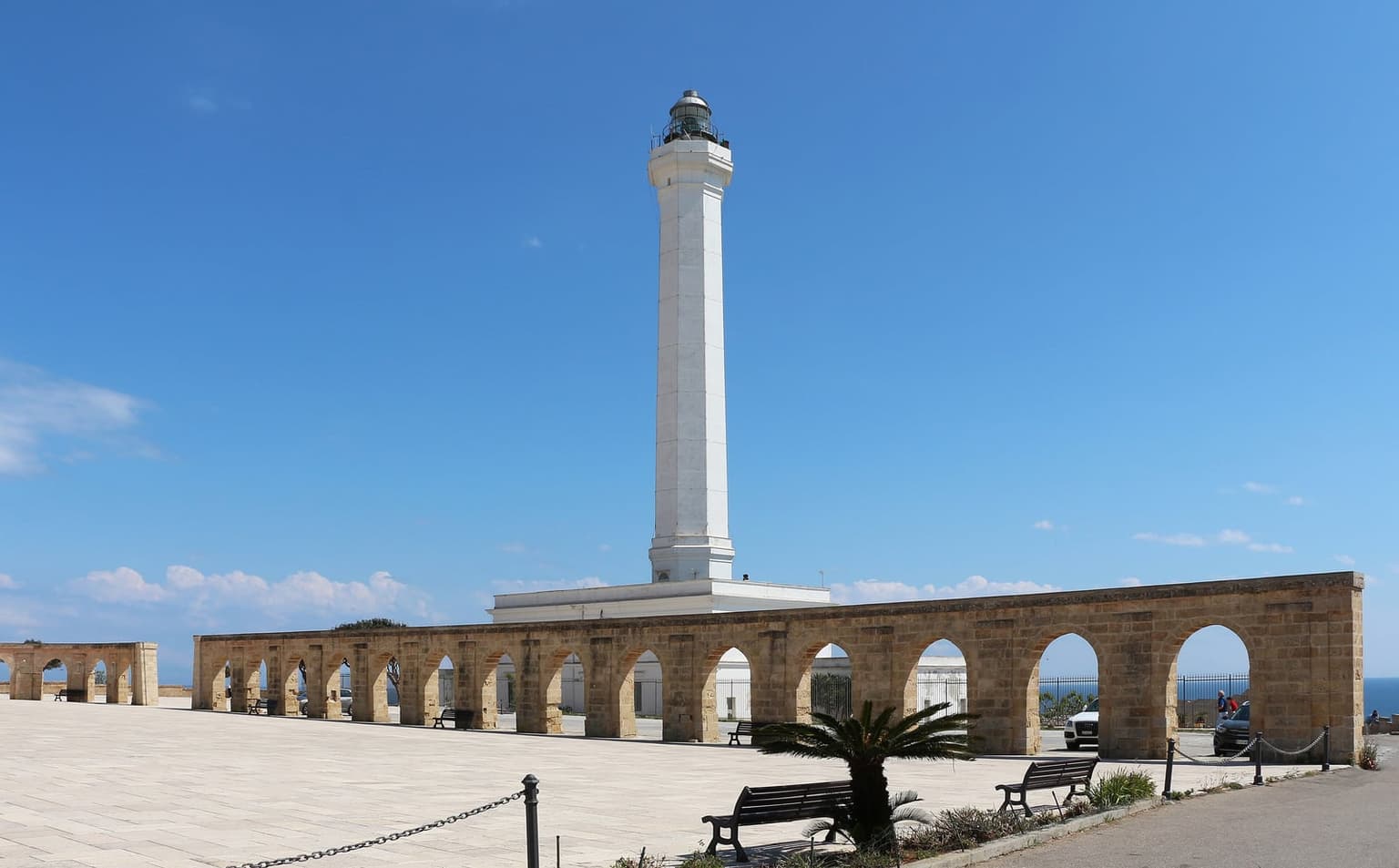
The Salento's beaches, on both coasts, make a day out from Lecce too, and which Salento beach suits the day is a question of its own.
In Lecce itself you won't need a car. For Leuca and the coast on your own schedule, rent one for those days only: pick it up at the airport the day you set out for them, not the day you land. Brindisi airport is the close one, 40 minutes from Lecce on SITA's airport bus.
Compare rental cars at Brindisi airport
Pick it up the day you set out for Leuca and the coast
Getting to Lecce: the train from Bari, the bus from Brindisi airport
The Bari to Lecce train runs 150 km to the end of the line, about 1 hour 20 minutes to 2 hours depending on the train, and from Brindisi airport SITA Sud's bus reaches Lecce in 40 minutes. As the last stop, Lecce spares you the usual worry about missing yours; the real trap is where the airport bus ends.
Which train you catch decides the time, and some need a reservation, so book before you board. The table is a late-afternoon sample from the timetable, not the whole day; trains reach Lecce right through the day.
Trenitalia's own journey search, Bari Centrale to Lecce on your date (trenitalia.com)
| Train | Bari Centrale to Lecce | Note |
|---|---|---|
| Frecciarossa | 1 h 21 min | Trenitalia's high-speed train; reservation required |
| Apulia Express | 1 h 27 min | reservation required, guaranteed seat; stops at Monopoli, Ostuni, Brindisi |
| Regionale Veloce | 1 h 41 - 43 min | the "fast regional"; sampled runs Monday - Friday, some with a reservation |
| Regionale | about 1 h 53 min - 2 h 3 min | the stopping train; sampled runs on Saturdays, two also on Sundays and public holidays, one with a reservation |
Flying into Bari, first get to Bari Centrale on the airport train; coming from Rome, the train beats driving the whole way down. In Lecce, the station is about 1.2 km from Piazza Sant'Oronzo, about 15 minutes on foot.
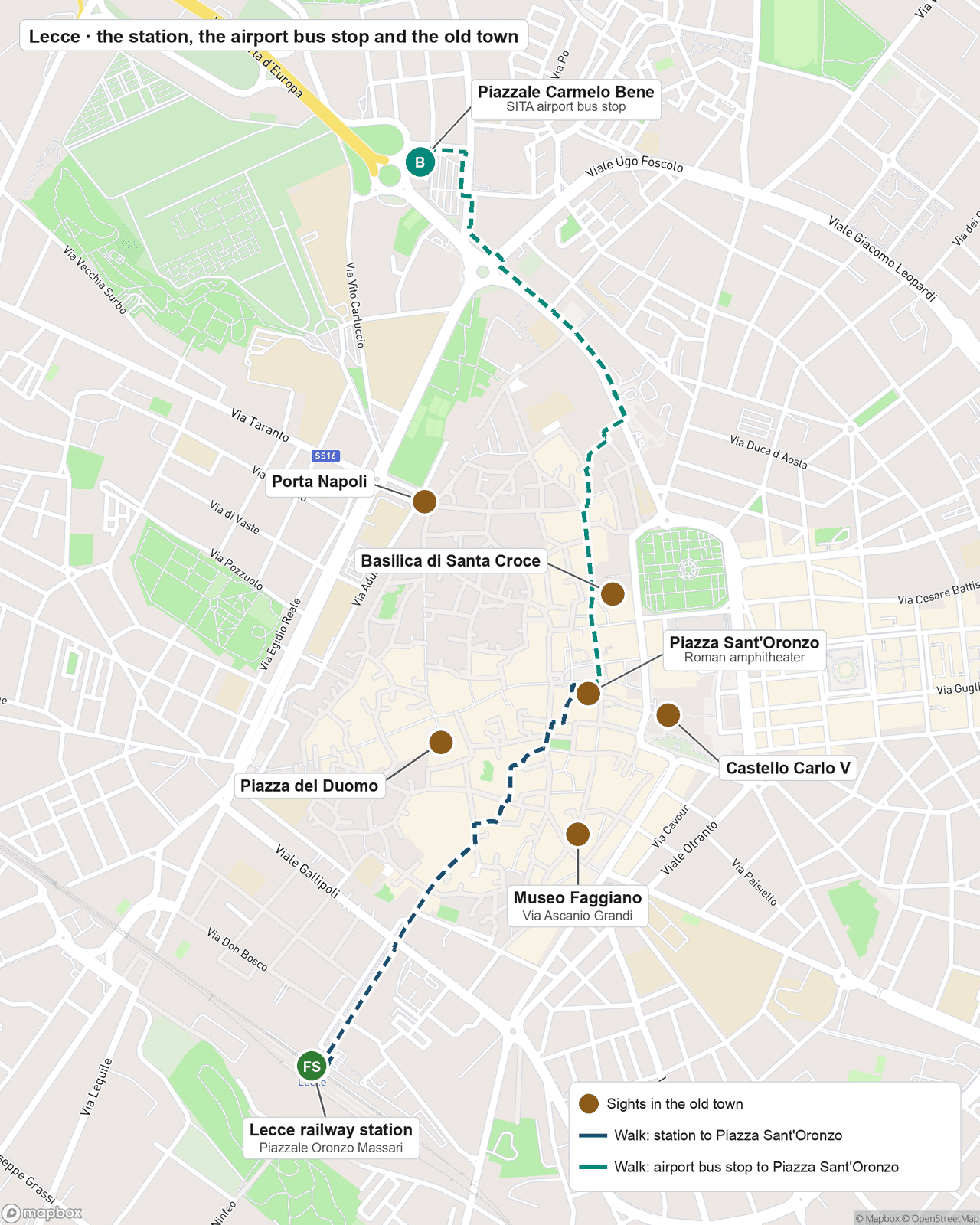
From Brindisi airport to Lecce, take line 793: nine runs a day each way on the posted timetable, the last leaving the airport at 23:40. Buy the €6.50 ticket before boarding, at the airport's Relay shop or online from Marozzi or Cotrap; on board it costs €1.50 more. On Sundays and public holidays, S.E.A.T. runs the line instead. The timetable can change with flights, so check your run exists before you fly.
SITA Sud's line 793 page, with the current timetable (sitasudtrasporti.it, in Italian)
⚠️ Warning
The airport bus ends at Piazzale Carmelo Bene (ex Foro Boario), not at Lecce's railway station. From there, Piazza Sant'Oronzo is about 20 minutes on foot.
Landing after the last bus, or facing the train chain from Bari airport with heavy bags? A pre-booked transfer to your hotel is the simpler option. Add your flight number when you book, so the driver can follow a late landing; the fare is fixed at checkout, tolls included.
Pre-book a transfer from Bari airport to Lecce
Straight to your hotel, at a fare fixed when you book
Driving in, leave the car in one of the lots just outside the historic center and walk in; ask your hotel which lot is nearest.
When to go to Lecce: September, and the quiet months
The best time to visit Lecce, Puglia, is September: the summer warmth hangs on, and the August beach crowds have left. The old town works in any month; what the calendar changes is the sea, the heat, and the company.
March is quiet in the small towns around Lecce. In April, the sea may still be too cold to enjoy, which matters only if the beaches are part of the plan.
Winter around Lecce tends to be clear and sunny, with the occasional cold, windy spell, and hardly any tourists; bring a jacket and take your time. Some businesses close for the season, but Puglia's cities don't shut down.
July and August are the hot months: see the old town in the morning and the evening, and give the middle of the day to the shade, which Lecce's split day makes easy.
I was in Lecce at the end of July, and the midday heat was hard going: the pale stone throws the sun back from every side, and by 14:00 the narrow streets were an oven. From about noon to 17:00 the old town emptied out. I rebuilt the day around it: out walking at 7:00 while it was cool, back to an air-conditioned room or off to the sea at midday, and into town again after 18:00, when the heat broke and the streets filled up.
Lecce FAQ
- Is Lecce worth visiting, and how many days do you need?
- Yes, for the baroque old town. Give it at least one night, since the evening is its best hour, and a night more for each Salento day trip.
- Can you do Lecce as a day trip from Bari?
- Yes, by train from Bari Centrale in about 1 hour 20 minutes to 2 hours, depending on the train. Stay at least until dinner and check the last train back; a night is better.
- What closes in the afternoon in Lecce?
- The old town takes a long midday break: expect many shops and cafes to close from early afternoon until the evening. The amphitheater, the castle tours, and Museo Faggiano (as listed on its site) keep afternoon hours.
- Can you see Gallipoli, Otranto, and Leuca from Lecce without a car?
- Gallipoli and Otranto, yes: Gallipoli by a direct FS Sud Est train, Otranto by a train to Maglie plus a bus on working days, or a direct train on Sundays and holidays. Leuca is not a day trip on FS Sud Est: the operator gets you there on school days only, and nothing comes back the same day.