George Mandrovny
Italy packing list: one bag you can lift
- The bag: one you can lift onto a train rack yourself and carry up stairs; a big suitcase stays home or in storage.
- Church days: cover shoulders and knees, with a light scarf for the shoulders. The Vatican, St. Mark's, Florence's cathedral and the Milan Duomo all bar bare shoulders; St. Mark's asks for knees covered, and the Milan Duomo bars shorts.
- Papers: a passport valid at least 3 months after you leave the EU and issued within the last 10 years; expect fingerprints and a facial image at the border. Drivers carry an International Driving Permit (or an official translation into Italian) with their US license.
- Money: by law, shops must take at least one debit and one credit card unless that is objectively technically impossible, so bring a second card of another brand and some cash in small bills.
A packing list for Italy starts with the bag, not the outfits: you lift it onto every train rack yourself and carry it up cobbled lanes and stairs, so pack one bag you can lift alone. The rest is a short list of what a church door, a border and a security line will check.
High-speed racks take a carry-on easily, even a fairly large suitcase if you can lift it overhead; a heavy one is a two-person job. Italo spells out its limits: medium bags go only in the overhead racks (at most 53 cm high and 42 cm deep), Smart Class takes luggage up to 75 x 53 x 30 cm at no extra cost, and large luggage has designated racks for Prima Business and Club Executive passengers. On a regional train, don't count on room for a large bag between the cars, least of all if you board mid-route. A soft-sided bag squeezes in where a hard shell won't; a cable lock to the rack ends the guard duty.
Spinner suitcases are the worst thing to drag over cobblestones; a backpack with wheels rolls where the street allows and rides on your back where it doesn't. Which is why the large suitcase, so sensible on the bed at home, is the bag to leave there.
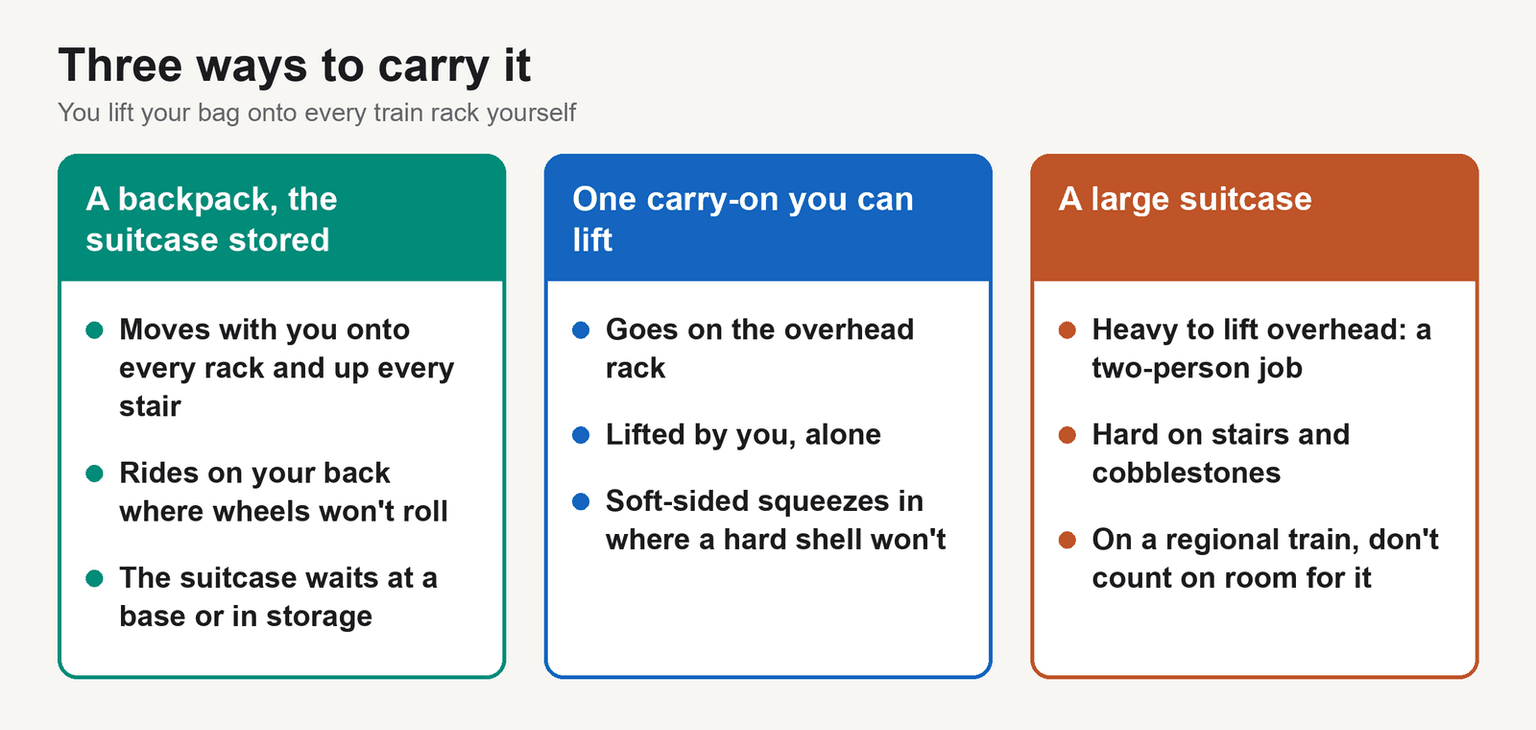
I try to leave my main luggage stored somewhere and move around with a backpack: the essentials, plus accessories that might come in handy. Suitcases anchor you. When I do bring one, it is packed for specific trips and works as a base: I swap things in and out of it, and the backpack does the moving.
For the gap between check-out and a late train, or an early arrival before check-in, leave the bag at a baggage-storage desk or a storage shop near the station. Book for the city where the gap falls and check the total before you pay, since the per-day price on the listing may leave out add-ons.
Shoes and clothes: grip for stone streets, layers for the rain
The shoes to pack for Italy are one pair of well broken-in walking shoes with real grip, because the streets are cobblestones, steps and uneven surfaces nearly everywhere; if rain is likely, make that pair water-resistant as well. Leave the new pair at home: Italy is no place to find out where a shoe rubs. A pair that has already lasted a few trips beats a fashionable one.
If the trip includes the sea, pack a second pair: sandals sturdy enough to wear into the water, because a rocky beach is no job for a flip-flop. My own walking pair is travel boots made for the mountains, in Gore-Tex.
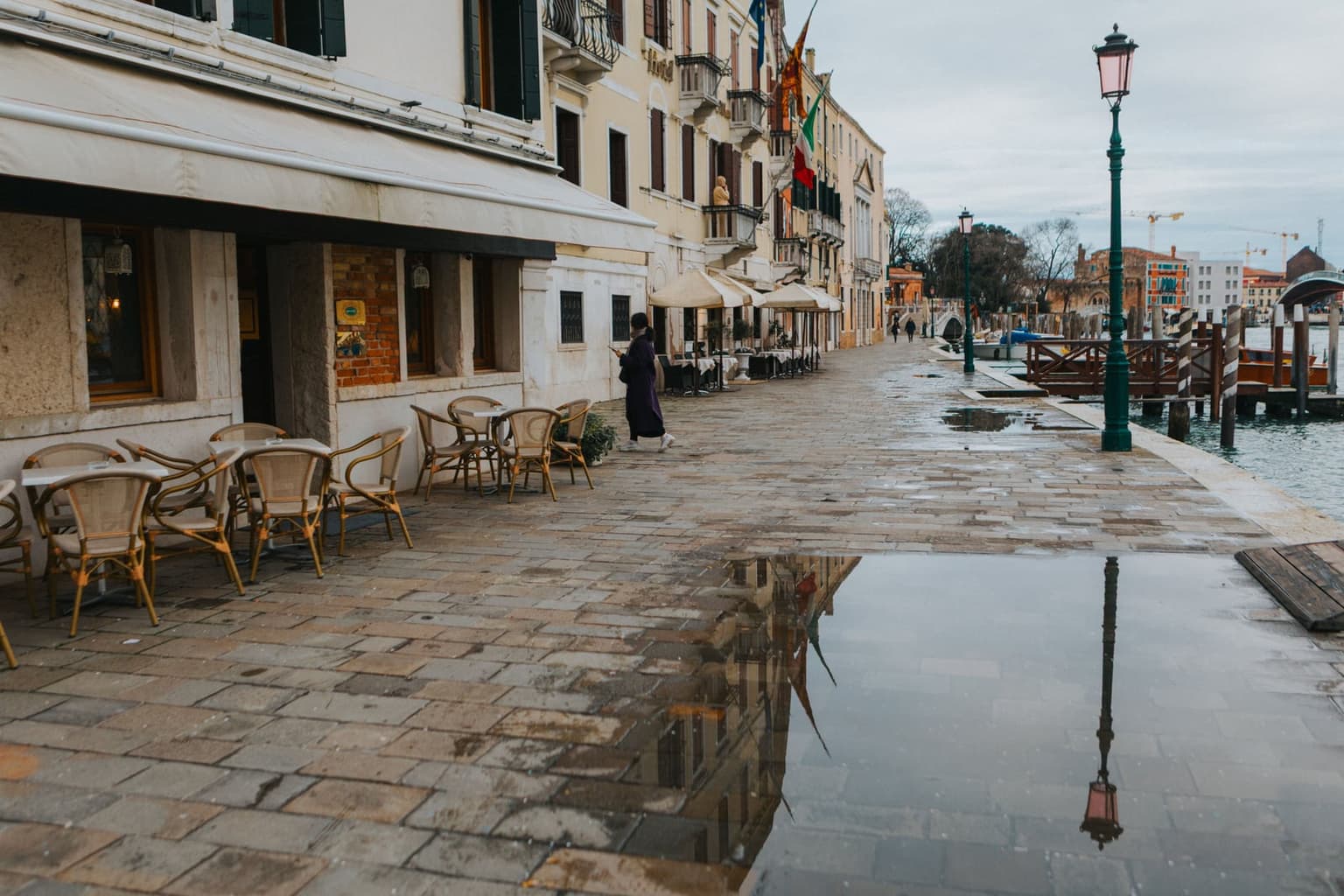
For a trip around early November, pack layers, a light waterproof jacket and waterproof shoes, and check the forecast right before you leave, so the last things go in on real weather, not hope. A rainy day in Venice is where a pair proves itself: one wet stone street and stepped bridge after another. How the weather moves through the other seasons is in my guide to Italy's three seasons.
The mountains are a separate trip with a separate list. If the Dolomites are on the plan, start with when their high trails run and pack from there.
Cut the sweaters first: you need fewer than you think, because a layer you can peel off beats a sweater you are stuck in, and in summer the fleece can stay home altogether. Two small things earn their space: an umbrella that folds small enough to live in the day bag, and a light towel that dries before the next train. On a longer trip, one load of laundry halfway through beats a fresh outfit for every day.
Church days: what the Vatican, St. Mark's and the Duomos let in
The written dress rules at the Vatican, St. Mark's in Venice, Florence's cathedral and the Milan Duomo all bar bare shoulders and clothing short above the knee. Each door words it its own way, and each also has a rule for the bag you carry in. The table has both.
| Door | Dress | Bags |
|---|---|---|
| Vatican | Museums, Sistine Chapel, St. Peter's Basilica and Gardens: no sleeveless or low-cut garments, no shorts above the knee, no miniskirts, no hats | Museums only: bags over 40 x 35 x 15 cm and backpacks (small ones possibly excepted) go to the free cloakroom |
| St. Mark's, Venice | Shoulders and knees covered; men uncover their heads; no bare feet | Backpacks and bags: 40 x 30 x 20 cm maximum; no rolling suitcases at all |
| Florence cathedral | Cathedral and Baptistery: no flip-flops, no bare shoulders, no legs uncovered above the knee | Ticket holders: luggage over the permitted size goes to the free cloakroom at Piazza Duomo 38/r before the visit |
| Milan Duomo | Inside the cathedral: no sleeveless or low-cut clothing, no shorts, no miniskirts, no hats | No luggage, suitcases or large backpacks; bulky bags discouraged |
The check comes at the door, after what can be a long wait, and the Vatican lets in only "appropriately dressed visitors," so dress for the door before you join the line. A light scarf or a button-up shirt in the day bag covers the shoulders and doubles as sun cover on bright stretches. The knees are the morning's decision, made at the hotel: on a church day, wear something that covers them. I have never run into a dress code myself, but I never walked in wearing swim trunks either.
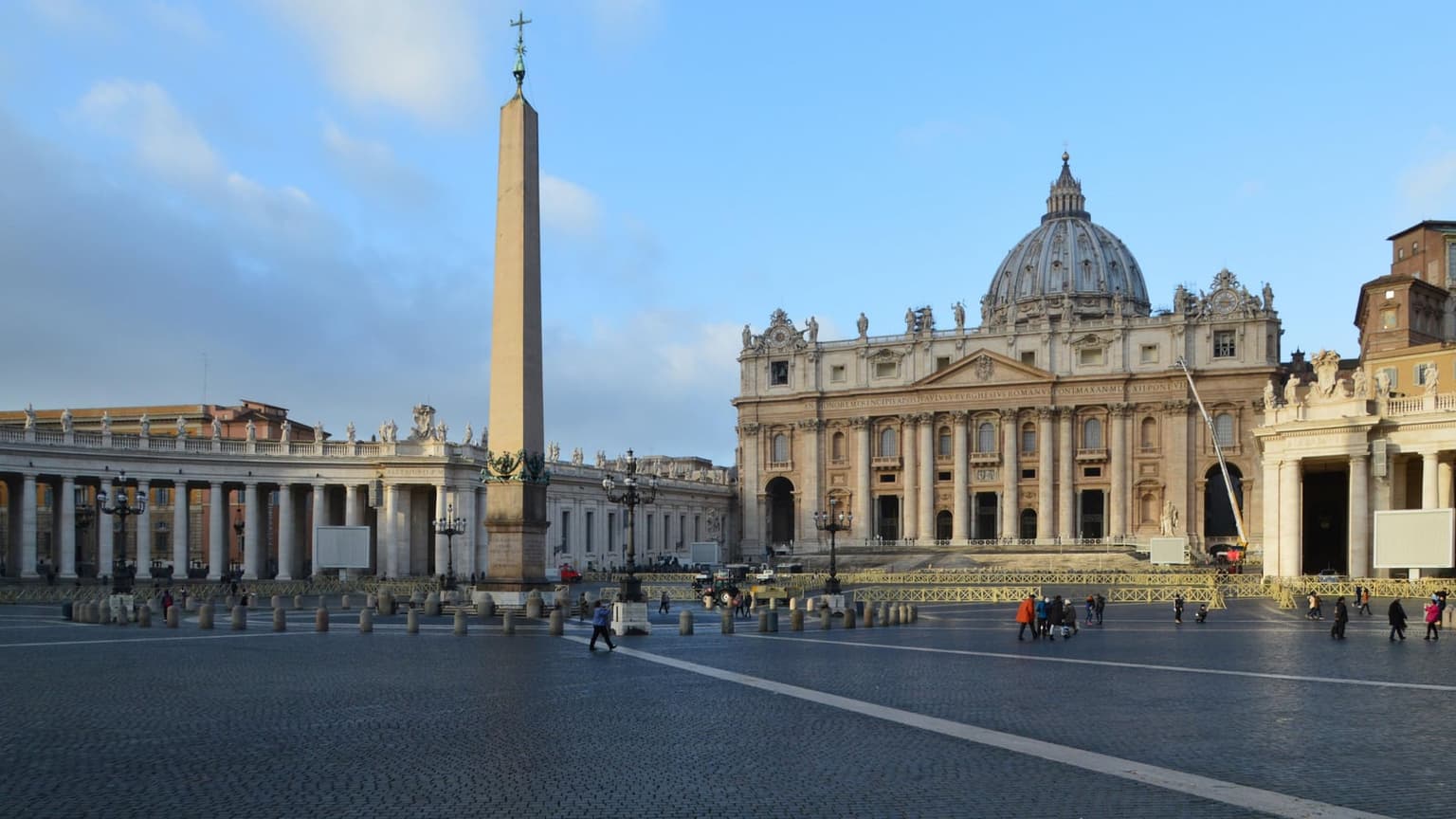
Umbrellas split the doors: the Vatican Museums send medium, large and non-folding umbrellas to the cloakroom, while the Milan Duomo lists umbrellas among the items it allows. The small folding umbrella from your day bag is the right size.
⚠️ Warning
The Vatican Museums cloakroom is free, but anything you leave there must be collected the same day, before the Museums close. If you continue into St. Peter's Basilica, the Museums remind you not to leave your bag in their cloakroom.
In a crowd, a crossbody bag of modest size is easier to steer than a backpack, and on crowded public transportation a backpack rides on your front. Anti-theft features on a day bag mostly get in the way. The likeliest way to lose a day bag is to leave it behind in a restaurant or a restroom, so the habit worth packing is a glance back every time you stand up.
Papers: passport, the EU's new border check, an IDP to drive
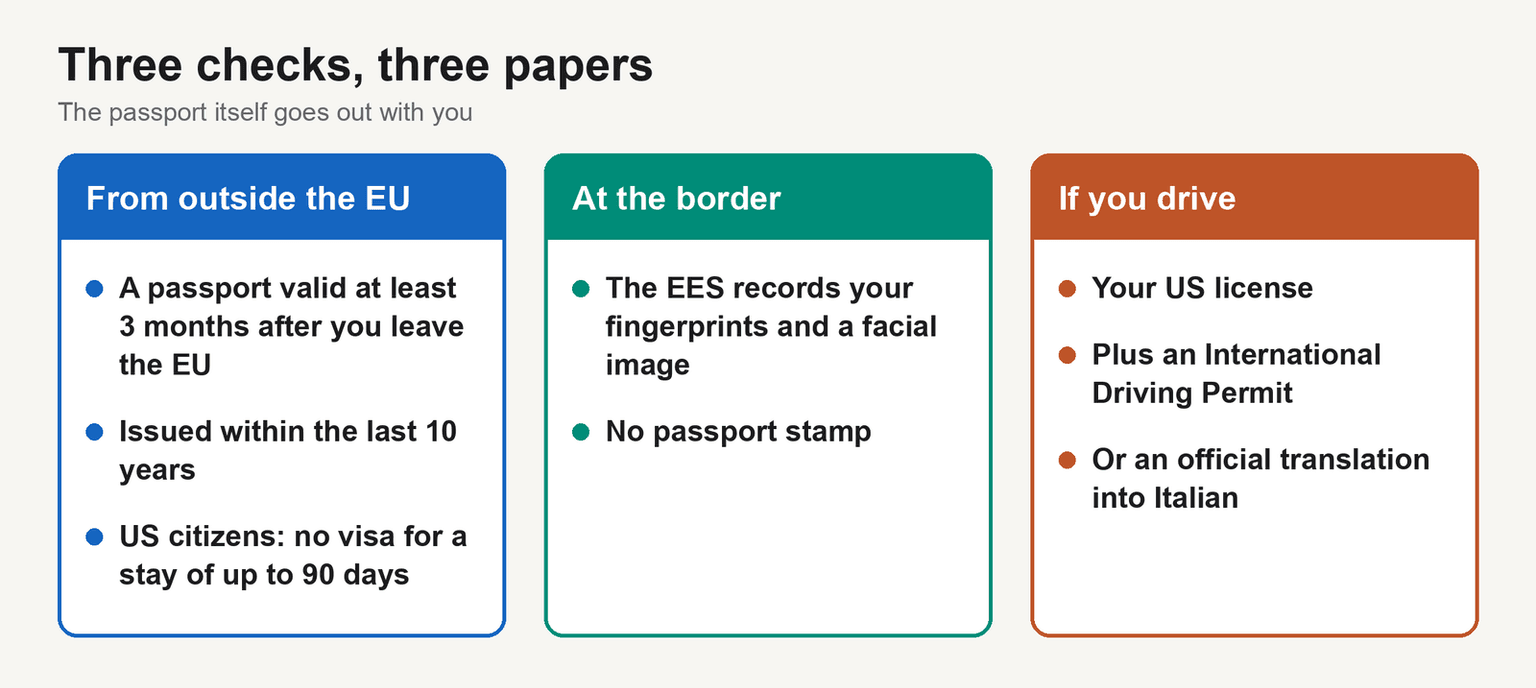
A passport for Italy should be valid for at least 3 months after the date you plan to leave the EU and must have been issued within the last 10 years, under the EU's rule for visitors from outside it. US citizens need no visa for a short stay in Italy of up to 90 days; the EU counts a short stay as up to 90 days in any 180-day period.
At the border, the EU's Entry/Exit System (EES) records your travel document data, your fingerprints and a facial image, and since April 10, 2026 it has replaced the passport stamp, so your passport comes home with nothing from Italy to show for the trip. The wait has run from minutes at the e-gates to hours in line, arriving and leaving alike, so leave slack before your flight home.
ETIAS, the EU's planned travel authorization, is not in operation as of October 2026 and collects no applications. The EU says it will announce the start date several months before launch, and the fee will be €20 when it starts; watch the official ETIAS portal for the date.
Inside Italy, the passport keeps working. Italian law requires a foreigner to show a passport or other identity document when the police ask, so the passport itself goes out with you, and a photocopy stays back at the hotel for the day the original goes missing.
To drive on a US license, Italy's road code requires an International Driving Permit or an official translation into Italian, carried with the license, and both must be valid; driving without either draws a fine of €408 to €1,634. AAA issues the IDP for $20 plus any sales tax (as of October 2026), as a paper permit only, no more than six months before you need it. The police are supposed to check it and rarely do, but I count carrying one as obeying the law, and insurance that costs pennies.
The other kind of insurance costs more than pennies, so choose it for what would break this trip, like medical care abroad or a lost or stolen bag, and read what paperwork a claim needs before you leave.
Liquids in the carry-on: TSA going out, Fiumicino coming home
Liquids in a carry-on leaving the US are limited to containers of 3.4 oz (100 ml) or less, all in one quart-sized bag; anything larger goes in checked baggage. Coming home from Rome, the rule splits.
At Fiumicino, the airport's own security checks let liquid containers of up to 2 liters ride in a carry-on, under the European Commission's new provisions. Two groups stay on the traditional rule of 100 ml containers in one clear bag of up to 1 liter: passengers on direct flights to the US or Israel by airlines that check in at Terminal 1, and transit passengers from non-Schengen countries outside "one stop security" agreements. Liquids needed during the journey for medical reasons or a special diet, baby food included, may be allowed after a separate check. So on a direct flight home with an airline that checks in at Terminal 1, pack the 100 ml way and put the olive oil in the checked bag.
With a connection, ask your airline whether the connecting airport restricts liquids: the 2 liters are Fiumicino's rule, never a promise for the whole trip home.
Money and phone: two cards and a little cash
Cards work in Italy because the law says so: shops and service providers must accept card payments, and since June 30, 2022, a refusal of any amount draws a fine. The duty lapses only in cases of objective technical impossibility, and it covers at least one debit and one credit card, not every brand, so make the backup card a different brand from the first. Add both to your phone's wallet while you pack.
Carry some cash anyway, small bills included, for the people who still insist on it: some B&B and apartment hosts and some taxi drivers, sometimes at the last minute. A trip can also run on cards from start to finish, so the cash is a cushion, not a fortune.
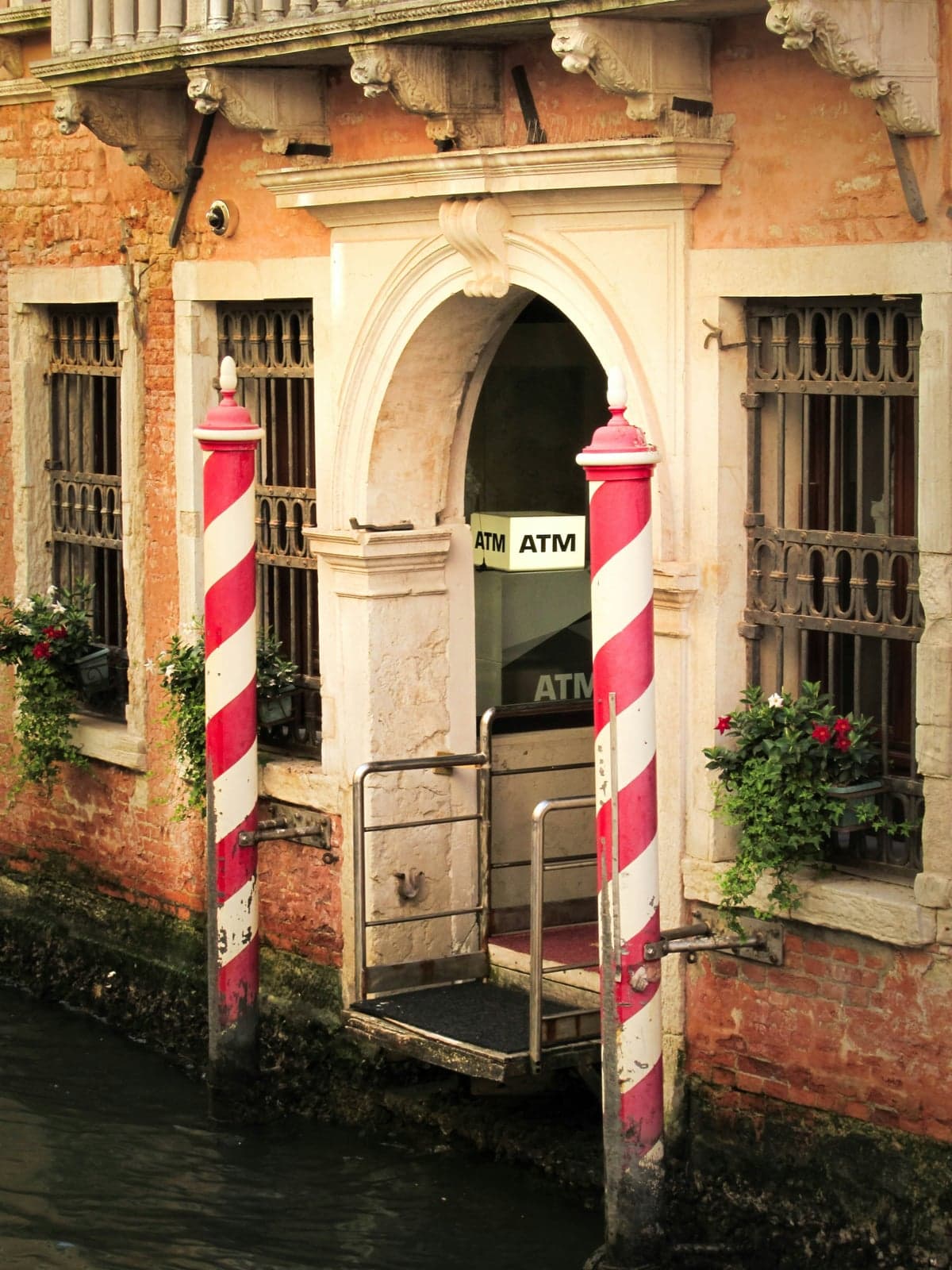
For that cash, use an ATM attached to a bank and skip the stand-alone machines. When an ATM or a card terminal offers to charge you in dollars, choose euros and let your own bank do the conversion. Both habits are cheap protection against the withdrawal that comes home on your statement costing far more than you expected.
Check your own card's foreign-transaction fee before you go. If it charges one, compare it with what a travel money card charges before you pick which one to spend with.
Set the phone up before you fly, too, so maps and messages work the moment you land; how to choose and install an eSIM for Italy is a page of its own.
Pack a power bank as well, because a full day of maps and photos drains a phone fast.
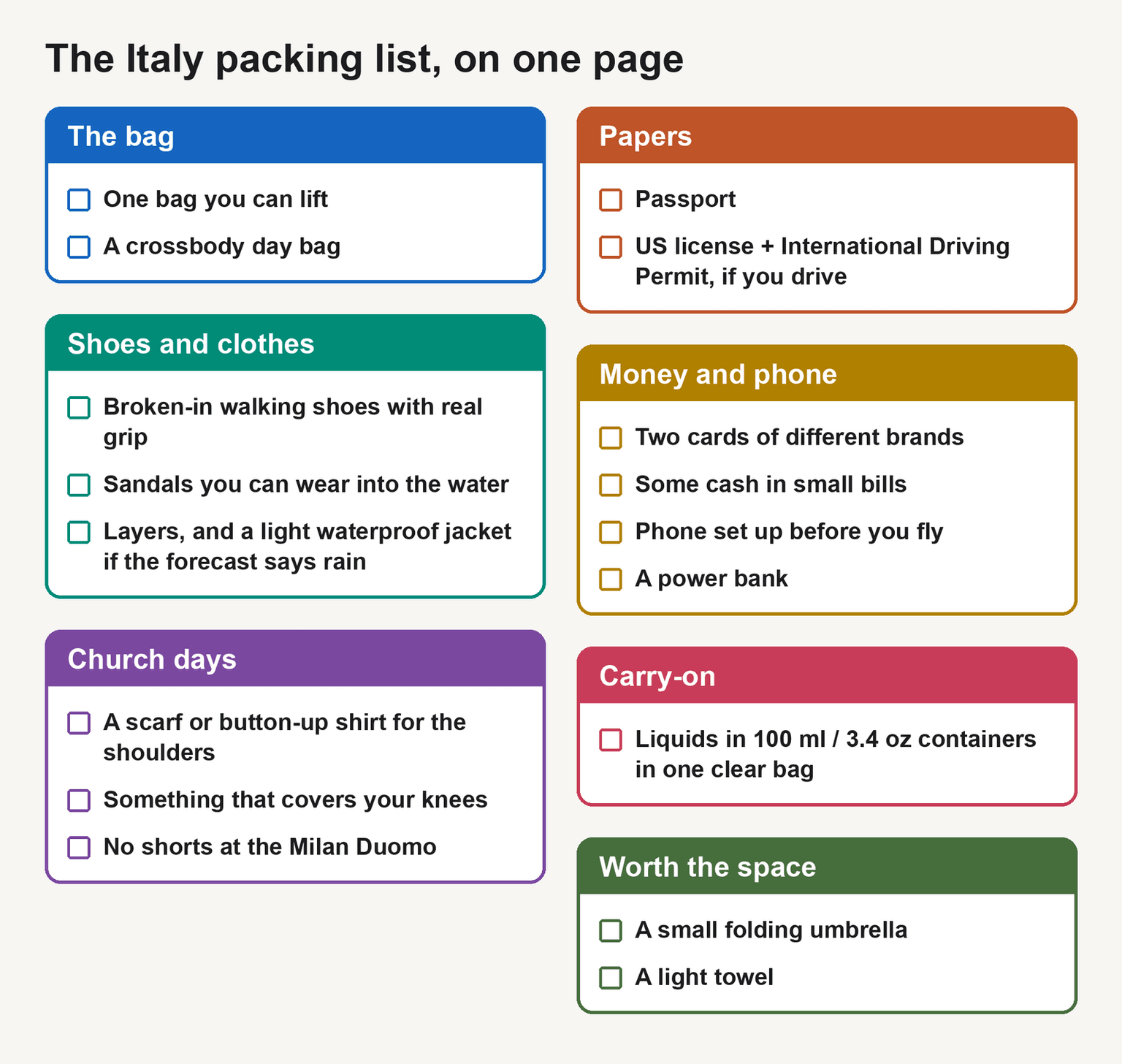
Nothing in Italy has ever surprised me in a serious way. You can always find an Italian who speaks English, and with a little preparation the worst case is losing some time. Here is the whole list on one page.
Italy packing list: common questions
- Should I bring a carry-on or a suitcase to Italy if I'm traveling by train?
- One bag you can lift onto the rack alone, because on Italian trains that is your job, and the streets add stairs and cobblestones. Leave the big suitcase at home; if you need one, store it at a base.
- What should I wear to the Vatican and churches in Italy?
- The written rules at the Vatican, St. Mark's, Florence's cathedral and the Milan Duomo all bar bare shoulders and clothing short above the knee. Carry a light scarf for your shoulders and wear something that covers your knees: St. Mark's asks for that, and the Milan Duomo bars shorts. The Vatican and the Milan Duomo also bar hats.
- Do I need ETIAS for Italy?
- Not as of October 2026: ETIAS is not in operation and collects no applications. The EU says it will announce the start date several months before launch, and the fee will be €20 when it starts.
- Do I need an International Driving Permit for Italy?
- Yes, to drive on a US license. Italy's road code requires an International Driving Permit or an official translation into Italian, carried with the license. AAA issues the IDP.
- Do I need cash in Italy?
- A little. Cards do most of the work: by law, shops must accept at least one debit and one credit card unless that is objectively technically impossible. Keep small bills, drawn from a bank's ATM, for the hosts and taxi drivers who still want cash.