George Mandrovny
Two towns on one hill, and a station in neither
Ragusa is two towns stacked on one hillside: Ragusa Ibla on its spur, Ragusa Superiore on the ridge above it, more than 300 steps between them and a train station in neither half. Give the town a long afternoon into the evening, and a night if you want Ibla after the day visitors leave. Walk down the staircase, ride the bus back up. Sleep in Ibla for the evening, in Superiore for the station, the buses, and the parking. And know before you plan: no direct train runs from Catania.
What you are looking at is one hillside with two towns on it. Ragusa Superiore is the newer half, laid out on a grid along the top of the ridge in the 18th century. Ragusa Ibla is the old one, packed onto the spur below it, and two staircases stitch the halves together. The 1693 earthquake is why there are two towns instead of one: the survivors built new on the highest hill and left Ibla where it stood.

The station is the part that catches people out. Trains reach Ragusa up in Superiore, at Piazza del Popolo, which is neither Ibla nor the middle of the upper town - it sits apart from both. Ibla is downhill from there, so walking out is easy and walking back is work. Arrive with a suitcase and take the taxi. The climb is long enough that hauling bags up it is a decision you make once.
The UNESCO badge on the brochures is a shared one: Ragusa was inscribed in 2002 as one of the eight Late Baroque Towns of the Val di Noto, along with Noto, Modica, Scicli, and four more. It is a listing of towns, not of a single square. What shapes your visit is the drop between the halves: which half you sleep in, whether you want a car, how you get back up the hill after dinner. All of it comes out of those steps.
Crossing between Ibla and Superiore: 300 steps down, and the bus back up
The main link is the Scalinata di Santa Maria delle Scale, which drops from Corso Mazzini at the top to Piazza Repubblica at the foot, past the church it is named for. Touring Club Italiano maps the flight at more than 300 steps; counts in circulation run from 200 to 340, depending where you start. The city puts the descent at 8 minutes, and 6 for the parallel Carmine flight across to Via San Paolo - downhill figures, both. Nothing here is flat, and the same climb in reverse runs 25 - 35 minutes with stops, the kind of work that is still with you two days later.

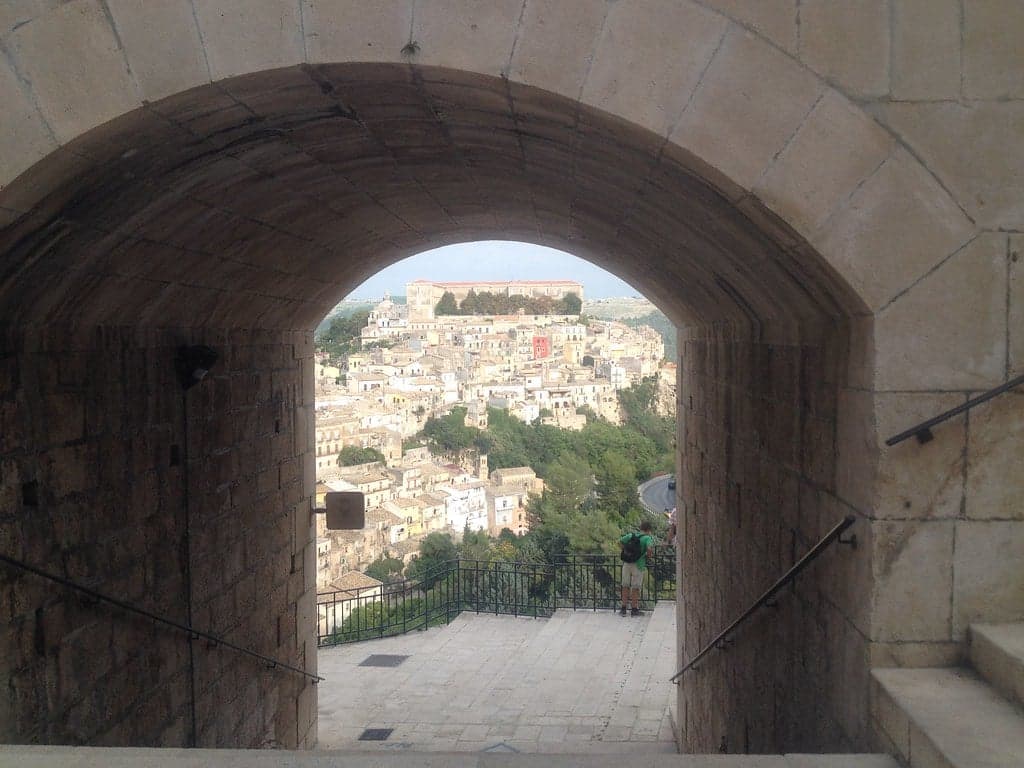
Partway down, the flight swings out along the cliff and the town stops being an abstraction. Ibla arrives all at once below the parapet - not street by street, the way a town usually gives itself up, but as one dense mass of roofs on its spur, San Giorgio's dome standing clear above them and open valley behind. At the church the parapet widens into a balcony, and that is where people stop walking. It is the view that makes you plan a second descent at first light, while the roofs are still gray.
Getting back up is the part that needs a plan, and in July I would not improvise it. Lines 1 and 3 both call at Corso Mazzini at the top of the flight and Piazza Repubblica at the foot of it, so you board at the bottom of the steps you came down instead of crossing Ibla to the garden terminus. Line 1 runs 07:00 - 20:30, with its 07:00 and 07:45 departures on weekdays only; Line 3 covers 07:30 - 23:15, every day.
⚠️ Warning
The climb back is the real physical work of a day here, and the daytime buses come around only once every 45 minutes. Check the clock at the bottom before you commit to the steps - there is no shade on the flight and nowhere on it to buy water.
After 16:00 it gets easier. The Verde comes every 20 minutes, 16:00 - 01:20, daily from April through September, then Fridays, Saturdays, Sundays and holidays only from October through March. Those are the Rossa's days too, when it adds a loop of its own, 18:15 - 00:15 every half hour. Either way it is an ordinary city bus on an ordinary ticket: €1.20 in advance from the app, the website or an authorized outlet, €1.60 bought on board.
The town's own tourist pages still print the line numbers of an operator that no longer runs Ragusa's city buses, under a timestamp from this year. The network you will actually ride is Etna Trasporti's: Lines 1, 3, Verde and Rossa.
Ibla: the Duomo, the balconies, and the garden at the end
San Giorgio, the church on Piazza Duomo, is free to enter, on hours that change with the season; the square is car-free at every hour, and the pair takes 30 - 45 minutes. Ibla arranges itself around one sloping square, and the slope is deliberate. Rosario Gagliardi set San Giorgio's tower-façade at the head of a broad staircase, above a square built as a stage set for it, so the church stands above you wherever you are in it.

Walking into a church here to pray or to look costs nothing. What costs money is the layer added on top: a bell tower, a sacristy, a museum, a nave with an audioguide. Each of those keeps its own closed day, and on the summer 2026 schedule they were shut, between them, on every day except Monday. The comune republishes the hours and closed days season by season, so pick the two or three you want and confirm theirs at the ticket desk or on the comune's page before you plan around them.
What costs money, and the day it was closed in summer 2026
| Site | Ticket | Closed (summer 2026) |
|---|---|---|
| Santa Maria delle Scale (bell tower) | €3 | Tuesday |
| Santa Maria Maddalena (audioguide) | €2 | Wednesday |
| Santa Maria dell'Itria (audioguide) | €3 | Thursday |
| San Giacomo Apostolo (audioguide) | €2 | Friday |
| Purgatorio bell tower | €2 | Saturday |
| San Giorgio balustrade and staircase | €3 | Sunday |
The audioguide is included at the Maddalena, San Giacomo and Santa Maria dell'Itria, and only there; Santa Maria delle Scale's €3 buys the climb up its bell tower instead. These are working churches, so dress like it.
The balconies cost nothing and take five minutes. Ibla's palazzi carry them on carved corbels, and the carvers were in a strange mood: grotesque faces, musicians, ordinary people straining under the ironwork. Palazzo Cosentini has the best of them, and among its five mascaruna i l'Archi one holds a snake and another a scorpion. There is no interior visit: no ticket, no hours, nothing to book. You look up from the street and walk on.

Two interiors here are not churches: Palazzo La Rocca, free when an exhibition is on and also the tourist office, and the Circolo di Conversazione, a private club that takes booked morning visits, not Mondays, about 20 - 30 minutes.
Keep going, though. Most visitors do the square, turn around and climb back, and never reach the end of the spur - which is where Ibla actually finishes. Giardino Ibleo is free and open into the evening: palm avenues running out to a balustrade, with the Irminio valley dropping away beyond it. Town, then parapet, then empty country. Allow 30 - 45 minutes.

The evening is the hour Ibla is actually for. Walk Via Capitano Bocchieri after dinner: the lane bends, and the dome of San Giorgio swings into the gap at the end of it.

By then the day's visitors are back up the hill and the square belongs to the people who live here.
Ragusa Superiore: the half most visitors skip
The cathedral bell tower in Ragusa Superiore costs €3, and on the summer 2026 schedule it was closed on Sunday, which is precisely when the day-trippers arrive. Its hours change with the season, so check them at the ticket desk or on the comune's page the week you go. The climb is 129 steps to the bell chamber and 36 more above that, topping out around 50 m. The cathedral underneath is free, and the pair takes 30 - 40 minutes. Access to the tower entrance is step-free from the side door on Corso Italia; the spiral inside is not.
What the climb buys is the town as one object: Ibla packed on its spur below you, the valley cutting in behind it, the grid of Corso Italia running back along the ridge, and a church dome sitting below your own eye level. Everything this town makes you decide - which half to sleep in, how to get across - is laid out under you in one turn of the gallery.
The other reason to be up here is the Museo Archeologico Ibleo, in Palazzo Mediterraneo on via Natalelli: €6, or €3 reduced, 09:00 - 19:00 on weekdays with last entry at 18:30, and 09:00 - 13:30 on holidays. It keeps full days, whatever you read elsewhere - the €4 ticket and the mornings-only hours still circulating online are out of date.
Most visitors never find out. They come off the train, head straight down to Ibla, and the upper half stays what it looked like through the window: the part you passed through on the way to the good one. It is also the working half: the bus terminal and the parking are up here with the station, and the old town is a walk from all of it.

Which half to sleep in - and whether to stay at all
Sleep in Ragusa Ibla for the evening and in Ragusa Superiore for the logistics: your luggage and your arrival time settle this, not which half is prettier. Ibla's case is the hours after the day visitors leave. Superiore's case is that no staircase stands between you and your luggage.
Ibla or Superiore: what each half buys you
| What matters | Ragusa Ibla | Ragusa Superiore |
|---|---|---|
| The evening | Where it happens | You ride down and back up |
| Trains and buses | Uphill from you | On your side of the stairs |
| Parking | Lots outside the pedestrian core | Covered garage by the station |
| Bags | Steps, ramps, lanes closed to cars | Car to the door, mostly |
| Rooms | Converted palazzi, small independents | Larger, plainer, easier to reach |
Ibla's cost is the part no listing photographs. The lanes are narrow and not all of them take cars, so plenty of places will ask you to park on a road nearby and walk the last stretch in, which can mean a 20-meter ramp with your suitcases. The bus between the halves runs on its own schedule rather than yours, so a late arrival or an early train turns into a taxi or a climb.
Whether Ragusa earns a night at all turns on the same evening. A day trip from Siracusa or Noto buys the square, the staircase and lunch, then puts you on the road before the lanes light. On a tight plan Ragusa survives being an afternoon. That is really a trip-shape question: how many bases a Sicily route can carry.
Ragusa or a neighbor is the same question from the other side, and they are close: Modica about 25 minutes' drive, Scicli roughly half an hour, Noto about an hour. Ragusa's own argument is the vertical split, and the evening at the bottom of it. If Noto is the one pulling at you, what Noto gives you, and when to go is argued in its own guide.
Whichever half wins, book it on the town's terms: check the distance to a staircase or a bus stop, whether parking is at the property or on a road two streets off, and whether the listing mentions steps at all. The listings that warn you are the honest ones.
One question to ask before you book: is a group booked into the property for your dates? Hotels this size take school and tour parties that fill the whole building, and calm at half capacity says nothing about two in the morning.
I sleep in Ragusa Ibla, no question. Superiore's case is real if you're dragging a hard-shell suitcase up from the car, but hand me a daypack and that argument disappears, because the whole reason to spend the night in Ragusa is what happens after the tour buses pull out. By day the lanes are shoulder to shoulder with groups working the same three photo stops; by six they're gone, and staying down here means someone hands you the keys to an empty baroque town. The lamplight goes soft and yellow on the honey-colored stone, I step out of the palazzo door straight onto the square in front of the Duomo di San Giorgio with nobody else standing in it, and my own footsteps are the only sound bouncing off the walls. That, plus coffee the next morning at the bar with people who actually live here, is worth the extra hundred steps with a bag on my shoulder. The stone wins.
Do you need a car in Ragusa? Getting in, and where you park
You do not need a car for Ragusa itself: the town is two halves with a bus line between them. You need one for everything around it. Modica, Scicli, Punta Secca, and the coast are short drives, and the car is what strings two of them into one day.
No train runs directly between Catania and Ragusa. The departures board at Ragusa station lists Modica, Siracusa, Gela, Vittoria, Donnafugata, and Caltanissetta; Catania is not among them, and the rail route there runs through Siracusa, about four hours. Etna Trasporti runs the direct bus to the airport and on into Catania, and publishes no schedule for it: times appear only after you enter a date in the operator's own planner.
Etna Trasporti's own departures board, where you pick the stop and the date (etnatrasporti.it)
The Catania bus ends at Terminal Zama, the operator's Ragusa terminus and ticket office, which adjoins the railway station and Piazza del Popolo in the upper town. The city lines down to Ibla leave from that plaza.

Every official parking area in Ragusa sits outside the restricted zone, and the ring road around Ibla is unrestricted, so the lots are always reachable. Blue lines are the paid stalls, charged April 1 - October 31, 10:00 - 24:00; the white ones, more than 160 of them, are free. The covered SiSosta garage on Piazza del Popolo runs 24 hours and is free to visitors from June 9 to September 9, on a card your hotel issues.
⚠️ Warning
Ragusa's ZTL runs on two clocks. The zones around Piazza Duomo never switch off, so the cathedral square is car-free at every hour; from April 1 to May 31, three more gates - Viale Margherita, Via Giardini, and Corso XXV Aprile - switch on for Saturdays, Sundays, and holidays, 20:00 - 02:00. They are cameras, not barriers.

Park wrong during the Festival of St. George and the car is not ticketed but towed, and the morning goes on an impound lot with your hotel translating. On the Montalbano drives down the coast, a disabled space you never saw the sign for runs about €330, or €231 if you pay inside five days.
Flying in, you pick the car up at the airport, either Catania Fontanarossa (CTA) or Comiso (CIY). The Fontanarossa counters have rules of their own, and what the desk wants before it hands over the keys is worth reading before you book.
Go smaller than you think on the car. Ibla's lanes settle that question, and in any case it will spend most of your stay parked outside the zone. Book the transmission you want at the moment you book the car.
compare rental cars at Catania airport
Go smaller than you think - the car spends most of the stay parked outside Ibla's ZTL
Landing late and not driving, book a transfer before you fly, at a price agreed in advance rather than at the curb at midnight. Give the full address: which half of town you are staying in matters more here than the street.
Pre-book a transfer from Catania airport to Ragusa
Give the full address - which half of town you're in matters more than the street
If you will not drive in Sicily at all, a hired driver for the day is how Scicli and the coast still happen. Settle what the price covers first: time in each town, whether the driver waits, and whether the figure is per car or per person.
Eating in Ragusa: scacce, Ragusano, and three stars in two rooms
Ragusa Ibla holds three Michelin stars across two dining rooms in the 2026 guide: two at Ristorante Duomo, Ciccio Sultano's kitchen, and one at Locanda Don Serafino. Don Serafino's room is cut into the rock on the road that rings Ibla.
Check that count against anything else you read. Don Serafino carried two stars for years and much of the press still prints two; the current answer is one.
The range is the thing worth knowing here: a bakery counter at one end, a tasting menu at the other. Scacce are the counter end, and the better introduction to the town: thin dough rolled around a filling and folded flat, so it bakes into layers. The classic is tomato with caciocavallo ragusano.

The rest of the local vocabulary is short: impanate, ricotta ravioli, and pastieri - lamb-and-kid pastries bound with cheese, egg, and pepper. The cheese behind most of it is Ragusano DOP, the caciocavallo that carries the town's name, with the local provola beside it.
The trap is the belt of tables around Piazza Duomo, where the address does the selling and the kitchen knows it gets one shot at you. Walk a couple of lanes off the square instead. That is where the town eats: slow-cooked meatballs in tomato sauce under melted cheese, and at lunch an outside table down at the foot of the staircase on Piazza Repubblica. Given one meal in Ibla, I would take the trattoria over the tasting menu.
Time it, though. Kitchens shut after lunch and do not reopen until evening, so an afternoon hunt for a real meal ends at a bar counter with whatever is left under the glass.
Montalbano: what is actually in Ragusa, and what is not
Ragusa Ibla plays Vigàta's main square in the Inspector Montalbano series: Piazza Duomo and the staircase under San Giorgio's front, free, outdoors and there at any hour. Corso XXV Aprile and the lanes around Via Capitano Bocchieri are Vigàta's streets. The Circolo di Conversazione on Corso XXV Aprile, the private club with the booked morning visits, is where the inspector meets Dottor Pasquano.

What is not here is the police station: Vigàta's is the town hall in Scicli, on Via Mormino Penna, and its ground floor holds a permanent set of Montalbano's office and Mimì Augello's. Both are open to visitors, which is the real reason to give Scicli a morning.
The house is not here either. It stands at Punta Secca, a little over half an hour away on the coast, and it is a working B&B now, open April through November, with no tour, no hours and no admission published for anyone who is not sleeping in it. The exterior and the beach in front of it are the whole promise.
The rest of the map spreads outward: Castello di Donnafugata, Sinagra's house, about 20 km inland and closed Mondays; Modica's own San Giorgio; Donnalucata standing in for Marinella's seafront; Sampieri for the Mànnara; Ispica; and Scicli again, for San Michele, Santa Teresa and Palazzo Spadaro.
Set against that, the Ragusa half of the list costs nothing and needs no booking: the square, the staircase and the lanes are simply there, and you will have walked most of them before you notice you are doing it.
When to come, and the beach half an hour downhill
Ragusa is best in spring or from September into October: April highs sit around 67°F (19°C) and September around 82°F (28°C), while July and August run near 90°F (32°C). Late September is the week I would book, when the heat has broken and the summer opening hours are still in force.
The town sits at about 515 m and runs measurably cooler than the coast. Cooler, not rescued: when an African heat wave pushes past 104°F (40°C), a town of staircases is no place to be at two in the afternoon. Give mornings to the climb and the upper half, sit out the worst of the light, and walk down late, when Ibla is coming on.
Winter here is mild - January tops out near 55°F (13°C) - and what it costs you is hours. December is the wettest month. The city republishes its church list one season at a time, so a winter visitor works from a shorter one and can find two locked doors in an afternoon. The frequent evening shuttles go seasonal after September, so a midweek dinner down in Ibla falls back on the daytime line and its long gaps. Blue lines stop charging for the winter, and the shoulder is sturdier than people fear: the town stays open well into October.
Marina di Ragusa is the town's beach, about 24 km and roughly half an hour by road down to the coast. It carries a Blue Flag for 2026 and a Green Flag for being easy on kids, and in high season it takes over 60,000 visitors: a full Sicilian resort, not a quiet cove.

Tumino runs the bus, Ragusa to Marina and on to Punta Secca and S. Croce Camerina - check the last run with the operator before planning a beach day that ends with dinner in Ibla.
Tumino's own departure times for the Ragusa - Marina di Ragusa line, both directions (tuminobus.it)
Etna Trasporti's Linea 11 is not the way down there, whatever the listings say: it shuttles the seafront inside Marina itself, late June to late September.
Frequently asked questions
- Ragusa or Modica if you only have one day?
- Ragusa, and the shape of the place is why: two towns stacked on one hillside, a staircase between them, and an evening at the bottom of it under a lit dome. Two starred kitchens sit in the lower half, three Michelin stars between them. Modica is about 25 minutes' drive, close enough to add if the day runs long.
- How many steps are there between Ragusa Ibla and Ragusa Superiore, and can you avoid them?
- Touring Club Italiano maps the Santa Maria delle Scale flight at more than 300, and the number shifts with where you start counting. You can skip the climb: Lines 1 and 3 stop at the top of the flight on Corso Mazzini and at its foot on Piazza Repubblica, every 45 minutes.
- Is it worth staying the night in Ragusa Ibla?
- Yes, if the evening is why you came. The day visitors leave, the lanes come on, and dinner happens in a square no car has crossed all day. You pay in stairs, and the station is up in Superiore: light bags and a late train, I would sleep in Ibla; an early start or a heavy bag, take the upper half.
- Do you need a car in Ragusa?
- Not for Ragusa itself: a city bus joins the two halves, and what you came to see is a walk from one stop or another. For the corner of Sicily around it, yes. No direct train runs from Catania either, so without a car you arrive by bus, ride the rail line to Modica, and hire a driver for the days that string two towns together.
One thing worth doing on the morning you arrive: buy the ride back up before you need it. In a town built on a staircase, the easy evening and the hard one are usually decided hours earlier.