George Mandrovny
What Alpe di Siusi is - and the quick answer
Alpe di Siusi - Seiser Alm in German, one place with two names - is Europe's largest alpine pasture: 56 km² of rolling meadow between the flat tabletop of the Sciliar and the spires of Sassolungo. You cannot drive up onto it during the day: private cars are allowed on the access road only before 09:00 and after 17:00, though driving back down is unrestricted. So most people ride the cable car up from Siusi - €21.00 one-way (sold as a "single" on the operator's page), €30.00 round-trip - and give the plateau a full day rather than two hours. The trap is the two-hour version: up the lift, a photograph at the edge of the meadow by the top station at Compatsch, and back down convinced you have seen it.
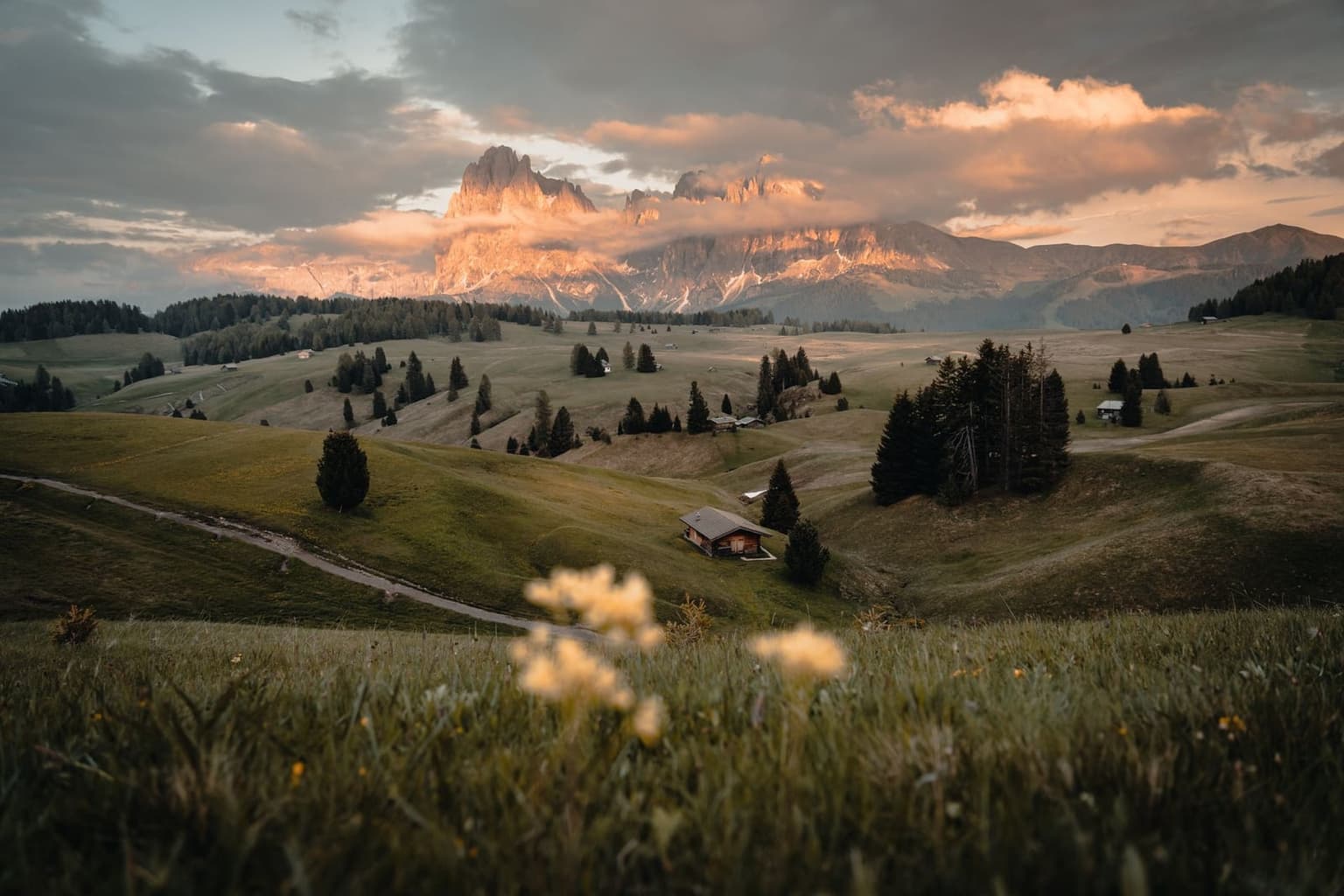
The meadow runs from about 1,680 m to 2,350 m and it is worked land - cattle out on the grass all summer, huts that are farms as much as restaurants. That is what makes it the odd one out among the region's marquee sights. The others are viewpoints: you arrive, stand at the railing, photograph the thing and go. This one has no railing and nothing to stand in front of. It is a landscape you walk around inside for a few hours, the Sciliar turning slowly behind you as you go. The meadow itself costs nothing - no ticket, no gate, nothing to book. Getting up onto it is the whole cost.
One naming thing, because it catches people at the worst moment. Alpe di Siusi and Seiser Alm are the same place, Italian and German, and South Tyrol uses both on everything: signs, timetables, hotel listings. Nobody trips over this while searching - they trip over it while booking, when the hotel confirmation, the bus stop and the guidebook look like three different destinations. They are one place.
Which door onto the plateau
Four ways up, and they are not interchangeable. The main one is the cable car from the valley station in Siusi: the cheapest door, and the one that buys the longest day. The first cabin goes up at 08:00; the last one comes down at 18:00, and at 19:00 from June 15 to September 14. That extra hour in high summer is the difference between finishing a long walk and turning back halfway.
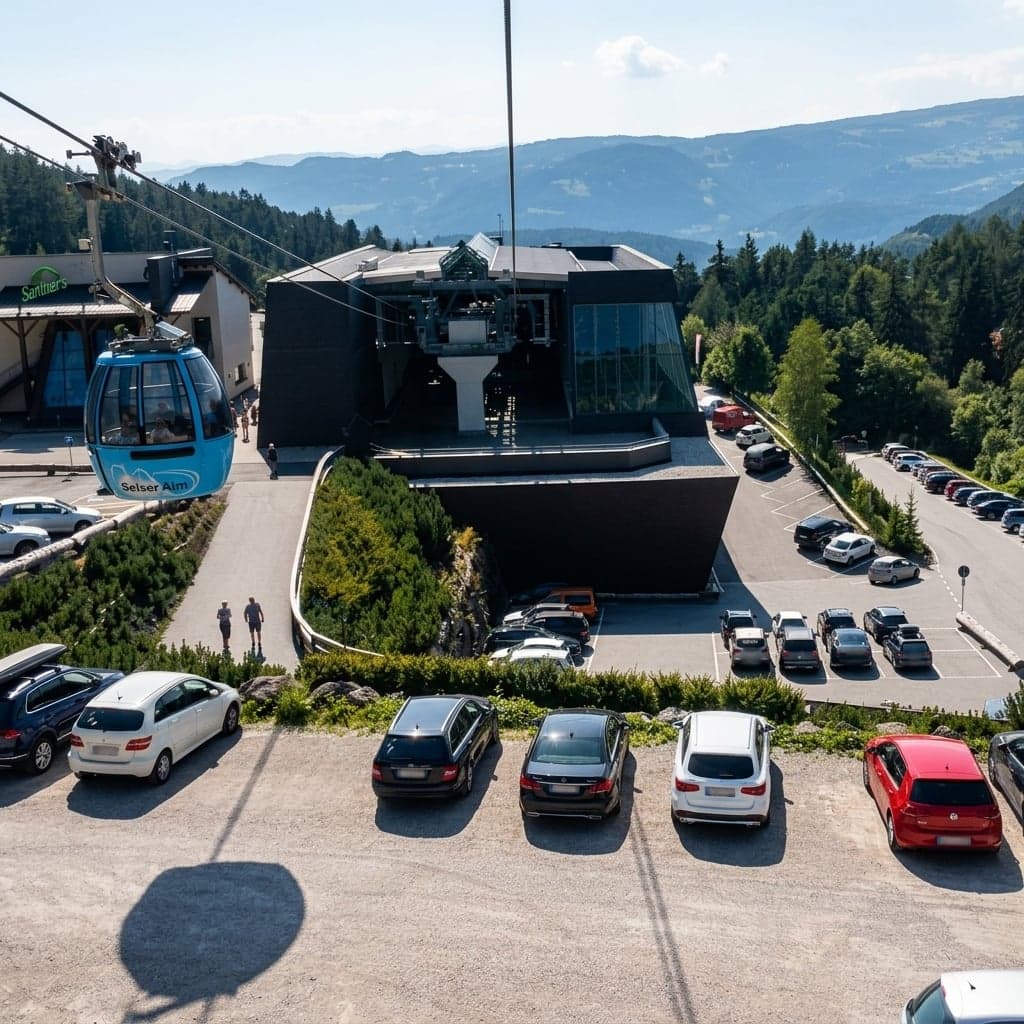
The Ortisei cable car is the second door and the expensive one; it earns its place only if you are already based in Val Gardena. Its first ride is 08:30 all season. Its last ride is not one time: the closing hour runs on three seasonal windows between May and November, so check the operator's page for your own dates.
Line 10, the Seiser Alm Express, drives the road you are not allowed to drive, from Kastelruth and Seis up to Compatsch. Tickets are sold on board, at the tourist offices in Kastelruth and Seis, and at the gondola valley station. One catch for Seis: the bus usually starts in Kastelruth and reaches Seis am Schlern only twice a day. The fourth door is your own car, which opens only at the edges of the day and only with a parking space reserved ahead, which is the next section.
| Door | Where it starts | 2026 season | Adult fare | Who it suits |
|---|---|---|---|---|
| Siusi cable car | Siusi (Seis) | May 22 - November 2 | €21.00 one-way, €30.00 round-trip | Cheapest, longest hours |
| Ortisei cable car | Ortisei (Val Gardena) | May 1 - November 2 | €26.00 one-way, €39.00 round-trip | A Val Gardena base |
| Seiser Alm Express (line 10) | Kastelruth and Seis | June 14 - October 16; combined 10+11 October 17 - November 2 | €30.00 round-trip | No car, Kastelruth or Seis |
| Your own car | The valley below | Any date, before 09:00 and after 17:00 | Parking fee by lot (next section) | Early starts, plateau hotel guests |
Seiser Alm cable car, the 2026 summer hours and fares (seiseralm.it)
All four put you in the same spot: Compatsch, a huddle of lift stations, hotels and bus stops at the meadow's edge. This is where the two-hour version of Alpe di Siusi happens, and it is why people leave believing they saw it. Compatsch is the doorway; what you came for starts behind it.
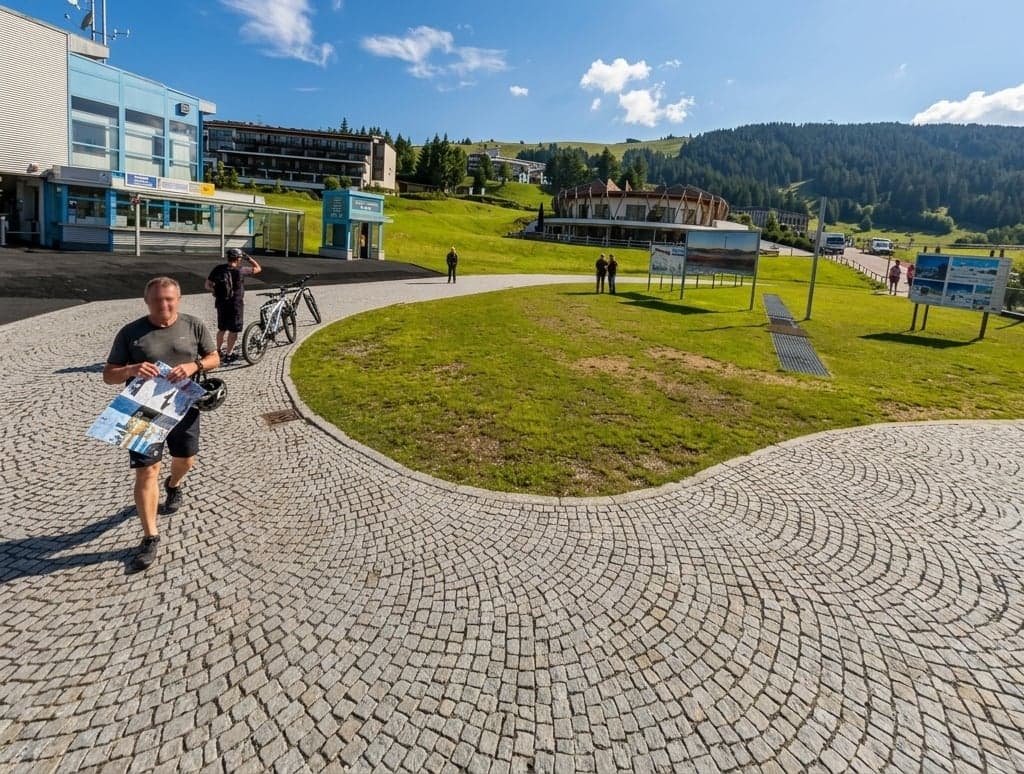
One-ways or a pass? Against that €30.00 round-trip, the Combi Card 3 in 7 costs €73.00, or €71.00 with a Südtirol Guest Pass, and covers three round trips by cable car or line 10 plus unlimited shuttle and Almbus rides within seven days. It pays from the third ascent, which is why I buy one-ways for a two-day visit. The Guest Pass covers neither the Seiser Alm Express nor the Almbus, which is the bill people do not see coming. Bikes go up on the cable car, €6.00 one-way and €12.00 round-trip, and no bus carries them.
Where you sleep in the valley picks your door. Siusi and Kastelruth sit at the cheap one, in reach of the 08:00 cabin; Ortisei is livelier and better connected, and its own door costs more.
If that first cabin is the plan, book with the valley station in mind rather than the town center: . Check how you would reach the station at that hour, whether there is parking you can leave a car in all day, and whether breakfast starts early enough for an 08:00 lift.
⚠️ Warning
From May 22 to June 13 the cable car is running and no bus goes up to Compatsch: line 10 does not start until June 14. For those three weeks the only ways up are the cable car, or your own car before 09:00 or after 17:00. From October 17 to November 2, the combined 10+11 service runs to the cable car's last day.
Driving up: the 09:00 gate and the two lots
Your own car is the fourth door, and it opens twice a day, at the edges. Private vehicles may use the access road before 09:00 and after 17:00; in between it belongs to the buses and to the people who live and work up there. Driving back down is unrestricted at any hour. The road has one checkpoint, at St. Valentin, and everything else here is about getting past it.
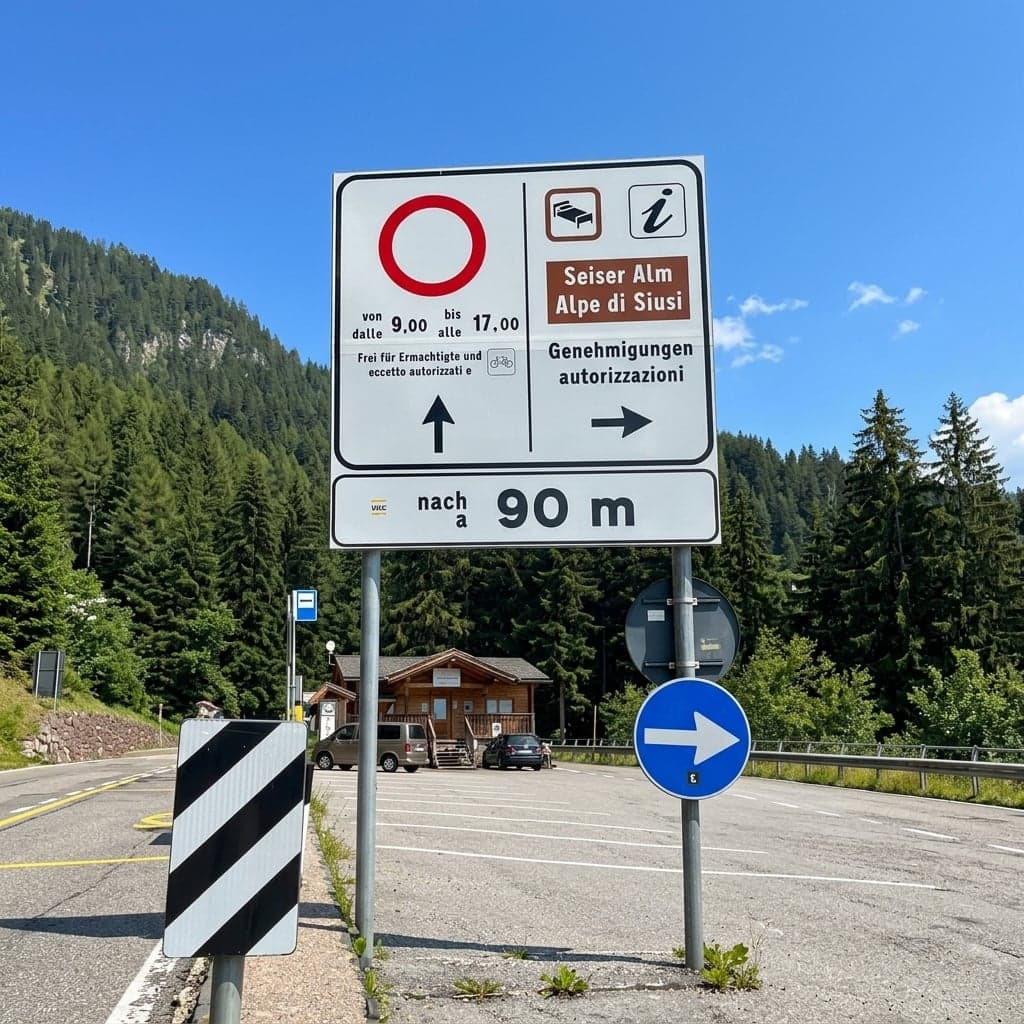
Hotel guests up top get their own rule, asymmetric in a way that catches people on day two. Arrival day and departure day, you may drive up or leave at any hour. In between, the drive from your hotel to Compatsch is allowed only before 10:00 and after 17:00 - an hour of morning grace nobody else gets. Holders of an official European Disability Card may drive up at any time.
Both lots, P1 Spitzbühl and P2 Compatsch, now take an online reservation made before you leave the valley. P2's entrance is a barrier that scans the QR code on your booking, so there is nothing to negotiate. Overnight parking is prohibited between 23:00 and 05:00 and fined, which rules out the sleep-in-the-van route to a sunrise. The region now gates most of its marquee places one way or another.
Reserve a space at P1 Spitzbühl or P2 Compatsch (seiseralm.it)
P2 sits at Compatsch itself, among the lifts and bus stops, and costs twice what P1 does. P1 Spitzbühl is the cheap one, and it sits a 30-minute uphill walk below the hub. The shuttle and the chairlift that would spare you that walk run for six midsummer weeks only, so for most of the season the saving buys you a hill. Plan for the operator's 30 minutes, not the optimistic 15 that gets thrown around.
| Lot | Per day | Puts you | The last stretch | The catch |
|---|---|---|---|---|
| P1 Spitzbühl | €15.00 (motorcycles €10.00) | Below Compatsch | 30-minute uphill walk | Shuttle and chairlift run July 25 - September 6 only |
| P2 Compatsch | €30.00 (motorcycles €15.00, buses €160.00) | At the hub | Nothing to cover | Barrier scans your booking's QR code |
And the equivalence that settles it: a day in P2 costs exactly what one adult round trip on the cable car costs - the operator's own words. Two people pay €60.00 for the cable car against €30.00 for the lot, and then the car sits parked all day on a plateau it may not drive on between 09:00 and 17:00.
⚠️ Warning
From June 29, 2026 you cannot drive up without a reserved space, and the reservation is not a promise: if both lots fill before 09:00, access closes and nobody gets past the St. Valentin checkpoint. Book up to six days ahead and be through before 09:00 - the road does not reopen to cars until 17:00. Or take the cable car.
I have done the before-8:00 version myself, unwilling to gamble on the lot filling first. Next time I would rather book a bed up here and skip the rush entirely - the day opens up once you are not racing a 09:00 clock before you have even had breakfast.
Getting to the valley in the first place
Alpe di Siusi is the one Dolomites highlight I would happily do without a car. The operator that runs the buses on the plateau also runs the shuttles under it, and they feed the cable-car valley station from every side. Shuttle 2 comes up from Völs and shuttle 3/3A links the station with Kastelruth, both from June 7 to October 16; at the thin ends of the season the two merge into a single shuttle 2-3, running May 22 to June 6 and again October 17 to November 2. Shuttle 5/15 runs from the station past Bad Ratzes to St. Valentin, the checkpoint from the last section, on the widest season of the lot: May 22 to October 16, and then October 17 to November 2.
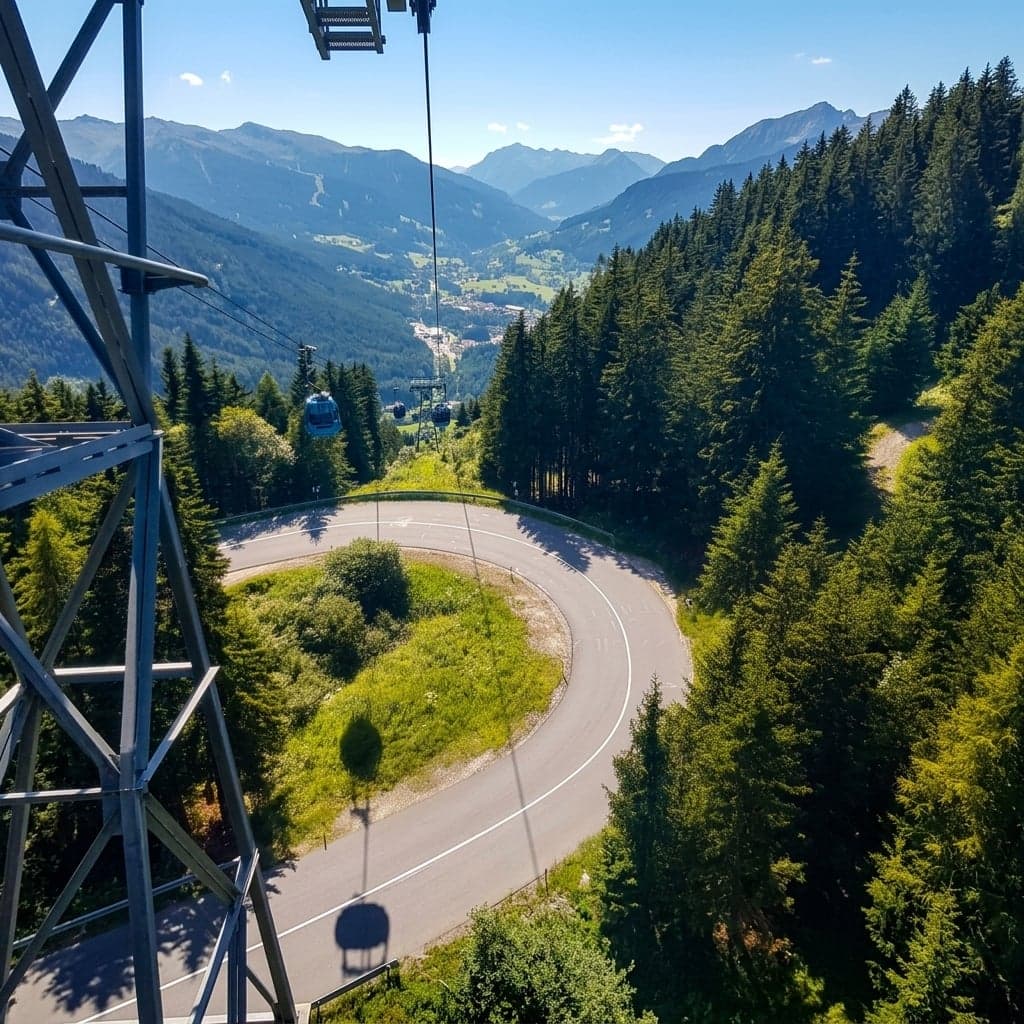
From Bolzano, the last leg is the regional bus up to Kastelruth and then shuttle 3/3A across to the cable-car valley station. From Ortisei there is nothing to connect: the town's own cable car is the door, and that is what the higher fare buys you.
Everything upstream of this valley - how you land in South Tyrol, what you ride once you have, what the rules are for driving here - is a trip-level decision rather than a day-level one, and it has a guide of its own: the flights, the transit pass and the driving rules for reaching this valley.
If you are driving the range anyway, the car earns its keep between valleys rather than on the plateau - and it is what gets you past the checkpoint before 09:00 or after 17:00, with a space reserved. Rent small: a car you can turn around on a valley hairpin and park in a village slot without a conversation. Get the insurance priced up front rather than argued over at the counter. What no rental buys you is the plateau in the middle of the day.
The walk almost anyone can do: Compatsch to Saltria
This is the honest answer to "we are not hikers, but we want to see the plateau." The Hans-und-Paula-Steger-Weg runs from Compatsch to Saltria: about 10 km, roughly three hours, a little over 300 m of climb spread thinly along the way and the same coming down. Wide, mostly flat, graded easy, and recommended outright for strollers. If you came here from photographs of a "panoramic" e-bike route, this is the flat version of that idea, and it stays pointed at the good scenery the whole way. With one afternoon and no ambition to climb anything, this is the walk I would take.
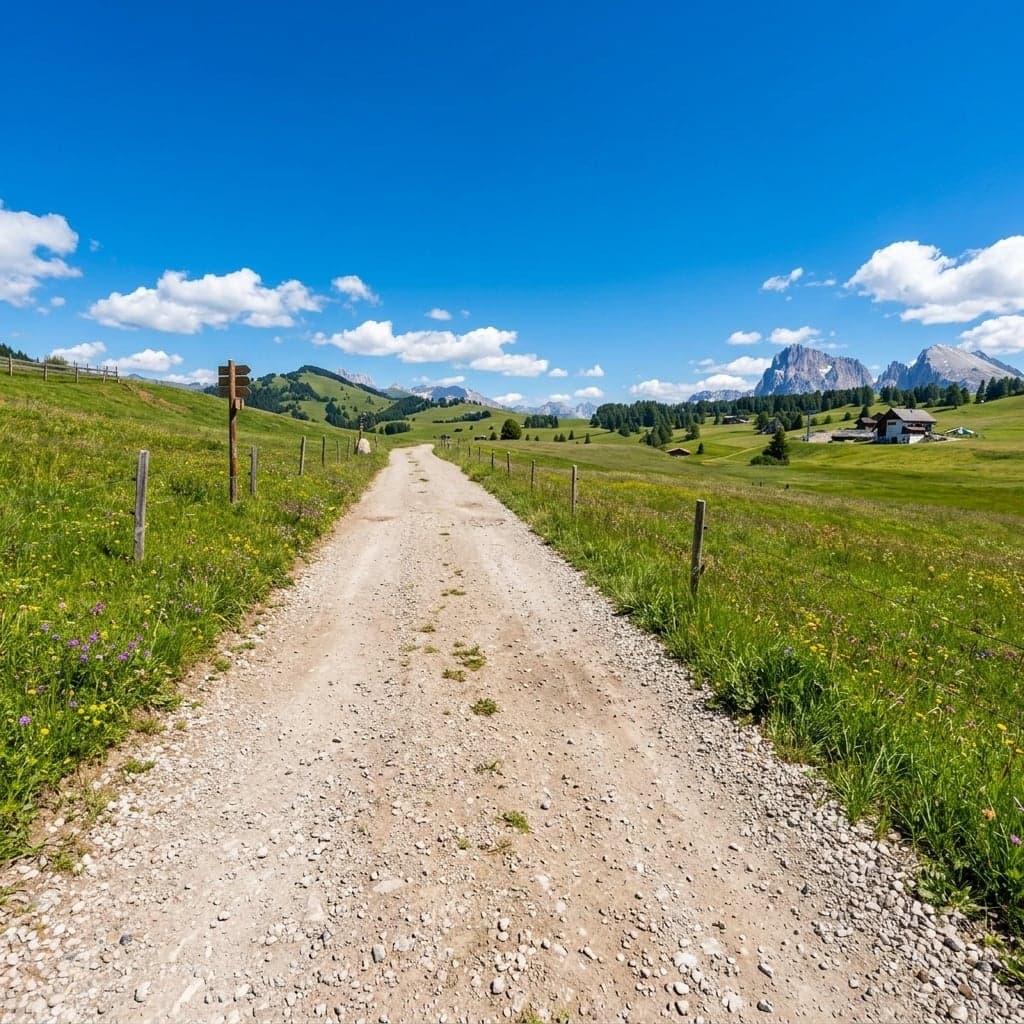
The bus is what turns this into a one-way walk. The Almbus covers this leg for €4.00 one-way and €7.00 round-trip, both sold on board. The 3-day and 7-day tickets (€11.00 and €17.00) are not: buy those at a machine in Compatsch or Saltria, or at the Seiser Alm tourist office, before you board.
Open pasture the whole way, a small church standing alone in the grass, huts to stop at, Sassolungo over the far end of the walk. The crowds thin fast past Compatsch, and how empty it gets depends on the day you draw: on a gray morning with rain coming and going, you can walk a ten-mile loop and meet nobody between one hut and the next. That solitude is paid for in weather.
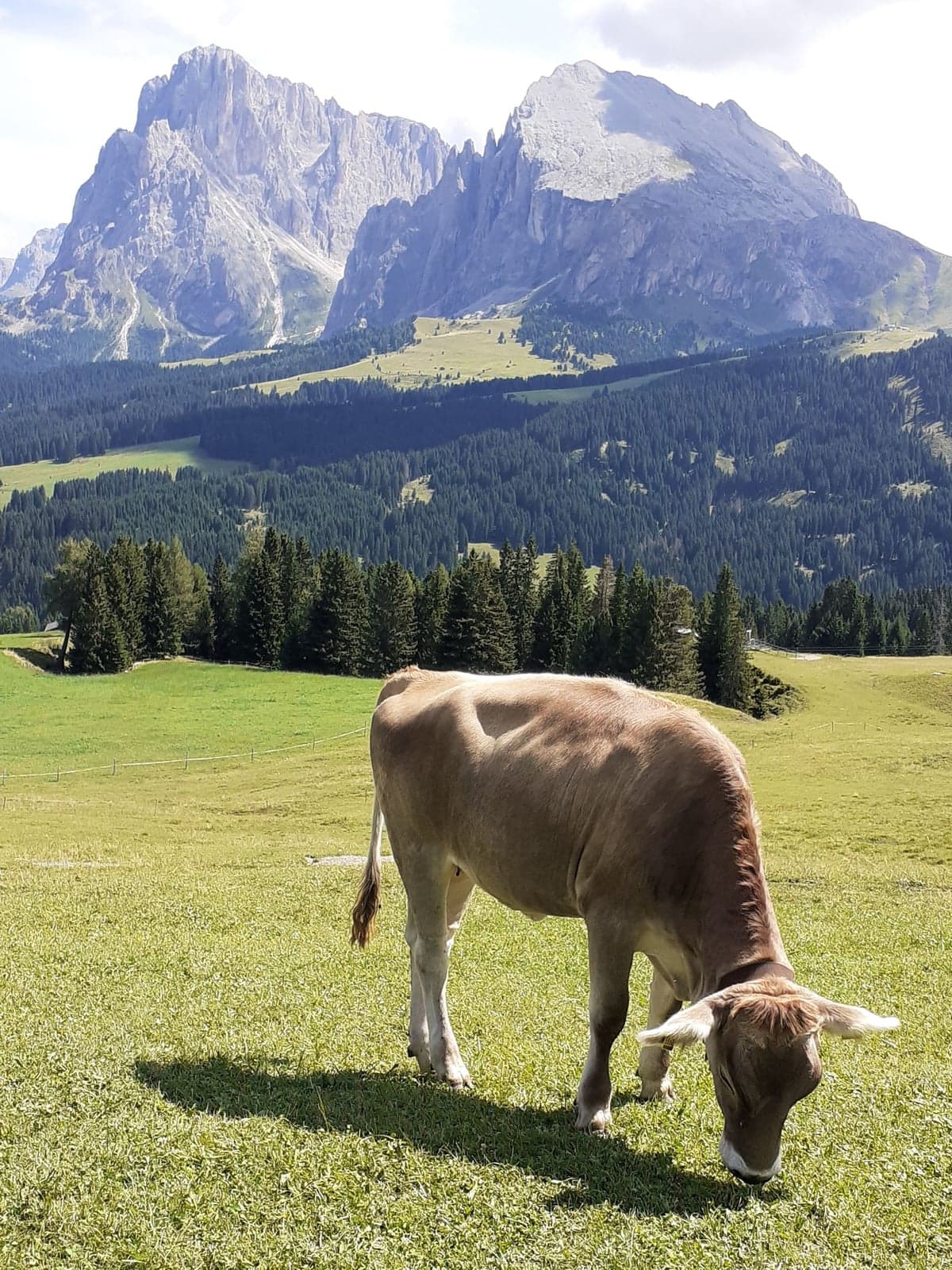
You are walking across a working farm, and only the southern part of the plateau lies inside the Sciliar-Catinaccio nature park, so the strictest rules do not cover the whole walk. What holds everywhere: stick to the marked paths, close gates and fences behind you, and expect some paths to cross private property. Dogs stay on a leash. Keep your distance from the grazing animals and do not feed or pet them. Inside the park, open fires and drones are out, every plant species is protected, and certain trails are officially closed to bikes and e-bikes.
💡 Tip
Walk the panorama path one way, Compatsch to Saltria, and ride back: three hours instead of six. The bus covers this leg as line 11 from June 14 to October 16, then as the combined 10+11 from October 17 to November 2, the cable car's own last day. Buy the ticket separately - the Südtirol Guest Pass is not valid on it.
I skipped the bus on this one and walked it out and back - some afternoons that is exactly the kind of walk you want, timetable or not.
More walking: the Witches' Benches loop and the Sassolungo side
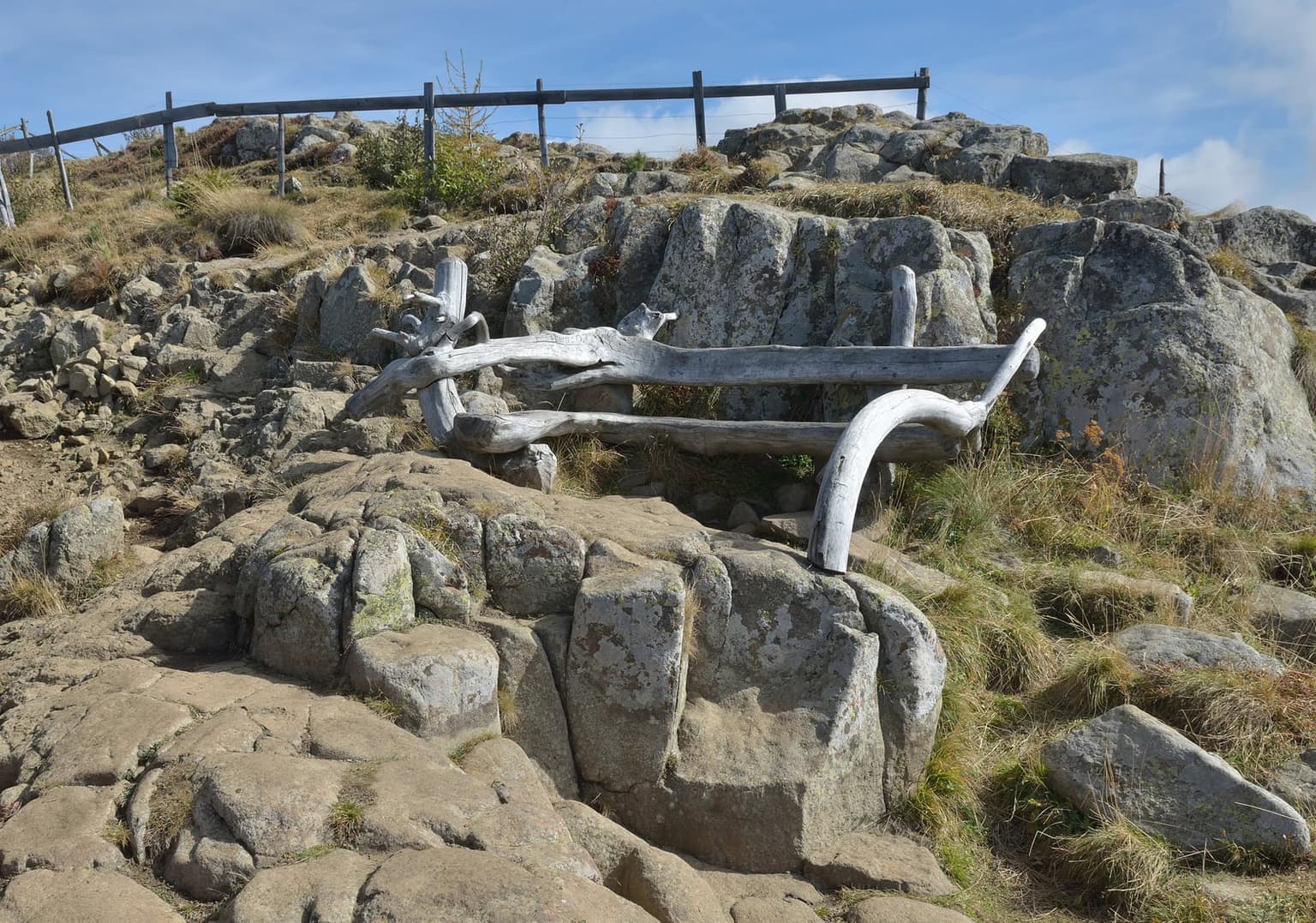
Two steps up from the panorama path, and neither is a mountain day. The Bullaccia/Puflatsch loop leaves Compatsch, crosses Mount Bullaccia and comes back around: about 9 km, a little over three hours, around 340 m of climb, easy enough for kids. What it is really for is the Witches' Benches at 2,176 m: basalt formations listed as a natural monument and described as "a double seat on which two people can sit," dolomite armchairs about 2 m high, and, less romantically, "probably of natural origin." The same listing records that "witches' dances and magic cults took place here up to the Middle Ages." From a distance they photograph as boulders. Sat in, they are furniture.
You can cut the loop short with the Bullaccia Telemix - fares and dates in the table below - but its 17:00 close is the trap. The Telemix shuts earlier than the cable car below it, in either of the cable car's two hour windows, so the last ride down the mountain is not the last ride off the plateau.
Five chairlifts run on the plateau in summer:
| Chairlift | 2026 season | Hours | Adult one-way / round-trip |
|---|---|---|---|
| Panorama | May 22 - October 11 | 08:30 - 17:00, and 08:30 - 17:30 from July 26 to September 6 | €8.50 / €12.50 |
| Bullaccia Telemix | May 22 - October 12 | 09:00 - 17:00 | €8.50 / €12.50 |
| Florian | May 30 - October 10 | 09:00 - 17:00 | €17.00 / €22.00 |
| Spitzbühl | July 25 - September 6 | 08:30 - 12:15 and 13:30 - 17:00 | €8.50 / €12.50 |
| Al Sole | June 6 - October 16 | 09:00 - 12:30 and 13:30 - 17:30 | €8.50 / €12.50 |
Laurin, Goldknopf and Euro run in winter only.
The other step up starts from Saltria. The Frederick Augustus Trail (Friedrich-August-Weg) runs along the foot of Sassolungo, Sassopiatto and their neighbors, and the walls stand directly over the path, close enough that the meadow behind you stops feeling big.
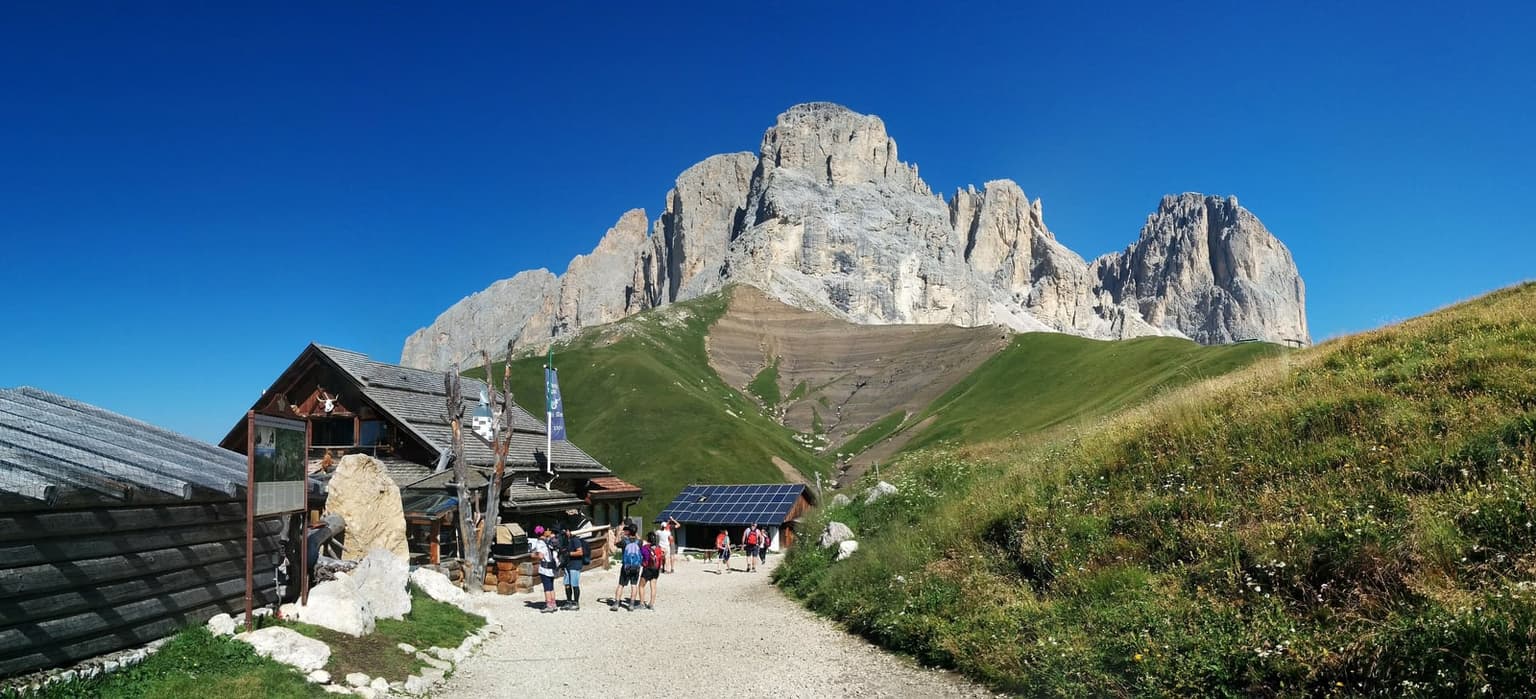
Access is the Florian chairlift - the most expensive lift on the plateau and the shortest season of the main three, per the table above - which makes it a real gate on this walk. Walk out toward Zallinger and turn back; that is the version I would plan. The full traverse runs about 16 km, roughly five and a half hours, and it ends at Passo Sella rather than back on the plateau. The Almbus does not reach the pass, and the plateau's own bus operator publishes no service there at all, so the way back runs on another operator's network, which this guide has not checked. Go one way only if you have already worked out how you are getting back.
The Sciliar day: Rifugio Bolzano and Monte Pez
The plateau's serious walk goes up onto the Sciliar itself, the flat-topped massif you have been looking at all day, to Rifugio Bolzano - the Schlernhaus - at 2,457 m, with Monte Pez above it. Figure roughly 16 to 17 km, about six hours of walking and close to 950 m of climb. Up there the meadow stops: bare stone, wind, a summit cross. The soft plateau has a hard edge after all.
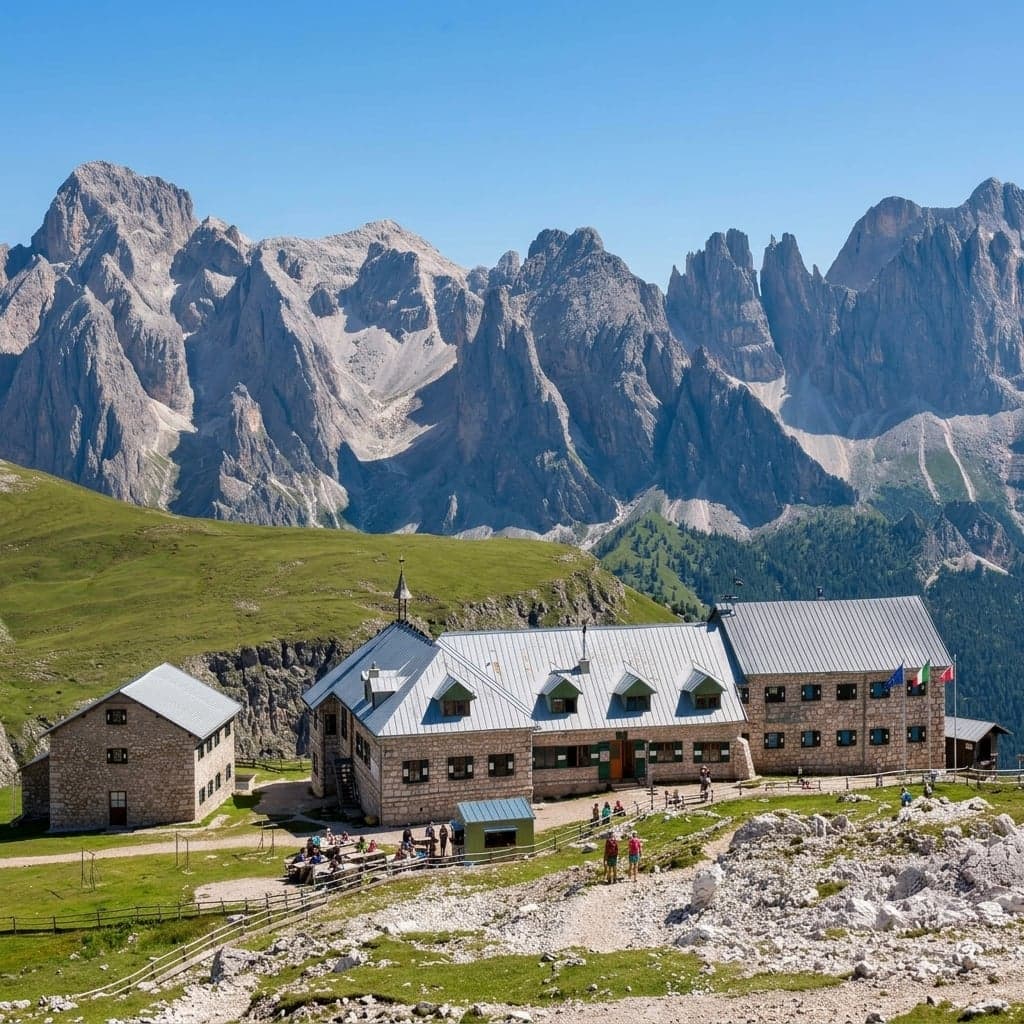
The hut's 2026 season runs June 6 to October 11, and it has 110 beds: about 30 in single and double rooms, the other 80 dormitory. Its own site settles the obvious question: "Your car will need to stay down in the valley. You can only reach us on foot."
So the day is arithmetic, and the answer changes with the date: the hard stop is the last cable car down. From June 15 to September 14 that is 19:00 - reach the plateau at 10:30, walk your six hours, stop at the hut, and you are back at Compatsch around 17:30, roughly ninety minutes clear. It fits. It will not survive a slow descent, a long lunch or a weather turn. Outside those dates the last ride is 18:00, the same day comes back with about half an hour in hand, and half an hour is no margin on a six-hour mountain day. Then it wants you walking from Compatsch by 09:00, which means the first cabin at 08:00 - or a bed up top. Those dates are early June and everything from mid-September on, both inside the hut's own season.
Budget a night in a high hut honestly: around €100 a person, cash for a three-minute shower, a handful of toilets and showers shared by the whole house, and a breakfast line that can push your start an hour past the plan. A hut bed buys height at dawn, not comfort.
⚠️ Warning
Work backward from the last cable car for your dates, not from the closing time you remember reading: the hour moves with the season. A 10:00 valley start works from June 15 to September 14, thinly; outside those dates, take the panorama path or sleep on the plateau.
Eating on the plateau
Every walk up here passes huts, and stopping at one is not a break from the day - for a lot of visitors it is the day. These are proper restaurants with a lunch kitchen and a sun deck pointed straight at the massifs. Their seasons run roughly with the lifts, so the choice thins at both ends of the summer.
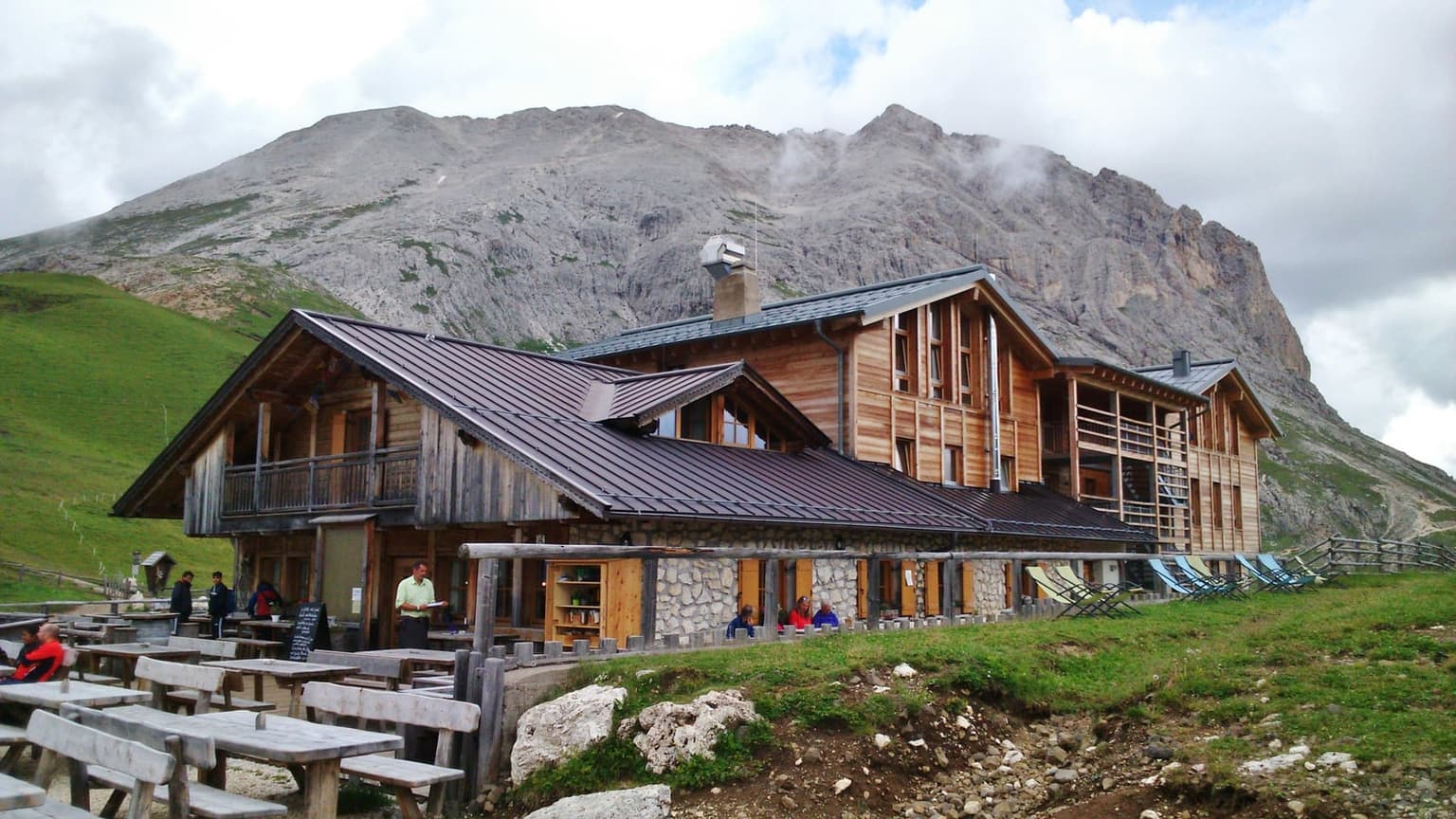
The food is regional and heavy in the way mountain food should be - the Rauchhütte's autumn menu runs to chestnut soup, and its kaiserschmarrn arrives in a portion meant for two. Kaiserschmarrn is a shredded, sugared pancake, and the portion is not a mistake.
Most huts take no booking, and the small ones are the exception: Gostner Schwaige has a handful of tables and the kind of kitchen people plan a day around - book it or stand.
And the rule no menu prints: at the premium huts, the ones with the terraces you came up for, they expect a full order. Ask for a coffee on its own and you will not be given the table.
One thing worth checking hut by hut is the kitchen's own hours, which are not the opening hours. Molignon, the Mahlknechthütte, keeps its doors open 08:00 to 22:00 every day from May 21 to October 11, 2026 - but the hot kitchen runs 11:30 to 14:30, and outside that window it is the snack menu, 08:00 to 18:00. The hut's own website posts no 2026 dates at all, so trust the tourism board's hut listing, or call ahead, before you plan a walk around lunch there.
💡 Tip
Coffee only? Drink it standing, or pick a quieter hut off the main path. At the huts with the best decks the tables go to people ordering a meal.
The cheese plates are what I keep ordering, whichever hut I stop at - the local cheese here is genuinely good. The soup gets more praise than it earns; not bad, more of an acquired taste, but it is a local specialty and worth the one bowl.
First light, and the case for sleeping up top
Sunrise is the plateau's best hour, and the access system is arranged to keep you off it. The first cabin of the day goes up at 08:00, which in summer is well after the light has happened. A drive up in the dark is legal - cars clear the road well before the 09:00 gate - and from June 29, 2026 it needs a parking space reserved ahead. That leaves two honest routes to first light: sleep up there, or set an alarm for the dark with the booking already on your phone.
Sleeping up top is not a comfort upgrade. It is the key to the gate: the hotel-guest driving rule from the driving section - any hour on arrival and departure days, the extra morning hour mid-stay - puts you out on the grass before the first cabin and still there after the last one. A bed up here costs more than the same bed in the valley and pins your evening to one spot, so buy it for the two hours at either end of the day rather than for convenience. One night does that; a second is just a hotel with a view.
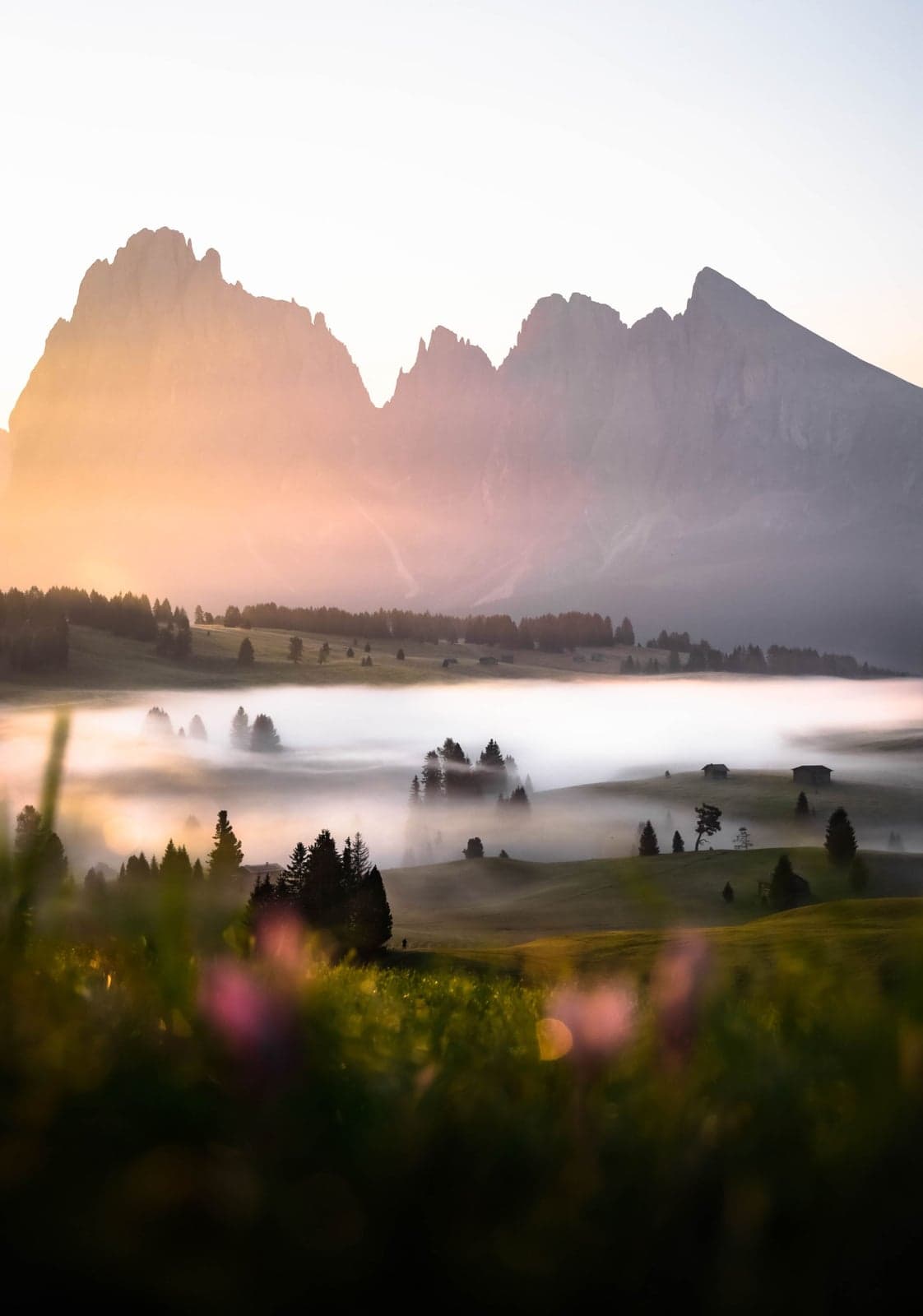
So book it for what it does. Check that you can drive to the door on arrival day, that breakfast starts early enough to be useful, and that the location fits the walk you came for: Compatsch for the lifts and the panorama path, Saltria for the Sassolungo side. Read the extras line as well: €35 a night for a dog can buy it no bed, no bowl and no food.
The hour itself needs no argument: just after sunrise the meadow goes quiet - no footsteps yet, no camera clicks, mist coming off the grass and the first light sorting itself through the larches.
If moving hotels for one morning is more than the morning is worth, hand the pre-dawn logistics to somebody else. A guided sunrise or early hiking day carries the transport and the timing; look for a named, well-reviewed departure that publishes its meeting point and its 2026 dates, not a general Dolomites tour with this plateau somewhere on its list.
ℹ️ Info
The parking reservation is new for the 2026 season, so most sunrise trip reports you will find online describe a drive-up that no longer works the way they say. Check the current rules before you plan a pre-dawn drive.
The light is worth staying up for either way - which half wins, morning or evening, depends on the day you draw, not on you. The price does not track the quality of that day, unfortunately. Mine paid off.
When to come
Up here the season is a timetable question before it is a weather question: what decides whether a visit works is which lifts and buses are running that week, and they do not all start and stop together.
| Window | What is running | What it gets you |
|---|---|---|
| May 22 - June 13 | Cable car; chairlifts phasing in | No bus up to Compatsch |
| June 14 - July 24 | Lines 10 and 11, all chairlifts but Spitzbühl | The full car-free day |
| July 25 - September 6 | Spitzbühl chairlift and its shuttle as well | The weeks the cheap lot has a lift |
| September 7 - October 16 | Buses; chairlifts closing from October 10 | The last of the full service |
| October 17 - November 2 | Cable car and the combined 10+11 | Walking, and the bus to Saltria |
Outside the cable car's own season the plateau becomes a lift lottery, and the shoulder weeks at either end are a gamble on which lifts you get. The road, at least, gets easier: during the off-seasons - mid-April to mid-May, and early November to early December - the cable car is closed and the road up to Compatsch is open to private traffic all day. Even then the road is not a promise: it can still end at a maintenance fence on a narrow dirt stretch with nowhere to turn a car around - not the standing rule, but it happens.
Weather is the other half, and it moves faster than the forecast you read at breakfast. May can hand you the full bloom or the third hailstorm in as many weeks, and one solid overcast takes the mountains away entirely. The flowering meadow belongs to early summer, and nobody can sell you a date for it. I walk in the morning and treat the afternoon as the part of the day I can afford to lose.
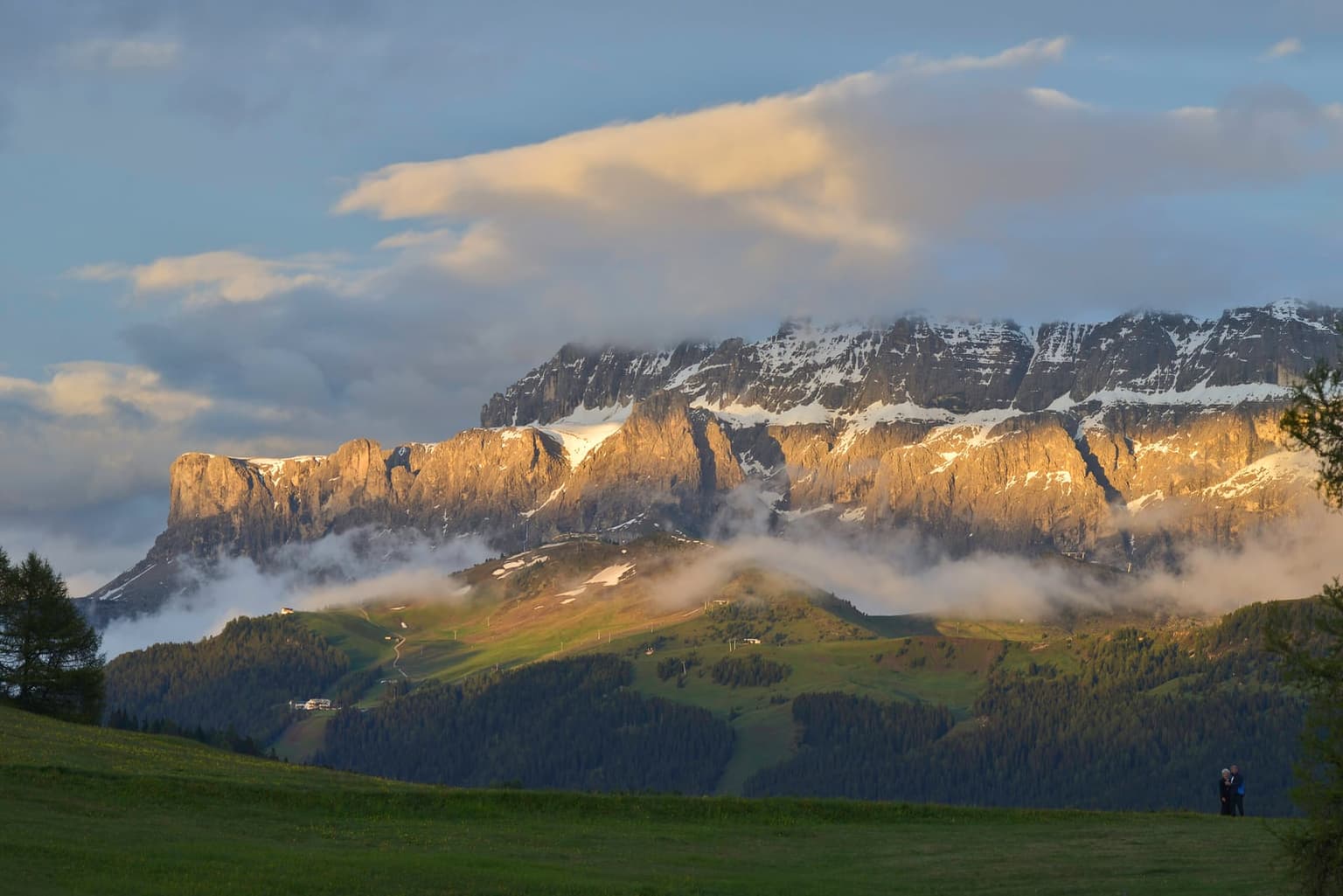
If your trip lands in the fall, ask locally when the cattle come down off the pasture: the Almabtrieb is the plateau's own end of season, and it happens when it happens.
Alpe di Siusi or Seceda?
Ortisei has a cable car to each of them, one to the ridge and one onto this plateau, which is why people keep trying to take both in a single day. The answer is no.
Look at what the plateau has already asked of you. It wants a full day, it ends on the hard stop of the last ride down, and the walks that justify the trip up run three to six hours before you have sat down anywhere for lunch. Halve that to make room for a ridge on the other side of the valley and you get two rushed halves instead of one good day. Combining them also costs more travel than the map suggests, and the ridge's timed slots sell out far enough ahead to take away the weather flexibility a two-sight day runs on.
So pick one. If you want a viewpoint and a famous ridge line to walk for an hour or two, that is Seceda, and my guide to it covers how the ridge day is done properly. If you want a day of walking inside a landscape, with huts to stop at, that is here. On money the ridge's cable car runs to more than twice the Siusi fare, which settles it for a lot of families: add both lift bills together and the two-mountain day stops looking like a plan. With two days, take one each and start both early.
Frequently asked questions
- How much time do you need on Alpe di Siusi?
- A full day, not two hours. The first cabin up is 08:00 and the last one down is 18:00, and 19:00 from June 15 to September 14. Two hours buys the doorway: the lift, a photograph at Compatsch, the lift back.
- Can you do Seceda and Alpe di Siusi in one day?
- No. The plateau is a full day on its own and it ends on the last ride down; add the ridge and you get two half-days, both rushed. Choose by the day you want: a ridge to walk along, or a landscape to walk inside.
- Is Alpe di Siusi worth it if you are not a hiker?
- Yes. The Hans-und-Paula-Steger-Weg from Compatsch to Saltria is wide, close to flat, graded easy and recommended for strollers, about three hours one way. Ride the Almbus back instead of walking it twice.
- Is a lift pass worth it, or individual tickets?
- Count your ascents first. A cable-car round trip is €30.00, and the Combi Card 3 in 7 costs €73.00, or €71.00 with the Südtirol Guest Pass, so the card starts paying at the third ascent and loses on a one- or two-day visit.
- Can you drive up to Alpe di Siusi?
- Only before 09:00 and after 17:00; in between the road belongs to the buses, and driving back down is unrestricted at any hour. From June 29, 2026 you also need a space reserved online at P1 Spitzbühl or P2 Compatsch, and if both lots fill before 09:00 the road closes at the St. Valentin checkpoint.
Pick the door first: it sets how many hours you get and what they cost. Then walk away from Compatsch until the lift stations are out of sight behind you - that is where the plateau starts.