 George Mandrovny
The short answer: count nights, not cities
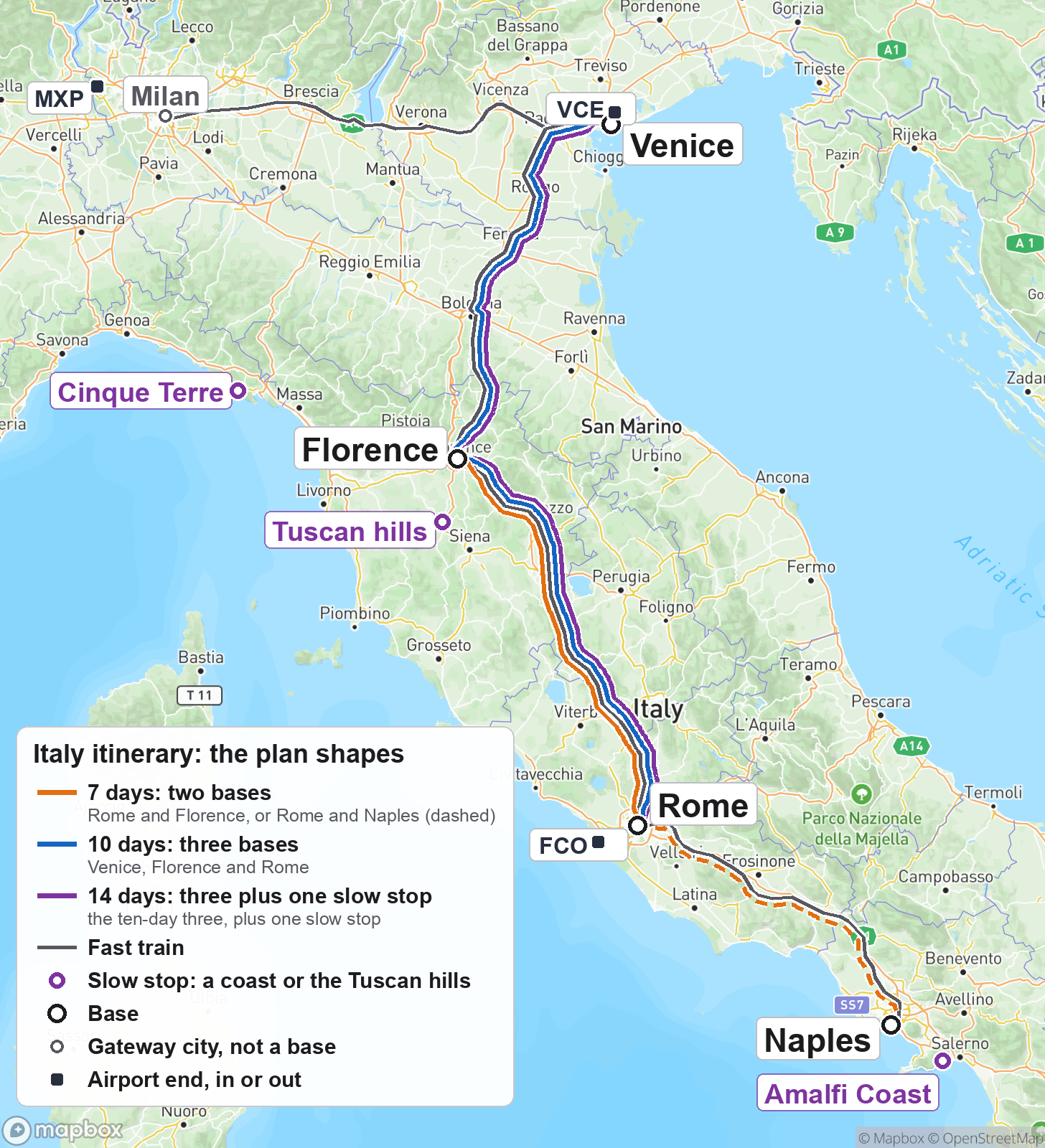
For a realistic first trip to Italy, count nights, not cities: two bases for a week, three for ten days, three plus one slow stop for two weeks. Fly into one city and home from another, so the trip never doubles back. The trap is the one-night stop. Every move costs about half a day, so a stop needs two nights to give you one full day.
| Days | Bases | The shape |
|---|---|---|
| 7 | Two | Rome and Florence, or Rome and Naples |
| 10 | Three, or two slow ones | Rome, Florence and Venice at three or four nights each, or two bases with day trips |
| 14 | Three plus one slow stop | The ten-day three, plus a coast or the Tuscan hills |
Italy's big cities are short train rides apart, which is exactly why first itineraries overbook them: on paper, one more city looks like one more train. The ride is only one part of a move. Packing, checking out, getting to the station, the ride, finding the hotel and checking in: that is the half day, and it runs longer than any plan allows for. So settle the nights first and the two airports second, and let the airports set the order. The last night belongs in the city your flight home leaves from. Under two weeks, pick north of Rome or south of it, not both. Everything below follows from those choices.
What a move costs: why every stop needs two nights
Every change of base on an Italy trip costs about half a day. That is door to door, from zipping the bags in one hotel room to checking in at the next, with the train somewhere in the middle. Two nights in a place sound like two days there. They are one, with a suitcase at each end. Add the trip's first day: after the flight over, jet lag makes half a day the best case.
| Nights at a stop | Full days it buys |
|---|---|
| 1 | None, only an evening and the next morning |
| 2 | One, between two half days of moving |
| 3 | Two, the first stay that feels like staying |
| 4 | Three |
In a week, three stops mean two moves, about a full day handed to luggage and platforms on top of the arrival half day; two stops mean one move, about half a day. The fast-train legs in the plans below run from a little over an hour to about four hours, so no faster train rescues a plan with too many stops. The packing and the check-ins come with every move, whatever the ride.
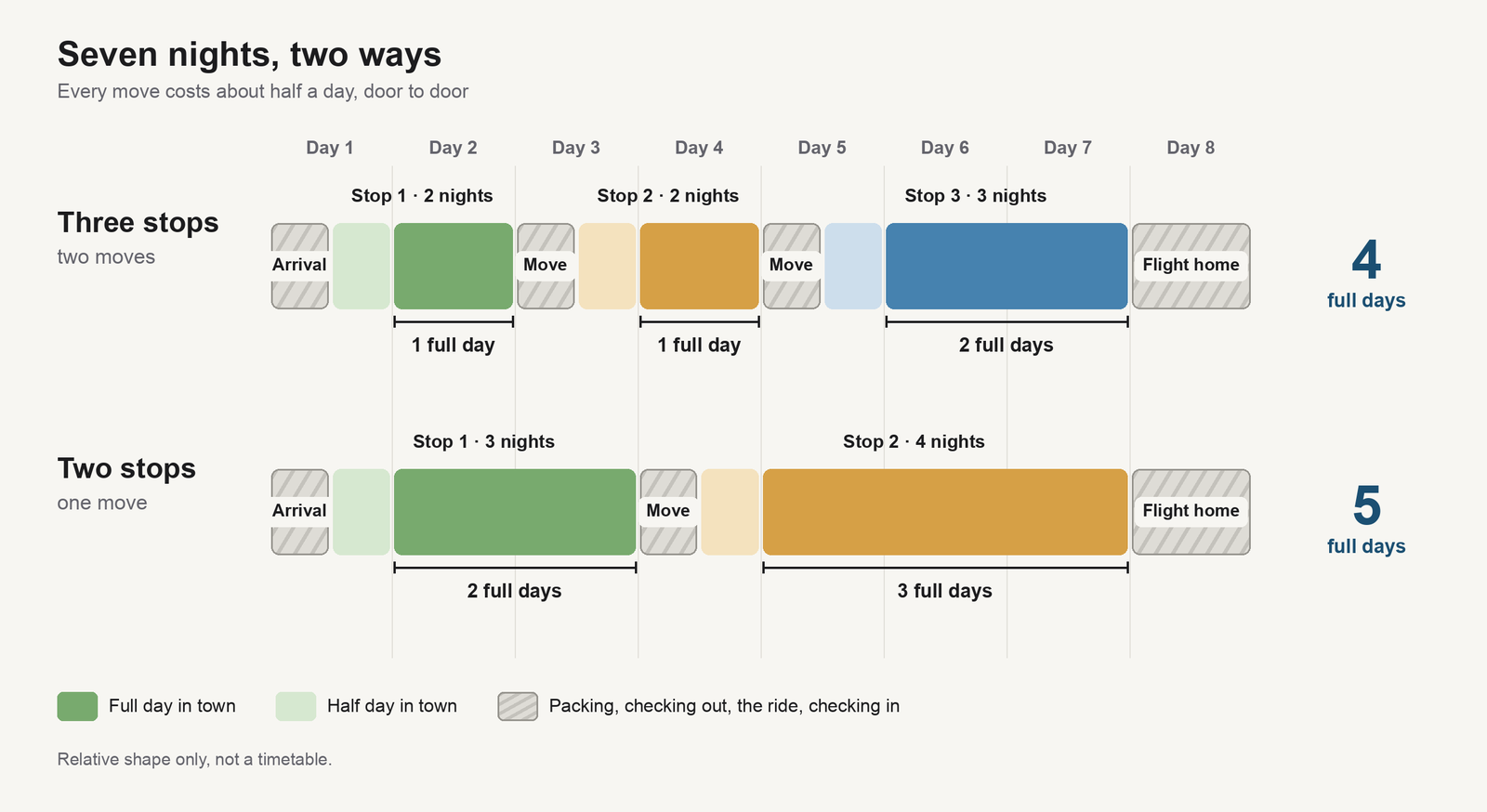
So the floor is two nights a stop. A one-night stop is a trade: one more city on the list, one evening in it, and the next morning spent packing again. Make it on purpose, never as the rhythm of the trip.
The move day does have hours you can win back: the ones between check-out and the train. Instead of guarding a suitcase in a hotel lobby, book a bag drop in the city you are leaving, one on your way to the station, and check its closing time against your train before you pay.
Book a bag drop on the way to the station
In the city you are leaving - check its closing time against your train
Which airport: fly into one city, home from another
The best airport to fly into Italy is the one at the far end of your plan. Book an open-jaw ticket, into one city and home from another, and the trip runs one way, ending where the plane home leaves; a round trip has to ride back to where it started.
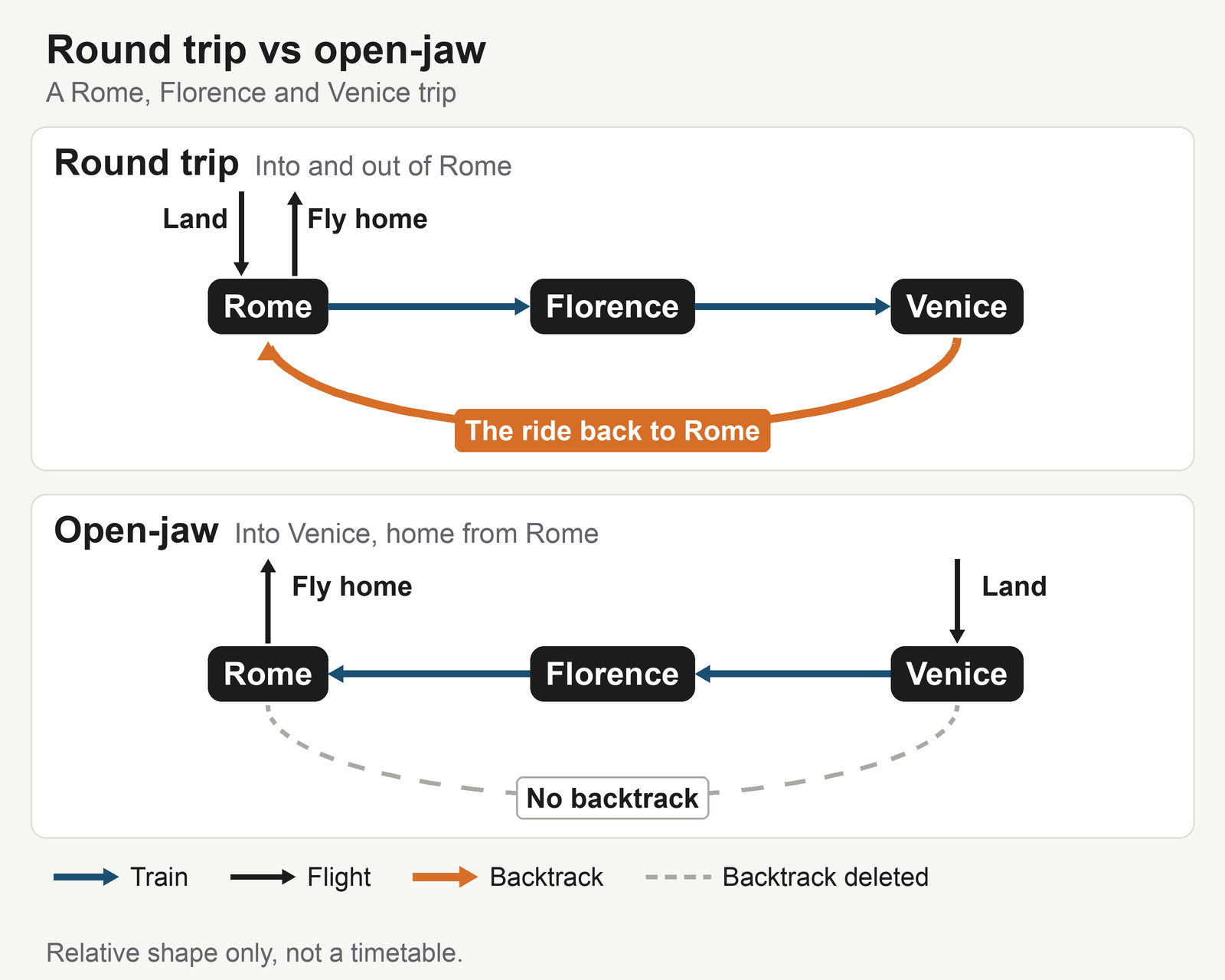
Which city comes first gets settled on practical grounds before taste gets a vote. A morning flight home says end in Rome, so fly into Venice: an early departure is the easier catch from Rome. Small kids, or fewer than three nights in Venice, say the reverse: land in Rome. It is the easier first city with children in tow, and a short Venice stay cannot spare a jet-lagged day. When none of that applies, both orders are taste: Rome's rush first and a slow finish in Venice, or Venice as the opening scene.
My own pick is Rome first and Venice last. Rome wants fresh legs: 20,000-step days, timed museum entries and street noise that never lets up are far easier at the start of a trip than after a week of moves. By the time the train pulls into Venice, I want to put the schedule away, wander without a map and let the quiet canals slow the whole trip down before the flight home.
If the ticket has to be a round trip from Rome, go to the far end of the plan on the day you land, north or south, and save every Rome night for the end. On a Rome, Florence and Venice trip that far end is Venice, about four hours away by fast train. On day one, the ride spends hours jet lag had already claimed; on the last day, it is the backtrack an open-jaw ticket deletes.
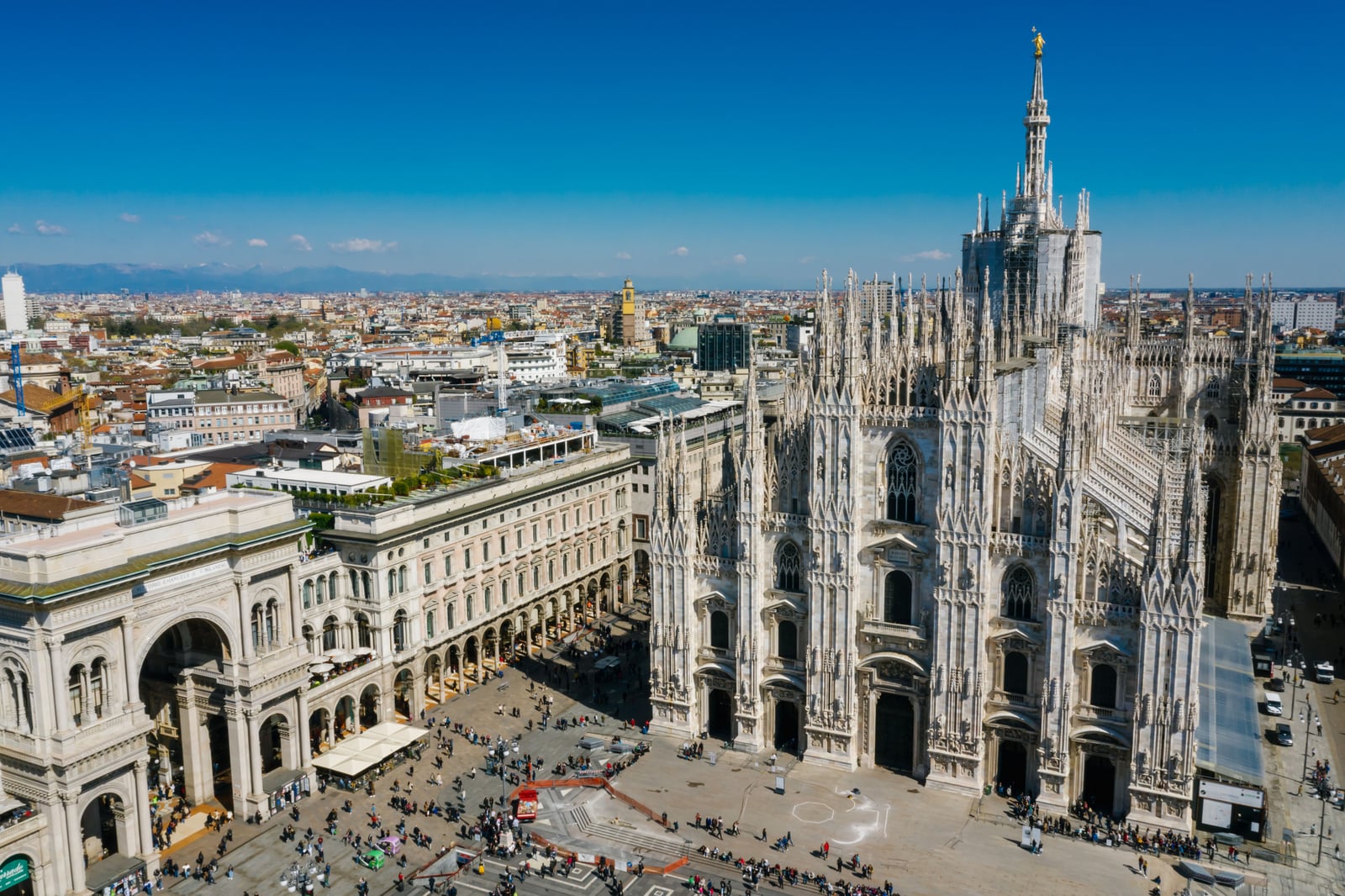
Milan is the third gateway, for a northern start: fly into Milan, take the fast train on to Venice, about two and a half hours, and work south to fly home from Rome. On a trip that leaves Rome out, Milan is the airport that puts Venice within easy reach.
Before you commit, price the two-airport ticket against a round trip plus the train back to your arrival city. Then book in order: the flights, then the last night and the bases, then the trains, because each one is pinned by the one before it.
Google Flights, with Multi-city picked as the trip type (google.com)
💡 Tip
Search and book both airports as one itinerary, under the flight search's multi-city option, never as two separate one-way tickets.
Once the direction is set, price the multi-city ticket with both airports fixed and the dates flexible by a day either way.
With both ends booked, the weak point moves to the departure end: a strike morning, or a late first flight that costs you the connection home.
Travel insurance earns its fee there, if it names those risks. Before you buy, look for strikes and missed connections in the covered reasons, not just trip cancellation.
Italy in 7 days: two bases, not three
A 7-day Italy itinerary holds two bases, not three: Rome and Florence, about an hour and a half apart by fast train, with a day out from one of them. Two bases mean one move all week, and the rest of the days are spent in a city rather than on the way to one, which is the point of flying this far.
Rome takes three or four of the nights. When the count wobbles, give Rome the extra night: of the two cities, it is the one that runs out first. A week this compact can fly in and out of Fiumicino, Rome's long-haul airport, on the round-trip version of the airport rule: ride on to Florence by train the day you land, and keep every Rome night for the end.
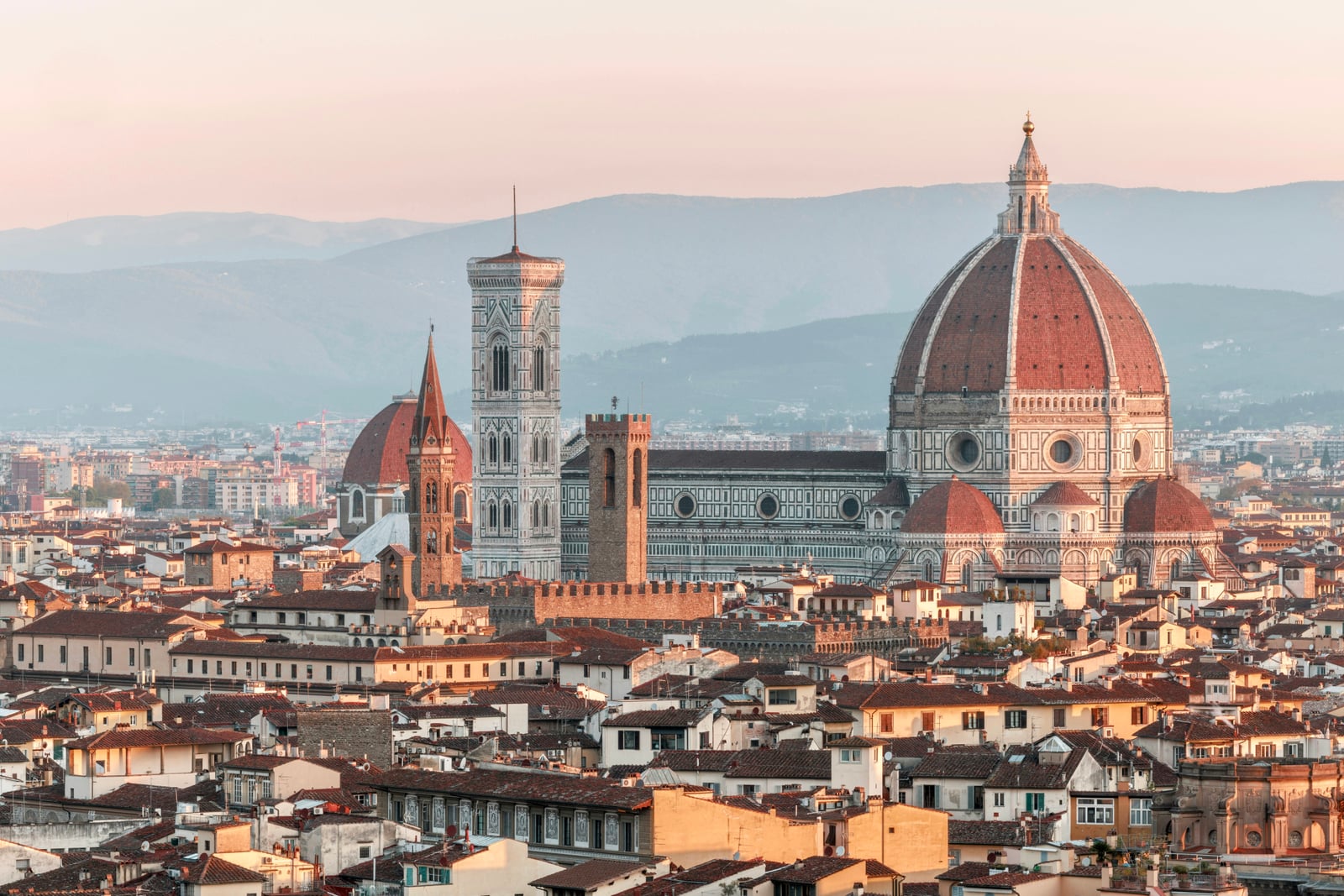
Florence takes three nights, and one of its full days can be a day out in the Tuscan hills. The countryside gets its taste without a third base, an excursion instead of a move. The rest belongs to the city, and a proper Florence itinerary will spend it well.
The other two-base week runs south: Rome and Naples, a little over an hour apart by fast train, for the traveler who would rather have the south than the Renaissance. Treat Naples as a base with its own days to fill, not a stopover. The order runs on the same rule: Naples first, every Rome night last, home from Rome. Sleep in Naples the night before the flight and the trip's last day turns into its most stressful one.
Three cities in about a week is a trade, not a mistake. Rome, Florence and Venice can fit into eight days without rushing the meals, and a once-in-a-lifetime trip may not want to leave Venice out. The price is plain: more cities seen, fewer evenings in each, and one more move than the two-base week.
Italy in 10 days: Rome, Florence and Venice, or two slow bases
A 10-day Italy itinerary holds three bases with no one-night stop: Rome, Florence and Venice at three or four nights each. The other shape is two bases at about five nights apiece, with day trips doing the rest. Either way, pick north or south, not both. Ten days cover one half of the country well and both halves badly.
The classic split is Rome four nights, Florence three and Venice three, or Rome three and Florence four with a countryside day. Florence to Venice is about two and a quarter hours by fast train. Stay on to Venezia Santa Lucia, the stop after Venezia Mestre. With Florence in the middle, the line runs one way in either direction: into Venice and home from Rome, or the reverse. At this count three bases are not a rush, but they cost one more move than the slower version below, and whether Venice is worth that move is the real choice.
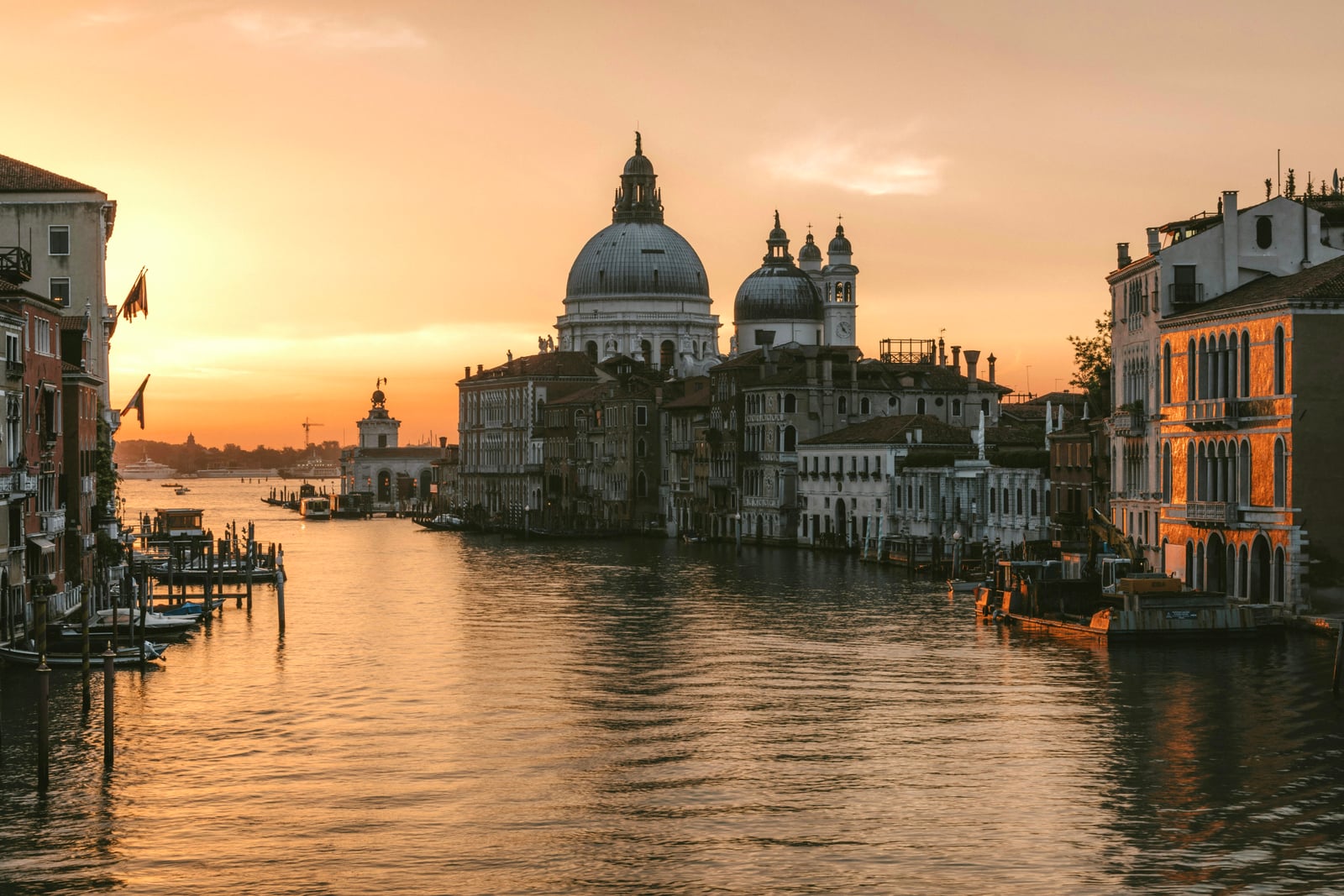
Venice is the third base by habit, not by rule: a coast or the Tuscan hills can take its nights, and the two-week plan below weighs them. If Venice stays, it gets three nights here and never fewer than two. A single night in Venice buys only the evening and the early morning, when the day visitors are gone, and booked as a hedge it has you packing just as the city wins you over.
The slower ten days drop Venice and split the nights between Rome and Florence, about five each, letting days out from Florence do the work of a third city. It suits couples: one move in ten days, and days that stop feeling like a schedule. The order is the same as the seven-day pair's.
The south version is Rome and the Amalfi Coast. The coast is harder to reach than the cities, and getting there from Rome is a plan in itself; the nights it needs are counted with the two-week shapes below. In and out of Fiumicino, the coast comes first and every Rome night last, so the trip ends where the flight home leaves. Adding Florence is where it breaks: Florence to Naples alone is about three hours by fast train, before the coast's own last leg.
Italy in two weeks: the third and fourth stop
A two-week Italy itinerary holds three bases plus one slow stop, a coast or the Tuscan hills, and the fourth earns its place only as a rest from the cities. Count the nights you will sleep in Italy, not your vacation days: the flights take their share, so the shapes below count nights.
At two weeks, Venice no longer has to beat a coast for the third base. Keep it, and add the slow stop as the fourth. If the city has never pulled at you, give its nights to the hills or a coast and stop at three.
If the slow stop is a coast, choose one: the Cinque Terre or the Amalfi Coast, rarely both on a first trip. Which coast suits you comes down to the nights you can give it and the transport plan you will put up with.
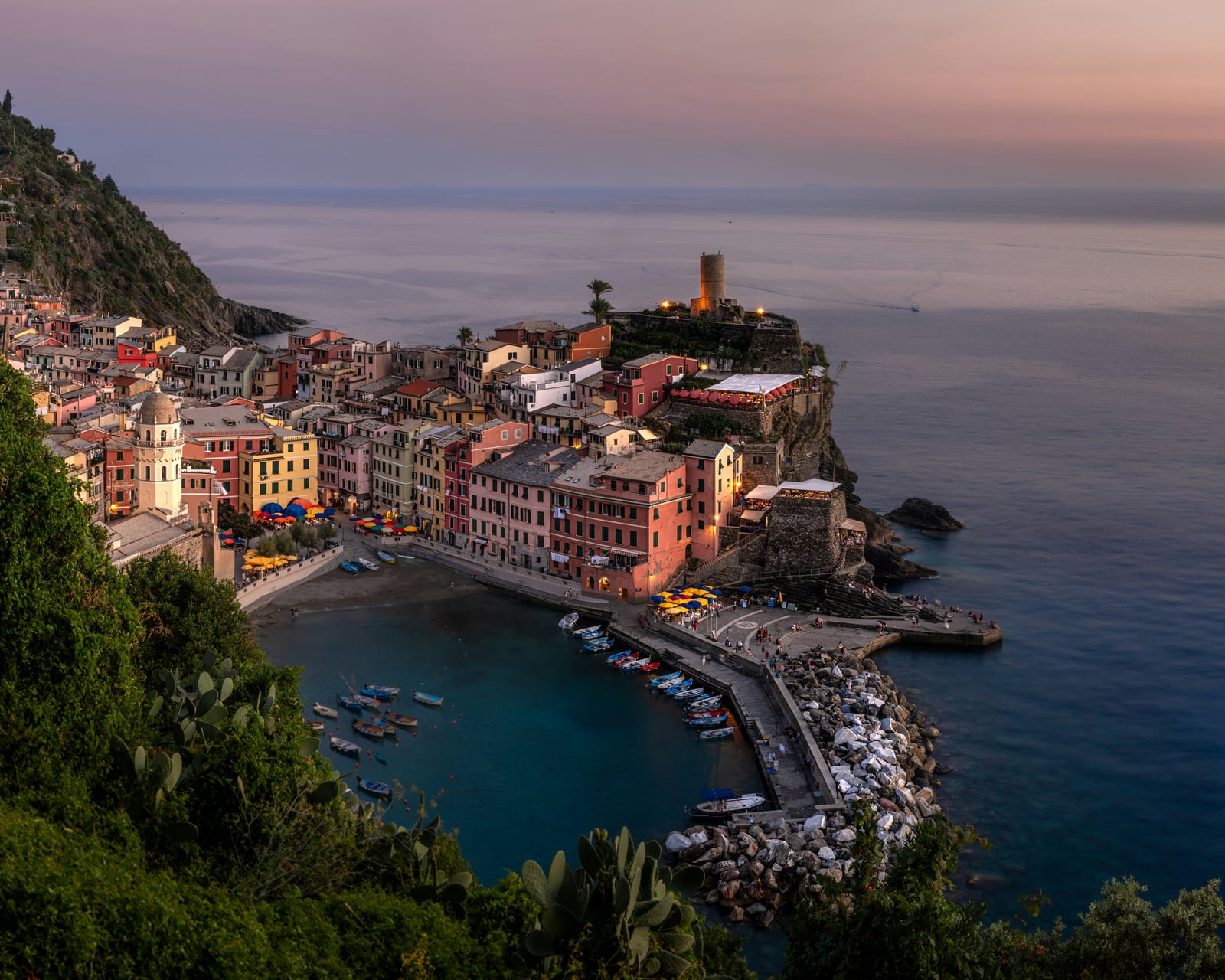
The Cinque Terre earns its place when you sleep in one of the villages. By day the lanes are packed with day-trippers; the villages are at their best once that crowd thins out, early and late, so a night beats a day trip. In the sequence, the villages come between the Florence and Rome stays, a breather between two cities.
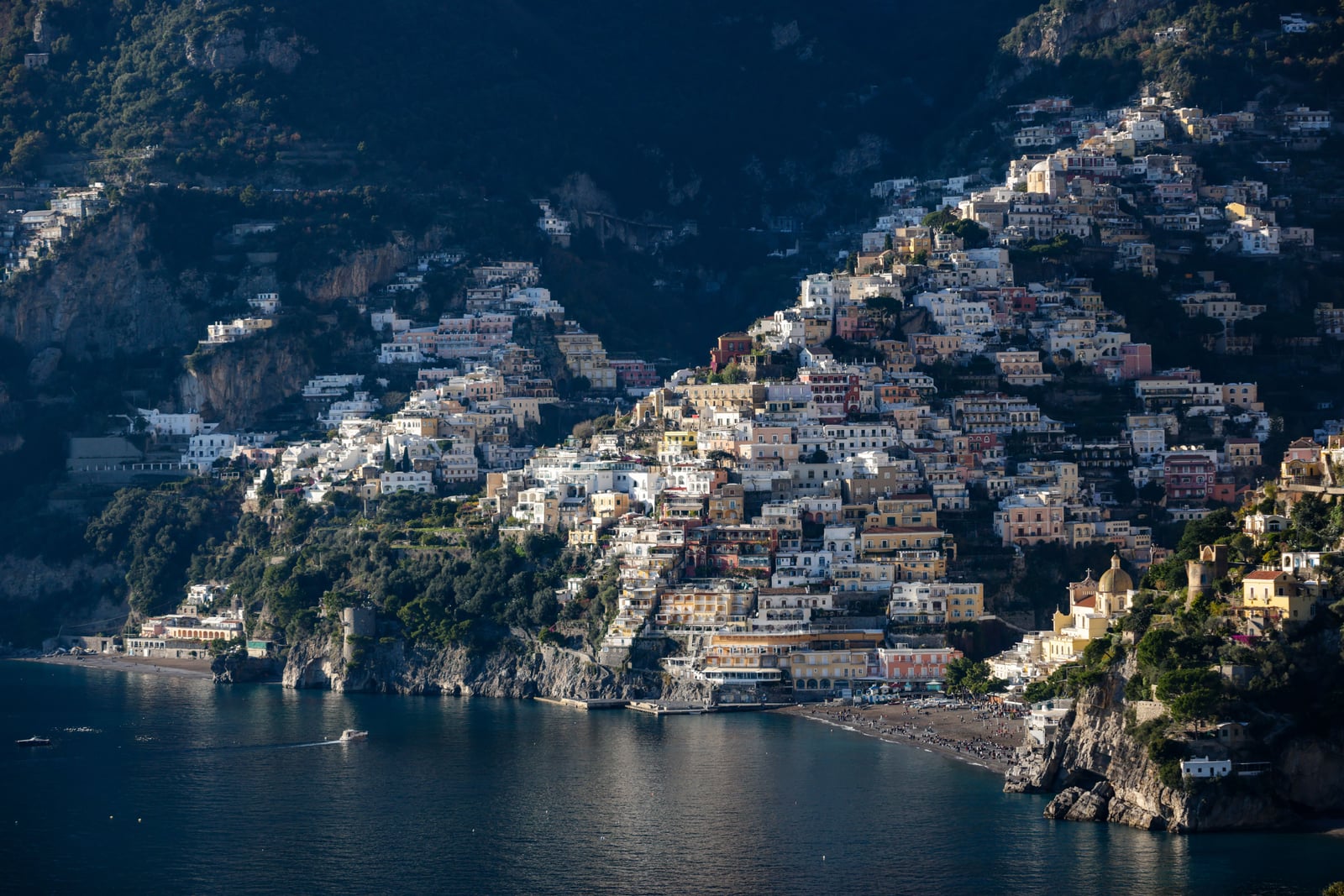
The Amalfi Coast asks for more: about four nights there and a transport plan of its own, without a rental car. Getting around is slow and everything takes longer, so fewer nights mean rushing the one stop meant for slowing down. Short of those nights, choose the villages.
The Tuscan hills are the slow stop for days with nothing booked: the nights go to one countryside base, a farm stay instead of a third city, with a car for that leg alone; where the car fits among the trains comes further down.
Two shapes, into Venice and home from Rome: Venice three nights, Florence four, the Cinque Terre two, Rome four or five; or Venice three, Florence three, the Amalfi Coast four (via the Florence-Naples train), Rome four. The first also runs backward. Either way, the slow stop is not the last base, because the last nights belong where the flight leaves. Both run thirteen or fourteen nights; with fewer, trim the longest stay, never a stop below two nights. Ending on the coast instead works too, and saves the slow days for last, but then the last day carries the whole journey to the flight home.
The first day and the last night
The first day of an Italy trip and the last night are fixed pieces, not days to fill: the arrival day is the short one the move math already counted, and the last night belongs in the city your flight home leaves from. Plan them first; they are where itineraries break.
Land at Fiumicino and the Leonardo Express train reaches Roma Termini in 32 minutes; a plan that starts elsewhere rides the fast train on from there to Florence, Venice or Naples. One day, then: a long flight, the border and two trains.
Trenitalia's Leonardo Express page, Fiumicino to Roma Termini (trenitalia.com)
Book the onward train with slack, on a fare you can move: Trenitalia's Base fare can be changed until departure, while Super Economy cannot be changed at all and is refundable only if you added the refund option at purchase. On the Frecce, Trenitalia's fast trains, Super Economy sells until midnight nine days out and Economy until three days out. Frecce tickets go on sale up to twelve months ahead; if your date shows no trains, the next schedule is not on sale yet.
Trenitalia's journey search, the fast train between your two bases on your date (trenitalia.com)
Italo, a separate company that also runs fast trains, admits only tickets with an Italo-assigned seat: a Trenitalia ticket will not get you on board, and a missed train is rebooked with the company that sold the ticket. The EU's Entry/Exit System now also registers non-EU short-stay travelers at the Schengen border, the outer border a group of European countries share. That is one more reason not to book the tight connection.
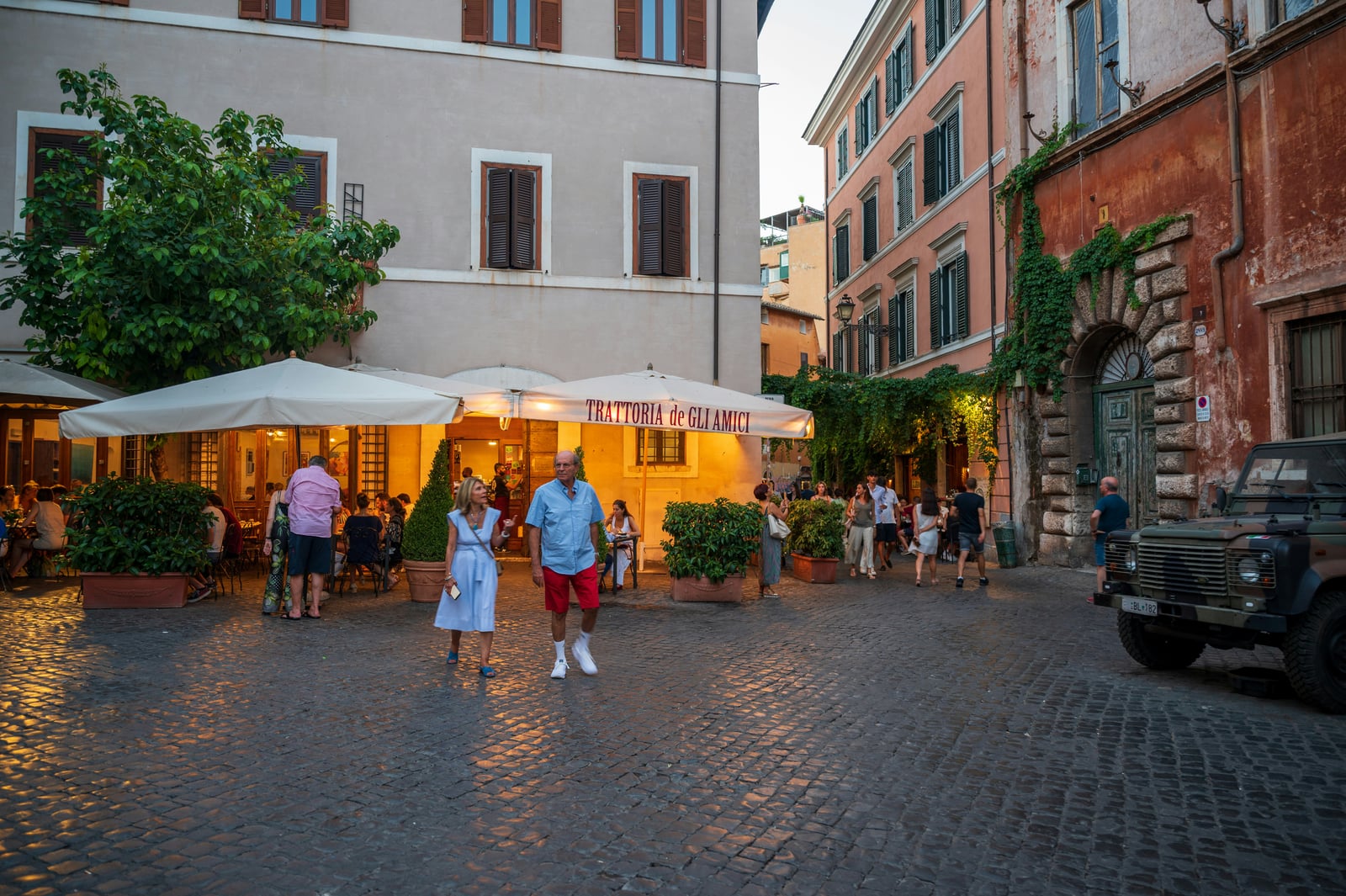
Keep the day itself small: bags down, a long lunch, a slow walk. It is for getting your feet under you, not for a booked sight. Hold out until evening (in Rome, end it in the Trastevere neighborhood) and the long sleep that follows sets up the rest of the week.
Before a long-haul flight home, sleep in the city it leaves from. A morning train from Florence into Rome on departure day can work, and it buys one more evening where you are, but it hangs the flight on one train. Fiumicino sets no single time to arrive. The airline's requirements decide, plus security and, for a flight leaving the Schengen area, passport control.
In Rome, that means a room near Termini, the station the Leonardo Express leaves from. The first one goes at 4:50.
Book that night for the flight home, not as the tail end of the last base. When the trip ends in Venice or Milan, sleep in that city. And if the last day ends on a train, check that the room takes a late arrival before you book.
I learned this one near Roma Termini. I had planned to get in around 23:00, a heavy downpour threw the whole evening off, and I got there after the front desk had closed at midnight. The booking went down as a no-show and was charged anyway. I found another room in the middle of the night, then spent a long time chasing a refund through the booking site's support and never got one. Now, for any night with a late arrival, I book only a hotel with a 24-hour front desk or a confirmed self check-in code, and I message the hotel my arrival time ahead.
⚠️ Warning
On a strike day only some trains are guaranteed. Check Trenitalia's guaranteed-trains list (in Italian) for your train; a Trenitalia train already running reaches its final station if that is within an hour of the strike's start. Italo posts its own guaranteed services on its own site. This is why the last night goes in the departure city.
If the flight leaves before the first train can get you there, or a strike falls on your departure morning, book a car from the hotel door to Fiumicino ahead of time, with the price fixed and the pickup address confirmed.
Prebook a private transfer to Fiumicino
From the hotel door, price fixed - confirm the pickup address
Car or train: the one leg a car earns
Trains carry an Italy itinerary between the cities, and on the Rome, Florence and Venice line a car has no job to do. It earns its place on one leg only, the countryside and its small towns. Pick it up for that leg and hand it back before Rome or Naples.
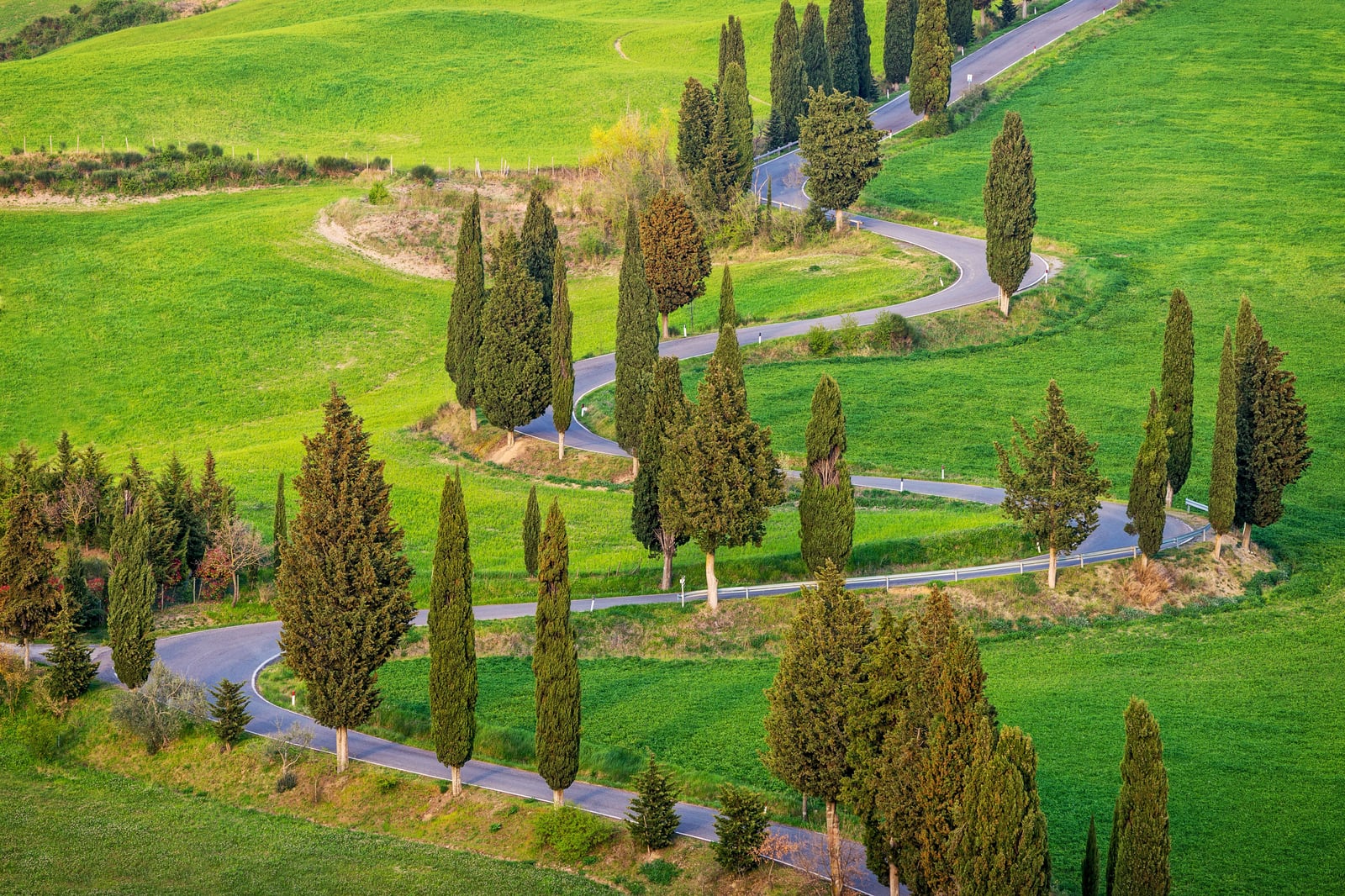
The Tuscan hills are that leg: hill towns, wine country and the back roads between them, on nobody's timetable but yours. Driving on into Rome is where the regret sets in, because the last hours go to city traffic with nothing to show for them. Pickup, drop-off and the days in between are a Tuscany itinerary of their own.
⚠️ Warning
Never pick up, return or drive the car in Rome or Naples, where the traffic is hard work, and leave it out of the Amalfi Coast: it risks the rental and wastes the coast.
Book the car for the countryside days only, not the whole trip, and name the return office before you pay, with its hours checked against your drop-off day.
Compare rental cars for the countryside days
Name the return office before you pay, and check its hours against your drop-off day
The permit, the restricted town centers and the fines that come with them are a subject of their own: read what the road rules ask of a visitor at home, well before you collect the car.
Or skip the car entirely. A full-day wine tour from Florence puts the hills in the trip with someone else driving, which also frees up the tastings. Choose one that names its towns and its stops; a tour sold only as "Tuscany" tells you nothing about where the day goes.
Book a full-day wine tour from Florence
Someone else drives - pick one that names its towns and its stops
Kids, older parents, couples: who changes the count
Who is traveling changes the base count more than the day count does. Small children and older parents mean fewer moves, because each move weighs heaviest on them, and a honeymoon is a case for fewer, slower bases.
| Who | What changes in the plan |
|---|---|
| Small kids | One base, two at most; one big thing a day, the rest for wandering |
| Teens | Close to an adult pace: three bases can work |
| Older parents | Fewer moves, a hotel with an elevator, go easy on Venice |
| Couples, honeymoons | Fewer, slower bases: the two-base ten days, or a slow stop instead of a city |
On an Italy vacation with small kids, make that one base Rome: the trips Rome does well in a day add the variety without anyone repacking a bag. If Venice is the second base, it comes last, so land in Rome and fly home from Venice. A small child sets the whole family's range, and every move skipped is a half day kept.
With older parents, Venice is the hard call. Its bridges and stairs are everywhere, and even stepping on and off the boats takes some doing for anyone unsteady on their feet.
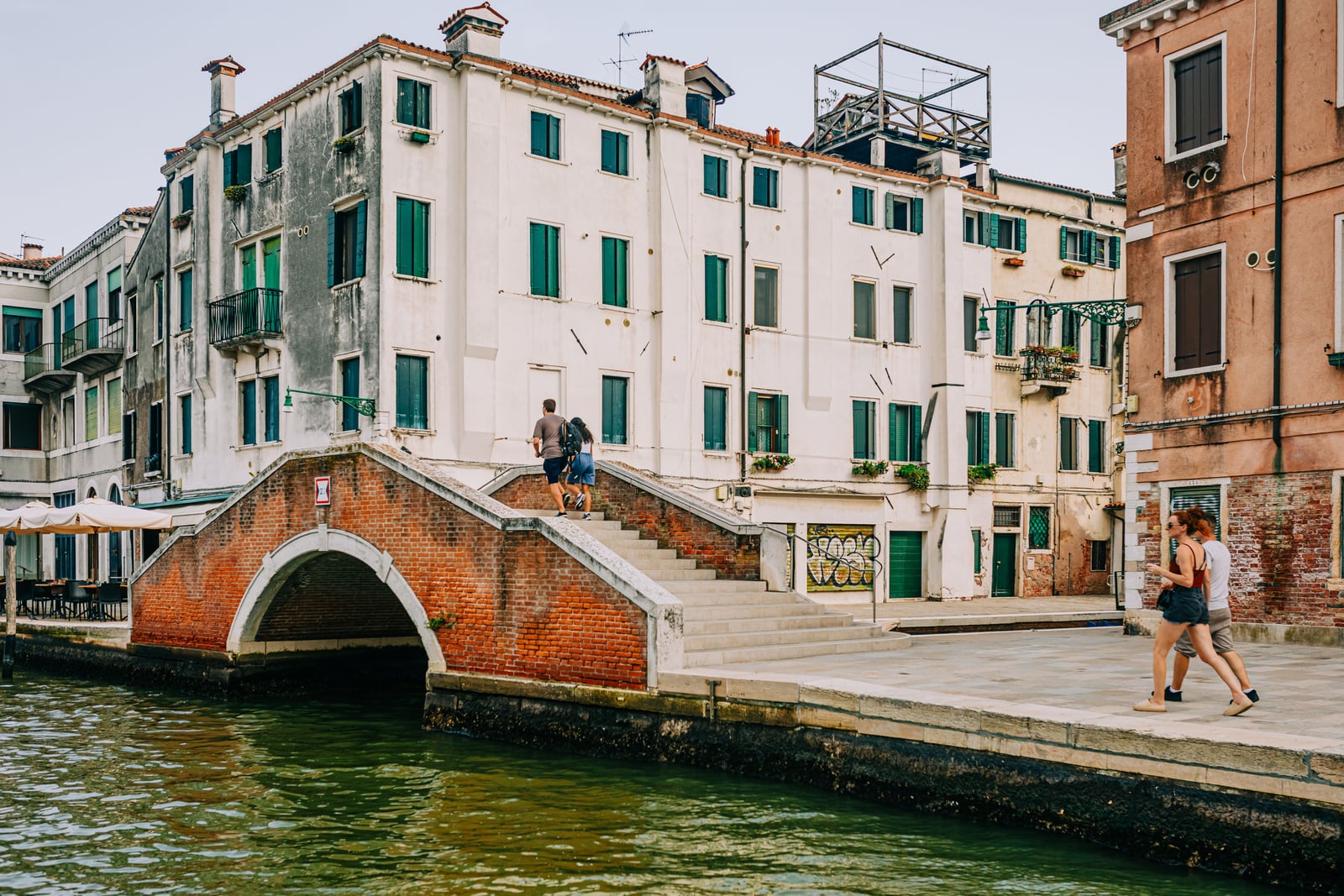
Age alone decides nothing: late seventies is no bar to doing northern Italy on your own. Ask who can climb the steps with a bag, not who is oldest.
Whatever the party, pack a bag each of you can lift onto the overhead rack alone: on Italo, medium bags ride only in the overhead racks. On bridges, stairs and cobblestones, packing light is the difference between a move and an ordeal.
The second trip: what to leave for next time
The best first trip to Italy leaves something out on purpose. A region that would break the pace is better saved for a trip built around it. Stop hunting for the perfect plan. It does not exist, and you will want to come back anyway.
Sicily is the clearest case. Bolted onto the end of a mainland plan, it is the extra base that breaks the pace. Planned as a separate Sicily trip, it gets the nights a first trip cannot spare.
Puglia, the heel of the boot, suits the traveler the south won over: less touristy, with history in layers. How a Puglia trip lays out on the map is the place to start.
Other regions wait their turn: Lake Como, the Dolomites, Bologna and Emilia-Romagna, Umbria. Squeezed into a first plan, any of them takes nights from somewhere else; left for later, each is a reason to book the flight again.
Italy itinerary FAQ
- How many days do you need in Italy for a first trip?
- A week holds two bases, ten days hold three, and two weeks hold three plus one slow stop, a coast or the Tuscan hills. Give every stop at least two nights: a move costs about half a day, so one night buys an evening and a morning, not a day.
- Is Rome, Florence and Venice too much for 7 days?
- It is a trade, not a mistake. Three cities in a week mean two moves, about a full day of packing and trains on top of the arrival day, and fewer evenings in each city. Two bases, Rome and Florence, make the relaxed week, and Venice gets its three nights on a ten-day trip.
- Should I fly into Rome or Venice?
- Into one and home from the other, on one multi-city ticket, so the trip never rides back to where it started. A morning flight home argues for ending in Rome, so fly into Venice. Small kids or a short Venice stay argue the reverse: land in Rome.
- Can you see northern and southern Italy in 10 days?
- You can, but the travel between the two halves eats the days you came for. Florence to Naples alone is about three hours by fast train, before the last leg out to the Amalfi Coast. In ten days, pick one half: Rome with Florence and Venice, or Rome with the Amalfi Coast.
Count the nights, then book in order: the two-airport flight, the last night and the bases, the trains. Whatever does not fit stays where it is, waiting for the next trip.